POWER QUALITY · ENGINEERING GUIDE
How non-linear loads distort the current waveform, how to measure that distortion, and how active and hybrid filters cancel it in real time to bring an installation back inside IEEE 519 limits — with the formulas, worked numbers and diagrams an engineer needs.
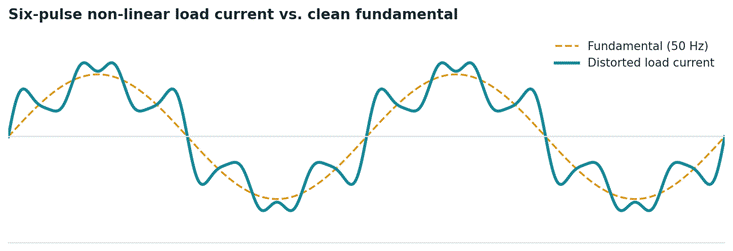
Figure 1 — A six-pulse non-linear load draws a flat-topped, distorted current; the clean fundamental is shown dashed.
01 — FUNDAMENTALS
What harmonics actually are
A power system is designed to run at a single frequency — 50 Hz or 60 Hz. Harmonics are voltage or current components at whole-number multiples of that fundamental: the 5th harmonic at 250 Hz, the 7th at 350 Hz, and so on. When these ride on top of the fundamental, the result is a distorted, non-sinusoidal waveform.
Incorporating an active harmonic filter into your system design can provide significant benefits.
The integration of an active harmonic filter into your power system can significantly enhance overall performance.
Implementing an active harmonic filter can significantly improve power quality by reducing these distortions.
In summary, an active harmonic filter is indispensable for managing harmonics effectively in power systems.
Using an active harmonic filter can enhance system efficiency by further minimizing power losses and ensuring compliance with standards.
An active harmonic filter works by actively canceling out the unwanted harmonics introduced by various loads.
Understanding the role of an active harmonic filter is crucial for improving power system performance.
HARMONIC FREQUENCY
f_h = h × f₁ e.g. f₅ = 5 × 50 = 250 Hz
By Fourier’s theorem, any repeating distorted waveform can be broken down into a fundamental plus a series of harmonics. The figure below shows how a fundamental and just two harmonics — the 5th and 7th, typical of a six-pulse drive — add up to the eared, flat-topped current you see on a real analyzer.
To reduce harmonic distortion, consider implementing an active harmonic filter for optimal results.
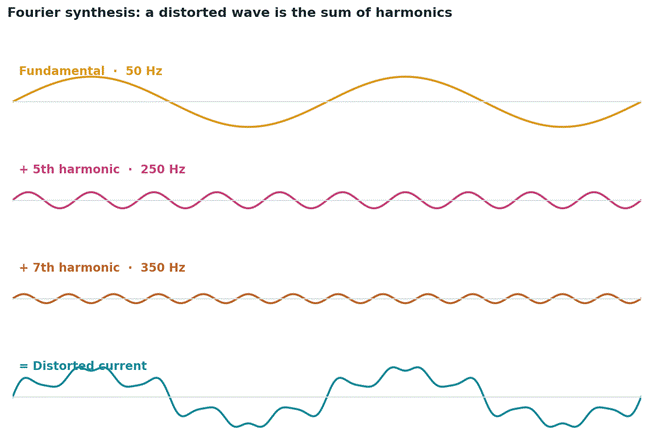
Figure 2 — Fourier synthesis: fundamental + 5th + 7th harmonics sum to the distorted load current.
Where harmonics come from
Any load that draws current in non-sinusoidal pulses generates harmonics. The usual sources are the rectifier front-ends of:
- Variable-frequency drives (VFDs) and DC drives
- UPS systems and switch-mode power supplies
- LED drivers and electronic ballasts
- Induction and arc furnaces, welders
- Battery chargers and EV charging
Why they matter
Consider the benefits of an active harmonic filter for long-term operational efficiency and reliability.
Incorporating an active harmonic filter into your system can prevent costly disruptions and equipment failures.
Harmonics cause real, billable damage: transformer and cable overheating, nuisance breaker trips, capacitor failure, motor torque ripple, neutral-conductor overload from triplen (3rd, 9th…) harmonics, malfunctioning electronics, and higher system losses.
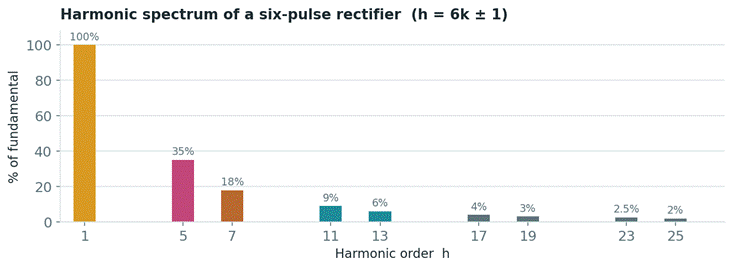
Figure 3 — Harmonic spectrum (FFT) of a six-pulse rectifier. Characteristic orders follow h = 6k ± 1: the 5th, 7th, 11th, 13th…
With the evolution of electrical technology, the need for an active harmonic filter has never been greater.
Employing an active harmonic filter is a strategic choice for managing electrical harmonics effectively.
02 — QUANTIFYING DISTORTION
The formulas you need
Every harmonic study, filter sizing and compliance check rests on this handful of equations.
Implementing an active harmonic filter effectively minimizes the risk of electrical malfunctions.
Total Harmonic Distortion (THD)
When assessing harmonic distortion, an active harmonic filter is essential for accurate measurements and solutions.
THD is the ratio of the combined RMS of all harmonics to the fundamental — the single most-quoted index of waveform quality.
Utilizing an active harmonic filter enables better management of harmonic levels in complex electrical systems.
An active harmonic filter is essential for addressing the challenges posed by modern electrical loads.
VOLTAGE & CURRENT THD
THD_V = √(V₂² + V₃² + V₄² + …) / V₁ × 100% THD_I = √(I₂² + I₃² + I₄² + …) / I₁ × 100%
True RMS with harmonics
The true RMS of a distorted wave is the root-sum-square of every component — which is why distorted currents heat conductors more than their fundamental alone suggests.
RMS OF A DISTORTED WAVEFORM
I_rms = √(I₁² + I₂² + I₃² + …) = I₁ · √(1 + THD_I²)
True power factor
With harmonics present, power factor splits in two. Displacement PF is the classic cos φ₁ between fundamental voltage and current; distortion PF accounts for the harmonic content. A capacitor bank corrects only the first — it does nothing for the distortion term and can make matters worse through resonance.
TRUE POWER FACTOR
PF_true = cos φ₁ × 1 / √(1 + THD_I²) ╰ displacement ╯ ╰─ distortion ─╯
Other key indices
TOTAL DEMAND DISTORTION (TDD)
TDD = √(I₂² + I₃² + …) / I_L × 100% ( I_L = peak demand current )
TRANSFORMER K-FACTOR
K = Σ ( I_h² · h² ) / Σ ( I_h² ) — used to specify K-rated transformers
CREST FACTOR
CF = I_peak / I_rms ( pure sine = 1.414; distorted loads > 1.5 )
03 — COMPLIANCE
IEEE 519 limits
IEEE 519-2014 sets distortion limits at the Point of Common Coupling (PCC) — the boundary the utility and customer share. The customer is responsible for current distortion; the utility for voltage.
Voltage distortion limits at the PCC
Active harmonic filters provide a comprehensive solution for managing electrical harmonics in varying loads.
| Bus voltage at PCC | Individual harmonic | Voltage THD |
| V ≤ 1.0 kV | 5.0% | 8.0% |
| 1 kV < V ≤ 69 kV | 3.0% | 5.0% |
| 69 kV < V ≤ 161 kV | 1.5% | 2.5% |
| V > 161 kV | 1.0% | 1.5% |
Current distortion limits — TDD as % of I_L (120 V – 69 kV)
| Isc / IL | h<11 | 11–17 | 17–23 | 23–35 | TDD |
| < 20 | 4.0 | 2.0 | 1.5 | 0.6 | 5.0% |
| 20 – 50 | 7.0 | 3.5 | 2.5 | 1.0 | 8.0% |
| 50 – 100 | 10.0 | 4.5 | 4.0 | 1.5 | 12.0% |
| 100 – 1000 | 12.0 | 5.5 | 5.0 | 2.0 | 15.0% |
| > 1000 | 15.0 | 7.0 | 6.0 | 2.5 | 20.0% |
Isc = short-circuit current at the PCC; IL = maximum demand load current. A stiffer supply (higher ratio) tolerates more harmonic current.
04 — APPROACHES
Three ways to fight harmonics
Finally, the role of an active harmonic filter cannot be overstated in today’s energy-efficient designs.
Passive filters. L-C branches tuned near a problem harmonic to give it a low-impedance path to ground. Cheap and near-lossless, but fixed, sensitive to grid changes, prone to resonance, and limited to one or two orders.
Active filters (AHF). A power-electronic converter that measures the load harmonics and injects an equal-and-opposite current in real time. Adaptive, broadband, no resonance risk — higher cost per amp, but precise.
Hybrid filters. A passive stage carries the bulk low-order harmonic energy while a small active stage cleans up the rest and damps resonance. Passive economy with active precision — best value at large ratings.
Passive filter design in brief
A single-tuned shunt filter places an inductor and capacitor in series so the branch resonates at — and short-circuits — a chosen harmonic.
The design of an active harmonic filter is critical for achieving reliable and stable power quality.
To achieve optimal power quality, consider the application of an active harmonic filter in your design.
TUNING FREQUENCY & ORDER
f_r = 1 / ( 2π √(L·C) ) h_tuned = √( X_C / X_L )
Active harmonic filters are increasingly recognized for their efficiency in reducing harmonic distortion.
Filters are usually tuned slightly below the target harmonic (a detuned reactor, e.g. at the 4.2th order for a 5th-harmonic environment) so they don’t drift into direct resonance as component values and grid impedance vary.
05 — THE ACTIVE SOLUTION
How an Active Harmonic Filter works
An AHF is essentially a fast, current-controlled inverter that behaves like a programmable harmonic current source connected in shunt. The principle is cancellation.
A current transformer (CT) continuously samples the load current. The controller extracts everything that is not the fundamental, then commands the IGBT inverter to inject that exact harmonic content back into the bus — phase-inverted. At the PCC the harmonics meet their mirror image and cancel, leaving the source to supply a near-perfect sine wave.
COMPENSATION PRINCIPLE
i_C = Σ i_h (all load harmonics) i_S = i_L − i_C ≈ i₁ (source left with the fundamental only)
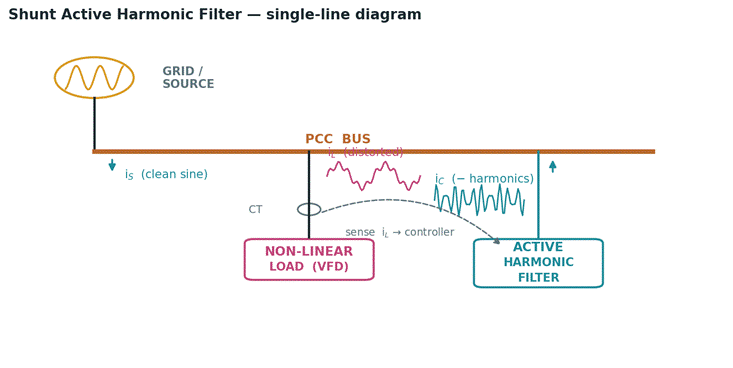
Figure 4 — Shunt AHF single-line. The CT senses distorted load current; the inverter injects the inverse harmonic current i_C so the source sees a clean i_S.
Sizing an AHF
An AHF is rated in harmonic amps — the RMS of the harmonic current it must inject, not the total load current — which makes the rating independent of the fundamental.
REQUIRED AHF CURRENT
I_AHF = √(I₂² + I₃² + …) = I_rms · THD_I / √(1 + THD_I²)
The control core: instantaneous power (p–q) theory
The most common control method transforms the three-phase quantities into a two-axis (α-β) frame with the Clarke transform, then separates power into instantaneous real (p) and imaginary (q) components. The oscillating parts of p and q correspond to the harmonics that must be cancelled; a high-pass filter isolates them, and they are inverse-transformed into the reference currents the inverter produces. The loop closes in well under a millisecond, so the AHF tracks load swings the instant they happen.
Key advantages of the active approach:
Integrating an active harmonic filter into your infrastructure is essential for modern electrical systems.
- Adaptive and broadband — cancels many orders at once and follows changing loads
- No resonance risk — it sources current rather than presenting a tuned impedance
- Can also correct displacement power factor and balance unbalanced phases
- Modular — units parallel to add harmonic-amp capacity as load grows
For optimal performance, the active harmonic filter should be calibrated according to the specific system requirements.
06 — BEST OF BOTH
Choosing the right configuration for your active harmonic filter will maximize its effectiveness.
Hybrid filter solutions
At high power, a pure active filter rated for the full harmonic load gets expensive. A hybrid lets a cheap passive stage carry the heavy, predictable harmonics while a small active stage does the precision work and suppresses the passive filter’s resonance and detuning weaknesses. You get passive cost with active performance.
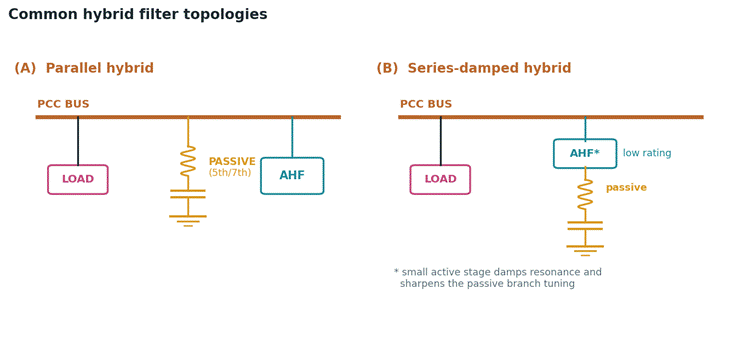
Figure 5 — Two common hybrids: (A) shunt active filter parallel with a shunt passive bank; (B) a low-rating active filter in series with the passive branch to damp resonance.
Passive vs. active vs. hybrid at a glance
| Criterion | Passive | Active (AHF) | Hybrid |
| Harmonic coverage | 1–2 orders | Broadband | Broadband |
| Resonance risk | High | None | Damped |
| Adapts to load change | No | Yes | Partly |
| Reactive power support | Fixed | Dynamic | Yes |
| Cost per harmonic-amp | Low | High | Medium |
| Best fit | stable single load | dynamic / mixed | large + PF need |
Rule of thumb: if the harmonic profile is steady and you also need bulk reactive power, a hybrid usually wins on lifetime cost. If loads switch and vary constantly, a pure AHF is simpler and more robust. A plain capacitor bank with no detuning reactor is the one option to avoid in a harmonic-rich plant — it invites resonance.
07 — CALCULATION WALK-THROUGH
Worked example: sizing an AHF
A 480 V, 3-phase facility runs a six-pulse VFD drawing a fundamental current of 200 A at a displacement power factor cos φ₁ = 0.96. The measured harmonic spectrum is below.
Given — measured spectrum
| Order h | 5 | 7 | 11 | 13 |
| % of I₁ | 35% | 18% | 9% | 6% |
| I_h (A) | 70.0 | 36.0 | 18.0 | 12.0 |
Step-by-step
Step 1. Harmonic RMS current
I_H = √(70² + 36² + 18² + 12²) = √6664 = 81.6 A
Step 2. Current THD
THD_I = 81.6 / 200 = 40.8% → fails IEEE 519
Step 3. True RMS load current
I_rms = √(200² + 81.6²) = 216.0 A (8% above fundamental)
Step 4. Distortion & true PF
PF_dist = 1/√(1+0.408²) = 0.926 → PF_true = 0.96 × 0.926 = 0.889
Step 5. Required AHF rating
I_AHF = I_H = 81.6 A; add ~20% margin → select ≈ 100 A AHF
Step 6. Result after compensation
Source supplies fundamental only → THD_I ≈ 3–5%, PF ≈ 0.99 ✓ COMPLIANT
Takeaway: the 100 A AHF is rated for harmonic amps (≈ 81.6 A + margin), not the 216 A total current — which is why active filters are specified by harmonic current, and why a hybrid (passive bank carrying the 5th/7th, small AHF for the rest) can shrink the active rating further still.
Note: Formulas follow IEEE Std 519-2014 and standard instantaneous-power (p–q) filter theory. Limit tables are summarized for reference — confirm against the current standard and your local grid code before final design. Worked figures are illustrative.