
Static VAR Generator (SVG) Working Principle: Dynamic Reactive Power Compensation
Static VAR Generator Working Principle is based on real-time reactive power compensation using advanced IGBT technology.
What is the Static VAR Generator Working Principle?
A Static VAR Generator (SVG) continuously monitors load conditions and injects precise reactive current to improve power factor, stabilise voltage, and enhance overall power quality. A static VAR generator (SVG) is an IGBT-based device that injects precisely controlled reactive current in real time, correcting power factor and stabilising voltage far faster and more accurately than conventional capacitor banks.
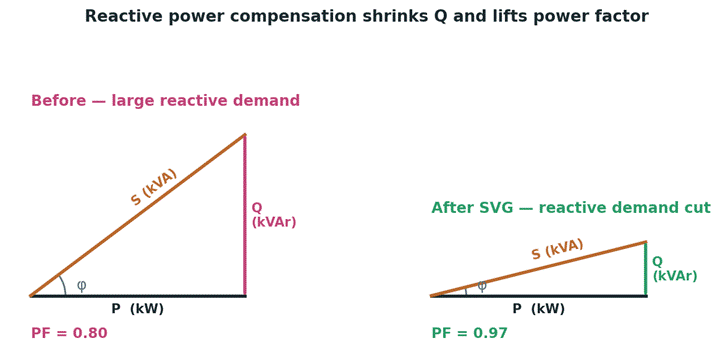
Reactive power compensation shrinks the reactive component (Q) and lifts power factor toward unity, reducing apparent power (kVA) demand.
What is a Static VAR Generator?
Understanding the Static VAR Generator Working Principle helps industries improve power factor and voltage stability more effectively than conventional capacitor banks.
Inductive loads – motors, transformers, welding sets, drives – draw reactive power (kVAr) that does no useful work but loads up cables, transformers and the utility supply. Traditional automatic power-factor-correction (APFC) panels switch fixed capacitor steps in and out, which is slow, coarse and prone to switching surges and resonance.
A static VAR generator replaces those fixed steps with an electronics-based, stepless compensator. It senses the exact reactive demand of the load and generates an equal and opposite reactive current, so the supply only ever sees real, working power.
Static VAR generator working principle
The Static VAR Generator Working Principle is based on advanced real-time power electronics that continuously monitor the electrical network and dynamically compensate for reactive power. The Static VAR Generator Working Principle begins by continuously measuring the three-phase load current and supply voltage using high-speed sensing circuits. These electrical parameters are processed by a digital controller that instantly calculates the reactive current, load imbalance, and power factor of the system. Based on these calculations, the controller determines the exact amount of leading or lagging reactive current required for compensation.
The Static VAR Generator Working Principle utilizes a voltage source inverter (VSI) built with high-speed IGBT modules. The controller generates precise switching signals for the IGBTs, allowing the inverter to inject or absorb reactive current in real time. This intelligent operation ensures that the compensation current exactly matches the reactive component demanded by the load. The Static VAR Generator Working Principle enables instantaneous response to rapidly changing industrial loads without interrupting plant operations.
Another important aspect of the Static VAR Generator Working Principle is its ability to compensate for load imbalance in addition to reactive power. As industrial loads continuously change, the controller updates its calculations within milliseconds and adjusts the inverter output accordingly. This fast dynamic compensation improves voltage stability and reduces unnecessary current flowing through the electrical distribution system. The Static VAR Generator Working Principle therefore provides highly accurate reactive power compensation under varying operating conditions.
The Static VAR Generator Working Principle also relies on pulse width modulation (PWM) techniques to generate smooth compensation currents with minimal distortion. By precisely controlling the inverter output, the SVG injects reactive current that is equal in magnitude but opposite in phase to the reactive component drawn by the load. As a result, the source supplies mainly active power while the SVG handles the reactive power requirement. The Static VAR Generator Working Principle significantly reduces the burden on transformers, cables, and generators.
One of the major advantages of the Static VAR Generator Working Principle is its extremely fast response time, typically less than a few milliseconds. Unlike conventional capacitor banks that switch in discrete steps, the SVG provides continuous and stepless reactive power compensation. The Static VAR Generator Working Principle maintains stable voltage levels even during sudden load variations such as motor starting, welding operations, cranes, elevators, and variable frequency drives.
The Static VAR Generator Working Principle further improves the overall power factor by ensuring that the source current remains almost perfectly in phase with the supply voltage. When the reactive component is effectively cancelled, the electrical system operates close to unity power factor. This reduces line current, minimizes transmission losses, improves equipment efficiency, and helps industries avoid utility power factor penalties. The Static VAR Generator Working Principle is therefore widely adopted in modern industrial power quality solutions.
Another key feature of the Static VAR Generator Working Principle is its ability to operate bidirectionally. Depending on system requirements, the SVG can either inject capacitive reactive power or absorb inductive reactive power. This flexibility allows it to maintain optimal system performance regardless of whether the connected load is inductive or capacitive. The Static VAR Generator Working Principle continuously adapts to changing load conditions without requiring manual intervention.
Overall, the Static VAR Generator Working Principle combines real-time sensing, digital signal processing, intelligent control algorithms, and high-speed IGBT inverter technology to deliver precise reactive power compensation. The Static VAR Generator Working Principle ensures that industrial electrical systems achieve excellent voltage regulation, balanced load conditions, lower losses, improved energy efficiency, enhanced equipment life, and a source current that remains nearly in phase with the supply voltage, resulting in a power factor very close to unity.
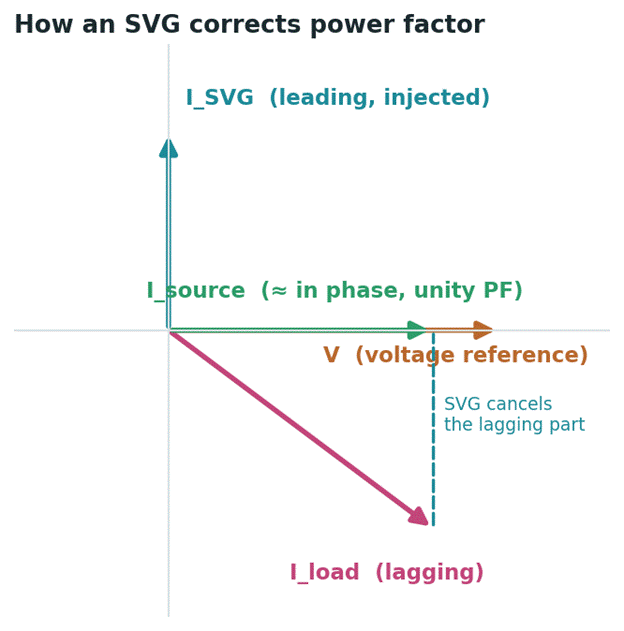
The SVG injects a leading reactive current that cancels the load’s lagging current, leaving the source current in phase with the voltage.
-
- Stepless — compensates continuously, not in fixed capacitor steps.
-
- Fast — responds within milliseconds to load swings, ideal for welding, cranes and drives.
-
- Four – quadrant — supplies both inductive and capacitive VARs and can balance unbalanced phases.
-
- No resonance — unlike capacitor banks, an SVG won’t resonate with system harmonics.
SVG vs. capacitor banks (APFC)
| Criterion | Capacitor bank / APFC | Static VAR Generator |
| Compensation | Fixed steps | Stepless, exact |
| Response time | Seconds | Milliseconds |
| Unbalance correction | No | Yes |
| Resonance risk | High | None |
| Capacitive & inductive | Capacitive only | Both directions |
Key benefits of an InPhase SVG
-
- Maintains power factor close to unity at all load levels, cutting kVA demand and PF penalties
-
- Stabilises voltage and reduces flicker for sensitive processes
-
- Corrects load unbalance across phases
-
- Stepless, surge-free operation with no capacitor switching transients
-
- Real-time DSP control with remote monitoring
Applications
The Static VAR Generator Working Principle makes SVGs ideal for industries with rapidly changing inductive loads such as steel, cement, textile, automotive, and pharmaceutical plants.
SVGs are used across textile, cement, steel, metro, chemical, automotive and pharmaceutical plants – and in any facility with fluctuating inductive loads, renewable integration or strict utility power-factor requirements.
Standards & grid codes
Utilities worldwide enforce a minimum power factor – commonly 0.95 to 0.99 and penalise low PF or excess reactive (kVAr / KVAH) demand. International standards such as IEC 61000-2-4 and EN 50160 also limit voltage variation and unbalance. An SVG helps facilities stay within these grid-code and utility requirements in any market.
Why choose InPhase
InPhase Power Technologies is a specialist power-quality manufacturer with R&D approved by DSIR (Government of India) and an installed base measured in kilo-amperes across 10+ countries and sectors such as steel, cement, metro, textile, oil & gas, data centres and green hydrogen.
-
- 100% focused on power quality, with DSIR-approved R&D
-
- Low-voltage SVG and medium-voltage VAJRA SVG (3.3–33 kV) from one manufacturer
-
- Modular SVG options for easy scaling and servicing
Frequently asked questions
What is the working principle of a static VAR generator?
An SVG measures the reactive component of the load current and uses an IGBT inverter to inject an equal and opposite reactive current in real time, bringing the power factor close to unity and stabilising voltage.
What is the difference between an SVG and a capacitor bank?
A capacitor bank corrects power factor in fixed steps and reacts in seconds, whereas an SVG compensates steplessly within milliseconds, handles both inductive and capacitive demand, corrects unbalance, and carries no resonance risk.
Does an SVG reduce electricity bills?
Yes. By raising power factor and cutting reactive (kVAr) demand, an SVG lowers apparent power (kVA), helps avoid power-factor penalties and can reduce KVAH-based billing.
Can an SVG correct voltage and unbalance?
Yes. Besides power-factor correction, an SVG stabilises voltage and can balance unbalanced three-phase loads.
The Static VAR Generator Working Principle provides a future-ready solution for dynamic reactive power compensation, voltage stabilization, and improved power quality.
Improve power factor and stabilise voltage with an InPhase SVG. Visit inphase.in or email sales@inphase.in for a reactive-power study.
Learn more about power quality standards from IEC Standards and IEEE Standards Association.
Learn more about our Power Quality Solutions and Static VAR Generator Solutions.
Related: Modular SVG, VAJRA medium-voltage SVG, and Smart Hybrid Active Filter (SHAF).