
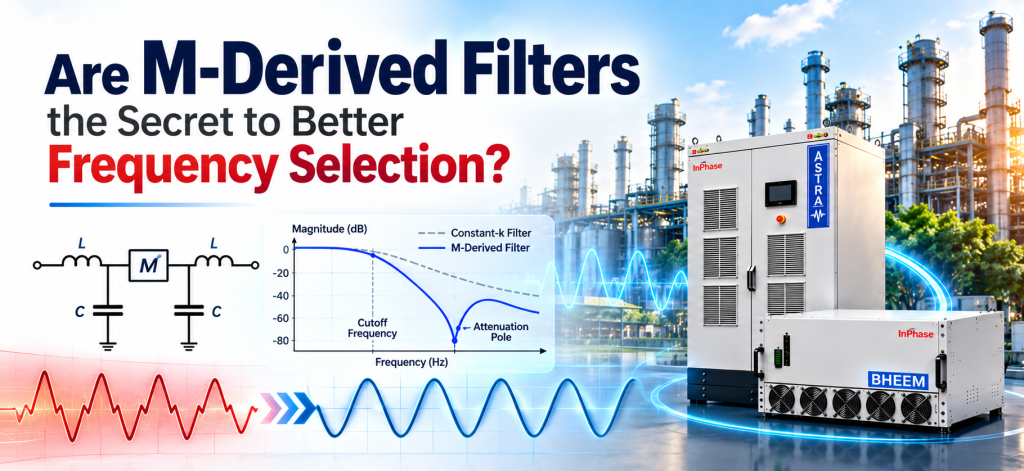
In electrical and electronic systems, selecting the required frequency while reducing unwanted frequency components is essential for reliable performance. The advantages of M-derived filters become important when a circuit needs better frequency selectivity and a sharper transition between the frequencies it allows and those it attenuates.
Traditional constant-k filters provide basic frequency selection, but their attenuation characteristics may not always meet the requirements of applications that need a sharper cutoff. M-derived filters address this limitation by introducing an attenuation pole at a selected frequency under ideal design conditions.
But how do the advantages of M-derived filters help engineers achieve better filtering performance? And when the problem involves harmonic distortion in an industrial electrical system, is a conventional passive filter enough, or is an active harmonic filter a better choice?
Let us understand the benefits of M-derived filters, the differences between filter technologies, and how the right industrial harmonic filtering solution can improve power quality.
What Are the Advantages of M-Derived Filters?
M-derived filters are passive electrical network filters developed from constant-k filter sections. Their main purpose is to improve frequency discrimination by modifying the original filter network using a parameter called (m).
The following advantages of M-derived filters make them useful in classical filter design.
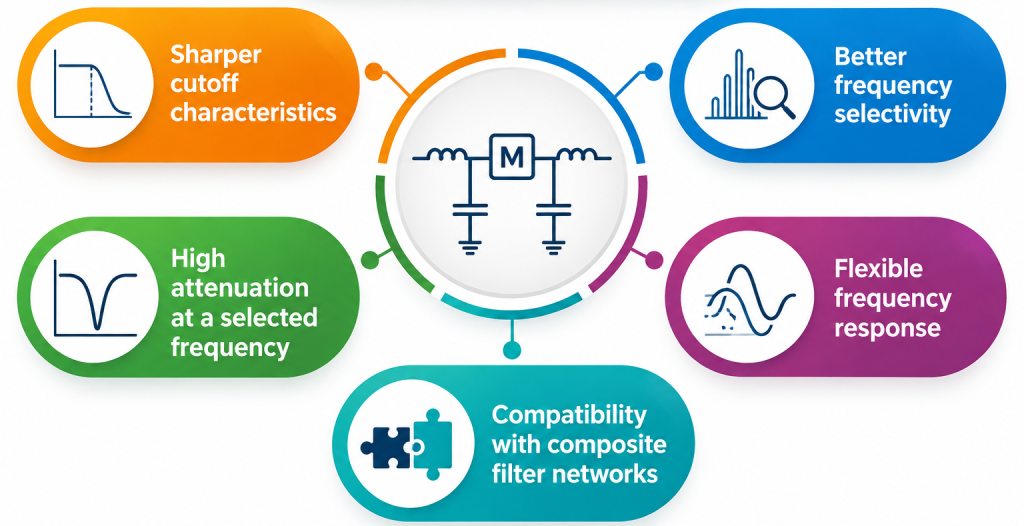
Sharper cutoff characteristics: M-derived filters can provide a sharper transition near the cutoff frequency than a basic constant-k filter section.
Better frequency selectivity: Their frequency response can help distinguish desired signals from unwanted frequency components.
High attenuation at a selected frequency: An M-derived filter can introduce a frequency of theoretically infinite attenuation in an ideal network model.
Flexible frequency response: By selecting the M parameter appropriately, engineers can adjust the location of the attenuation pole relative to the cutoff frequency.
Compatibility with composite filter networks: M-derived sections can be combined with constant-k sections to achieve a desired overall frequency response.
These advantages of M-derived filters make them valuable in classical passive network design. However, the actual performance depends on component values, termination conditions, and the response across the complete frequency range.
How Do These Advantages Help in Practical Filter Design?
The usefulness of the advantages of M-derived filters becomes clearer when the required signal must be separated from nearby unwanted frequencies.
For example, consider a low-pass filter with a cutoff frequency of 1 kHz. If the M parameter is 0.6, the ideal frequency of infinite attenuation can be calculated using:
f∞ = fc / √(1 − m²)
Where:
f∞ = Frequency of infinite attenuation in the ideal model
fc = Cutoff frequency
m = M-derived filter parameter
For this example:
f∞ = 1 / √(1 − 0.6²) = 1.25 kHz
The ideal attenuation pole is therefore located at 1.25 kHz.
This illustrates one of the key advantages of M-derived filters: the ability to position a high-attenuation point at a selected frequency. In practical circuits, component tolerances and parasitic effects limit the achievable attenuation. It is also important to remember that attenuation may decrease beyond the pole. Therefore, engineers must evaluate the complete frequency response before selecting the filter.
Can M-Derived Filters Solve Industrial Harmonic Problems?
This is where an important distinction must be made.
M-derived filters are classical passive networks used to shape frequency responses. Industrial harmonic filters are designed specifically to reduce harmonic distortion in electrical power systems. Industrial facilities use equipment such as variable frequency drives (VFDs), rectifiers, uninterruptible power supplies (UPS), and switched-mode power supplies. These nonlinear loads can draw nonsinusoidal currents, introducing harmonic components into the electrical system.
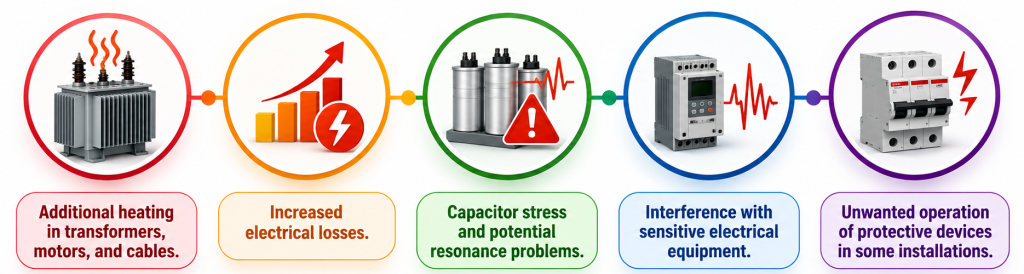
Harmonic distortion can contribute to:
Therefore, the advantages of M-derived filters should not be confused with the benefits of industrial harmonic filters. The appropriate solution depends on the electrical problem being addressed.
What Are the Benefits of Industrial Harmonic Filters?
Industrial harmonic filters help manage unwanted harmonic components generated by nonlinear loads. Their benefits depend on the type of filter selected, the system configuration, and the measured harmonic levels.
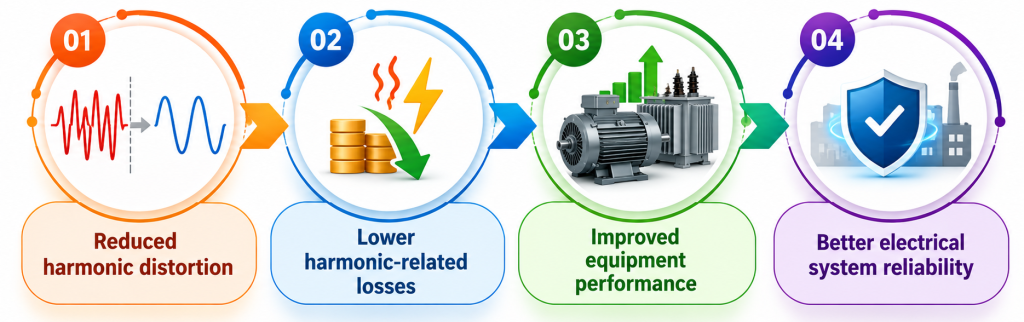
Reduced harmonic distortion: A properly designed filter can reduce targeted harmonic components and improve waveform quality.
Lower harmonic related losses: Reducing excessive harmonic currents can help limit additional heating and losses in electrical equipment.
Improved equipment performance: Managing harmonics can reduce certain power quality problems that affect transformers, capacitors, cables, and other equipment.
Better electrical system reliability: Appropriate harmonic mitigation can help reduce harmonic related stress and support reliable operation.
Improved power quality compliance: Correctly designed harmonic mitigation can help an installation meet applicable distortion limits at the point of common coupling (PCC). The effectiveness of any harmonic filter depends on the actual electrical conditions. Harmonic measurements, load characteristics, system impedance, and the possibility of resonance should be considered before selecting a solution. For further technical guidance, refer to IEEE 519 Standard for Harmonic Control in Electric Power Systems. The standard addresses harmonic control and distortion limits at the PCC.
Which Harmonic Filter Is Better for Your Industry?
Choosing the right harmonic filter depends on the type of load, the harmonic spectrum, the required compensation, and how frequently the operating conditions change.
Two common approaches are passive harmonic filters and Active Harmonic Filters (AHFs).
| Feature | Passive Harmonic Filter | Active Harmonic Filter (AHF) |
|---|---|---|
| Operating principle | Uses passive components to attenuate selected harmonics | Uses power electronics to inject compensating currents |
| Harmonic compensation | Usually designed for selected frequencies | Can compensate multiple targeted harmonic components within its design range |
| Changing load conditions | Performance depends on tuning and system conditions | Can adapt to changing harmonic currents |
| Resonance considerations | Requires careful assessment of system interaction | Avoids relying solely on a tuned passive branch, though system assessment is still necessary |
| Typical consideration | Suitable for known harmonic profiles and appropriate installations | Useful for variable nonlinear loads and changing harmonic profiles |
A passive harmonic filter may be appropriate when the dominant harmonic frequencies and operating conditions are well understood. However, its performance can be affected by changes in system impedance, load variation, and resonance.
An AHF is often worth considering when nonlinear loads change frequently or several harmonic components need to be addressed dynamically. The final selection should be based on measurements and an engineering assessment rather than on the filter type alone.
When Should You Consider an Active Harmonic Filter?
Consider an industrial facility where several VFDs, rectifiers, and other nonlinear loads operate at different times. As production changes, the harmonic current demand may also change.
A conventional passive filter is designed around particular electrical conditions. If those conditions change, its performance may not remain optimal, and the possibility of resonance must be assessed. An Active Harmonic Filter takes a different approach. It measures the relevant current components and uses a power electronic converter to inject compensating currents. This helps reduce targeted harmonic currents under changing operating conditions.
An AHF may be particularly suitable when:
Harmonic levels vary with production activity.
Multiple nonlinear loads operate simultaneously.
Several harmonic orders require compensation.
Flexible harmonic mitigation is needed.
Power quality measurements identify harmonic distortion as a significant problem.
How Can InPhase Active Harmonic Filters Improve Industrial Power Quality?
InPhase Power Technologies offers Active Harmonic Filter (AHF) solutions through its MicroBheem and ASTRA platforms to address harmonic distortion in industrial electrical systems. An InPhase AHF monitors the electrical system and injects compensating currents to reduce targeted harmonic components. Its power electronic control enables it to respond to changing nonlinear loads, making it suitable for industrial facilities where harmonic current levels vary with production activity.
Key features include:
- Harmonic mitigation up to the 50th harmonic
- Fast response of approximately 1 to 5 ms
- Around 98% efficiency
- Suitable for 415 V ±10% systems
- Modbus RTU, TCP/IP, and Ethernet communication
- Suitable for industrial applications with changing loads
The MicroBheem platform uses three level IGBT technology. Its standard AHF configuration supports harmonic filtering up to the 25th order, while the AHF+ configuration extends filtering up to the 50th harmonic. Depending on the selected model and configuration, additional functions such as power factor correction and reactive power compensation may also be available.
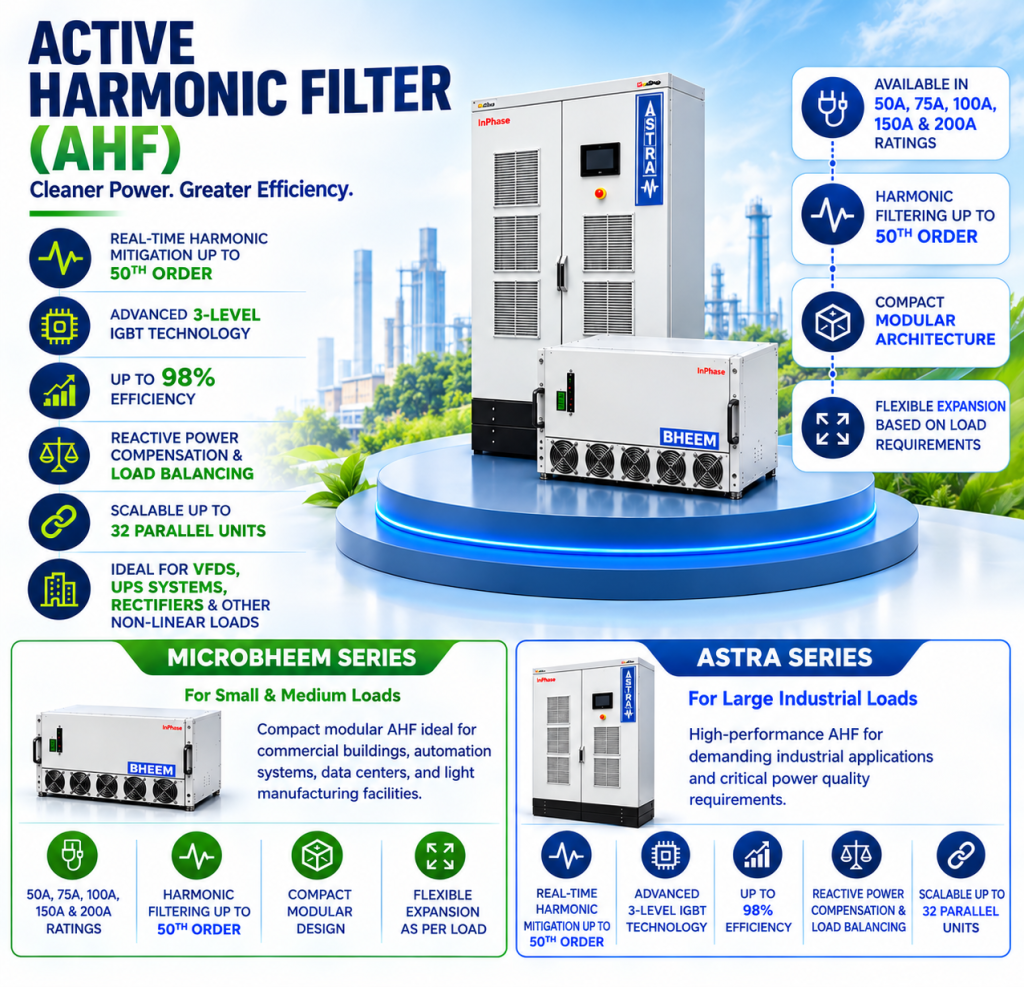
These capabilities make InPhase AHF solutions suitable for industries seeking to reduce harmonic distortion, manage changing load conditions, and improve overall power quality. Before selecting an AHF, a power quality assessment should be conducted to determine the harmonic spectrum, load profile, and required compensation capacity. This helps ensure that the selected solution meets the actual electrical requirements of the installation.
Explore InPhase Active Harmonic Filter solutions to learn more about industrial harmonic mitigation and power quality improvement.