
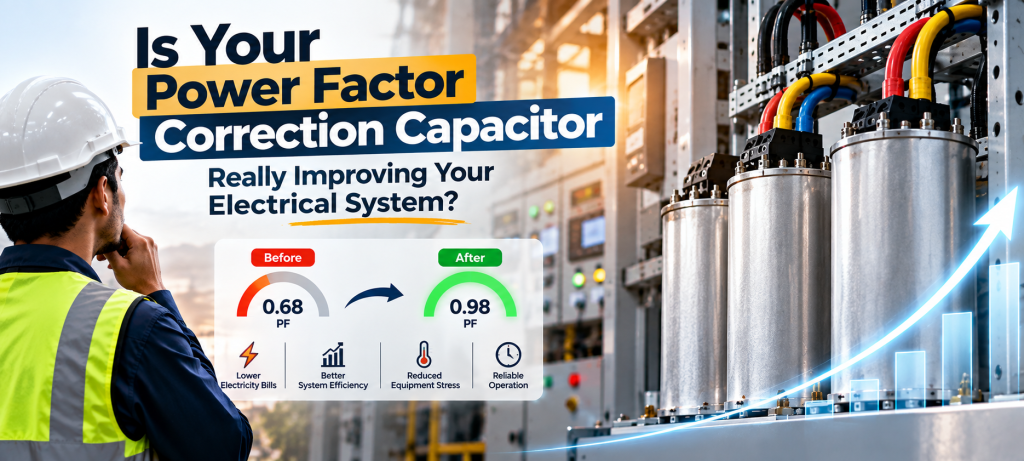
Your industrial facility may be consuming hundreds or even thousands of units of electricity every day. Motors are running, pumps are operating, compressors are starting, and production equipment is working continuously. But there is another part of your electrical system that is often overlooked ,that is, reactive power.
Inductive loads such as motors and transformers need reactive power to create magnetic fields, increasing current in the electrical system without producing useful work. This adds load to cables, transformers, and switchgear. A power factor correction capacitor supplies reactive power locally, reducing the demand from the utility, improving power factor, and supporting more efficient operation.
But is simply installing a capacitor enough? How does a power factor correction capacitor actually work? How do you calculate the required capacitor capacity? And what should you consider before selecting one for an industrial application?
Let’s take a closer look.
What Is a Power Factor Correction Capacitor?
A power factor correction capacitor is an electrical capacitor used to compensate for the reactive power consumed by inductive loads. Industrial equipment such as induction motors, transformers, compressors, pumps, and other electromagnetic loads generally require reactive power during operation.
The relationship between useful power and apparent power is commonly expressed as:
Power Factor = kW / kVA
When the power factor is low, the electrical system needs to draw more current to deliver the same amount of useful active power. A power factor correction capacitor helps by supplying part of the required reactive power near the load. This reduces the reactive power demand from the source and improves the overall power factor.
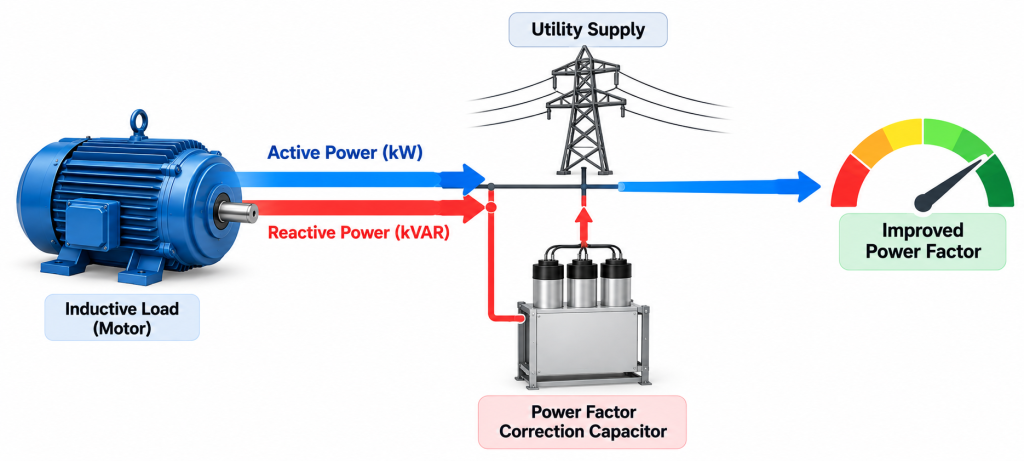
The figure shows how a power factor correction capacitor supports an inductive load such as a motor. The capacitor supplies reactive power locally, reducing the reactive power drawn from the utility supply and helping improve the overall power factor.
Why Is Power Factor Correction Important for Industries?
Power factor may look like just another number on an electrical meter. But in an industrial facility, it can have a direct impact on how effectively the electrical system is being used.
Consider a plant with several large induction motors operating throughout the day. These motors require active power to perform mechanical work, but they also require reactive power for their magnetic operation. If the power factor is low, more current is required to deliver the same useful power.
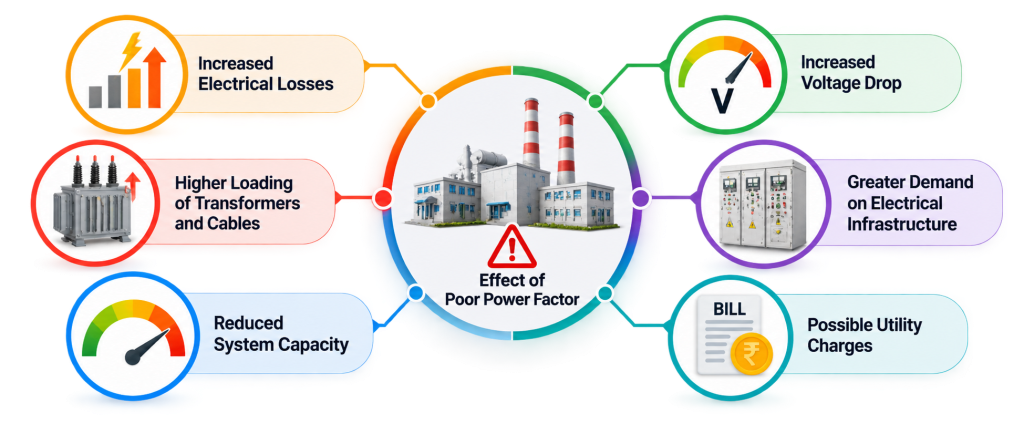
This is why power factor correction is an important part of industrial electrical management. A correctly selected power factor correction capacitor can compensate for reactive power and help the system operate closer to its desired power factor.
How Does a Power Factor Correction Capacitor Work?
The working principle is simple. An inductive load draws reactive power from the electrical supply. A capacitor provides reactive power compensation locally. Instead of making the utility supply provide all the reactive power required by the load, the capacitor supplies part of that requirement. This reduces the reactive component of current flowing through the upstream electrical system.
The basic process can be understood as:
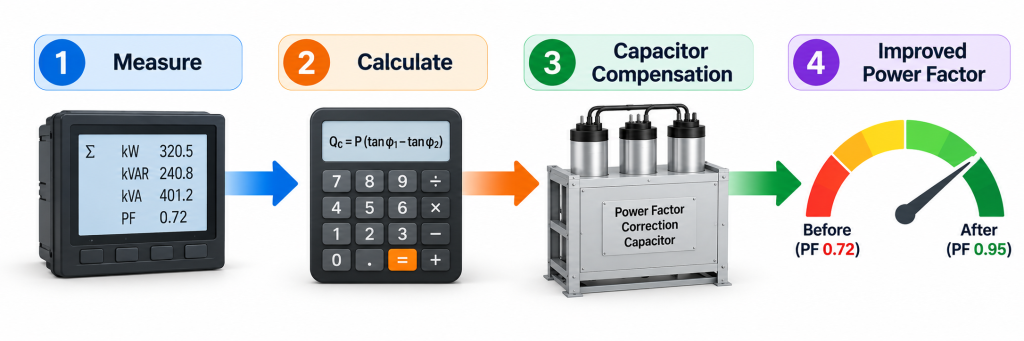
First, the electrical system is measured to determine the existing power factor and reactive power requirement. Next, the required compensation is calculated. The appropriate power factor correction capacitor or capacitor bank is then connected to provide the required reactive power. As a result, the power factor improves and the electrical system can make better use of its available capacity.
How Is Power Factor Correction Capacitor Capacity Calculated?
Choosing the right capacitor capacity is one of the most important parts of power factor correction. A capacitor that is too small may not provide sufficient compensation. A capacitor that is too large can result in overcompensation and may create other electrical problems.
The required reactive power compensation can be estimated using:
Qc = P × (tan φ₁ − tan φ₂)
Where:
Qc = Required capacitor capacity in kVAR
P = Active power in kW
φ₁ = Existing power factor angle
φ₂ = Desired power factor angle
The power factor angle can be calculated using:
φ = cos⁻¹(PF)
For example, suppose an industrial facility is consuming 400 kW at an existing power factor of 0.75, while the desired power factor is 0.95. The existing and target power factor angles can first be calculated. These values can then be used in the above equation to estimate the required kVAR compensation. This provides a starting point for selecting the appropriate power factor correction capacitor capacity. However, actual capacitor selection should not depend on this calculation alone. The load profile, voltage level, harmonics, operating conditions, switching requirements, and future expansion of the facility should also be considered.
Is a Power Factor Correction Capacitor Enough for Your Facility?
The right power factor correction solution depends on the actual electrical conditions of the facility. If the main requirement is reactive power compensation from relatively stable inductive loads, a properly designed power factor correction capacitor or capacitor bank can provide the required compensation. However, what happens when the reactive power demand changes frequently throughout the day? Motors, pumps, compressors, and other industrial loads may switch ON and OFF at different times, causing the reactive power requirement to change continuously.
An APFC system can automatically switch capacitor stages according to the changing requirement. But because it works through predefined capacitor steps, the compensation may not always match the instantaneous reactive power demand of rapidly changing loads. In such applications, a Static VAR Generator (SVG) can provide dynamic reactive power compensation. Instead of switching fixed capacitor steps, an SVG continuously adjusts its reactive power output according to the actual load condition.
Before selecting between a conventional capacitor bank, APFC, or SVG, the electrical system should therefore be measured and analyzed.
Important parameters include:
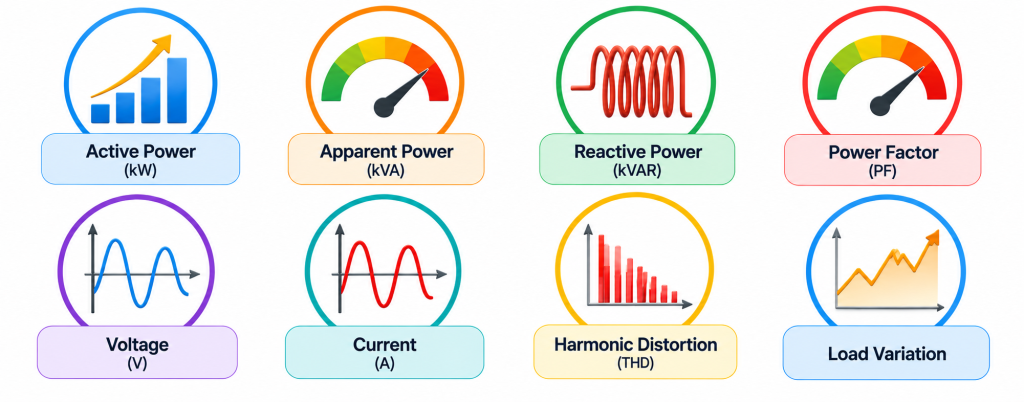
Once the actual problem is understood, the appropriate power quality solution can be selected, while harmonic performance can be evaluated with reference to IEEE 519 which establishes harmonic control goals and distortion limits at the point of common coupling (PCC).
Power Factor Correction Capacitor vs Static VAR Generator
| Feature | Power Factor Correction Capacitor | Static VAR Generator (SVG) |
|---|---|---|
| Primary purpose | Reactive power compensation | Dynamic reactive power compensation |
| Main application | Improving power factor | Dynamic power factor and reactive power control |
| Technology | Capacitive compensation | Power electronic converter |
| Reactive power compensation | Yes | Yes |
| Compensation method | Fixed or stepwise | Continuous and dynamic |
| Response | Depends on switching and capacitor steps | Fast electronic response |
| Suitable for changing loads | Limited depending on load variation | Well suited for rapidly changing loads |
A power factor correction capacitor can be an effective solution when the reactive power demand is relatively stable. However, when the load changes frequently, fixed or stepwise capacitor compensation may not always match the actual reactive power requirement.
When Should You Consider an SVG?
Consider an industrial facility where motors, pumps, compressors, welding equipment, or other loads switch ON and OFF frequently. In such systems, the reactive power demand can change continuously.
A conventional capacitor bank compensates reactive power through predefined capacitor steps. When the load changes faster than these steps can respond, the system may experience periods of under compensation or over compensation.
This is where a Static VAR Generator (SVG) can be useful.
An SVG continuously monitors the electrical system and dynamically supplies or absorbs reactive power according to the changing load requirement. Instead of depending on fixed capacitor steps, it uses power electronics to provide continuous reactive power compensation.
How InPhase SVG Can Support Dynamic Power Factor Correction
InPhase Static VAR Generator (SVG) solutions are designed for dynamic reactive power compensation. The SVG continuously responds to changing load conditions, helping maintain the required reactive power balance and supporting stable power factor operation.
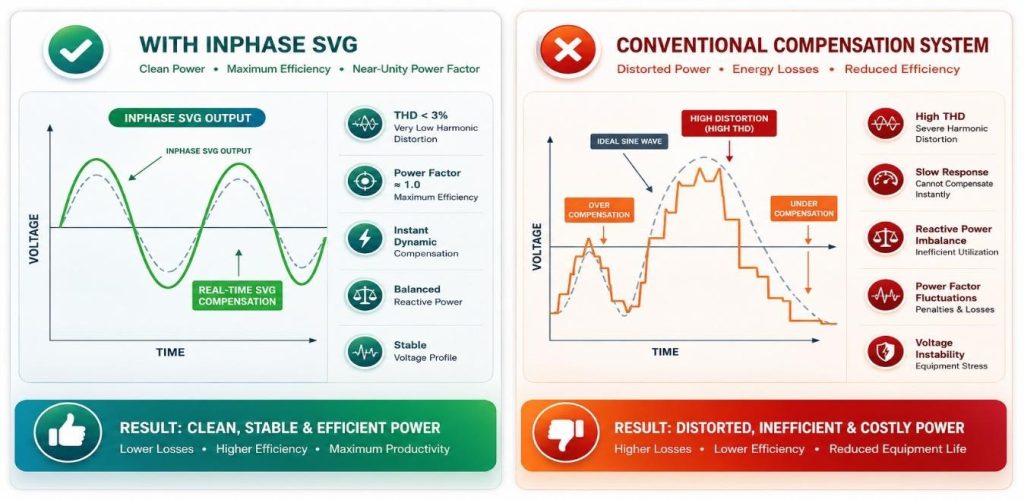
The comparison above shows how a conventional compensation system may experience over compensation, under compensation, power factor fluctuations, slower response, and reactive power imbalance when the load changes frequently. These limitations can make it difficult to maintain the desired power factor consistently.
The InPhase SVG addresses these challenges through fast and continuously adjustable reactive power compensation. With three-level IGBT technology, a response time of less than 0.1 ms, power factor greater than 0.99, and efficiency greater than 98%, the SVG can respond dynamically to changing load conditions. Unlike conventional capacitor-step switching, it continuously adjusts compensation according to the reactive power requirement, helping maintain a more stable power factor and reduce unnecessary electrical losses.
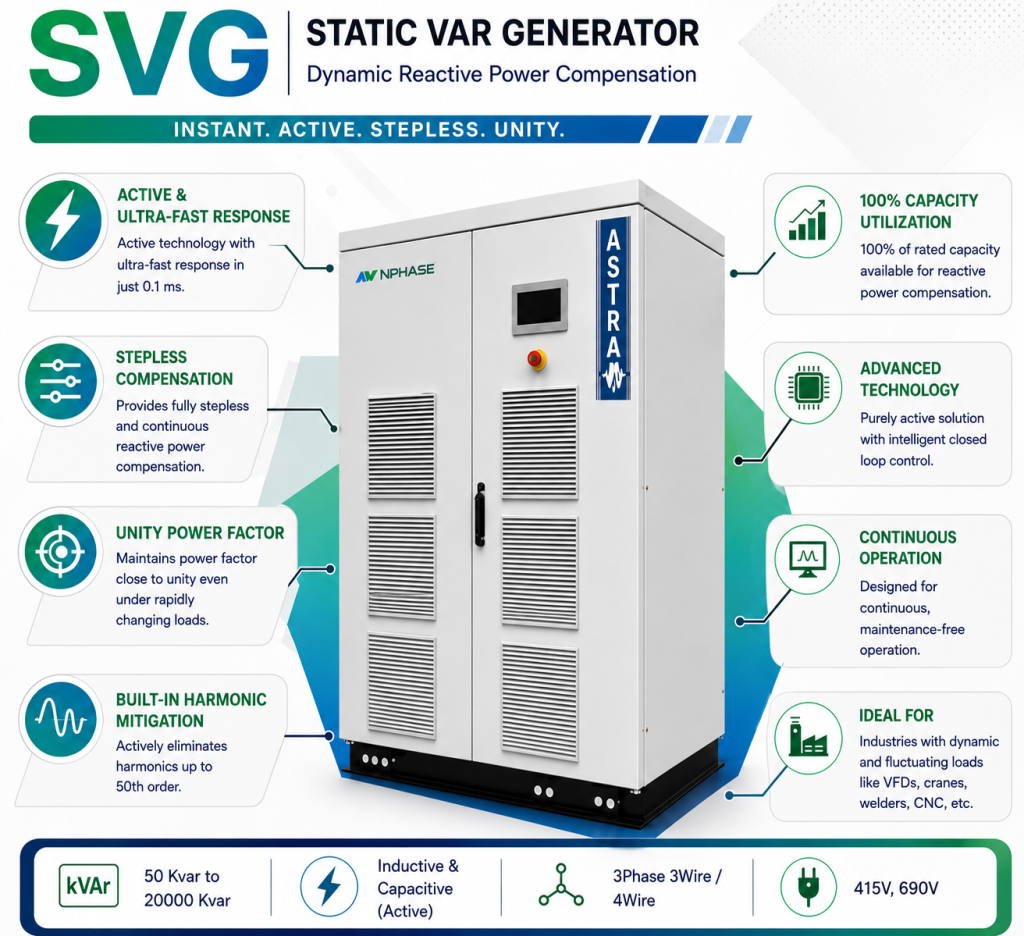
If your facility experiences rapidly changing reactive power demand, explore InPhase Static VAR Generator solutions for dynamic power factor correction.