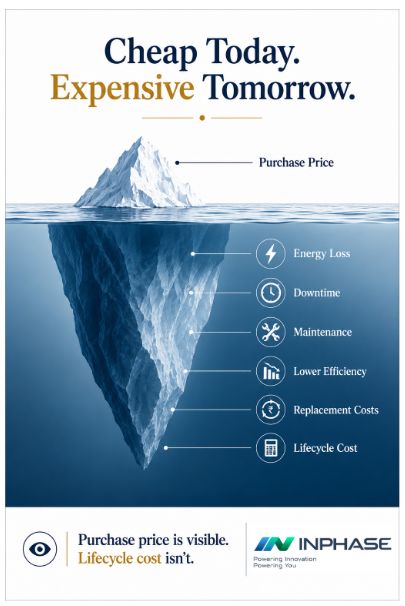
A cheaper Active Harmonic Filter can cost you more than you saved — every single year.
Here’s what most procurement teams don’t see:
Imported AHFs are 20–40% cheaper upfront. That’s real. But here’s what the price tag doesn’t tell you.
At InPhase, we’ve installed and maintained hundreds of systems across industries. And when customers come to us after trying low-cost imported units, the story is almost always the same:
⚡ Peak efficiency of 97% vs 98.5% for a well-designed indigenous unit
⚡ Real-world average efficiency drops to 92–96% under Indian grid conditions
⚡ That 2–3% gap translates to ₹1 lakh+ in wasted electricity — every year
Within 4–5 months of operation, the price advantage disappears completely.
But efficiency is just one part.
→ Many imported units are designed for about 60% of normal operating conditions. Indian temperature and grid variations? They struggle.
→ They derate fast — and don’t deliver the harmonic compensation they promise
→ When they break down, there’s no local service network. The entire panel has to be replaced.
→ Harmonics needs 24/7 monitoring to verify. Most facilities don’t have that. So they’re left with underperforming systems and no way to tell.
I’ve seen this cycle too many times. A facility buys on price alone, can’t verify performance, and two years later reinvests the same amount again.
The question every procurement head should ask — what is the lifecycle cost, not just the purchase cost?
A harmonic filter is not a commodity. It’s a health system for your electrical network. Treat it like one.