
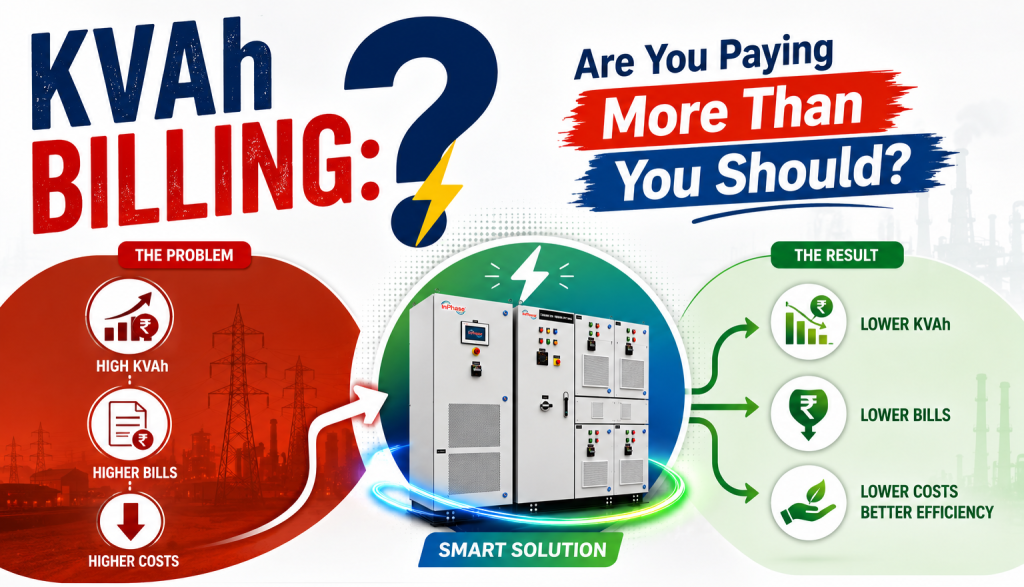
Your industrial facility may be consuming the same amount of useful electrical energy every day. Yet, the electricity bill can still be higher than expected. Have you ever wondered why?
One important factor can be KVAh consumption.
In modern industries, electrical loads such as motors, pumps, compressors, variable frequency drives, and automated machinery do not always operate at a constant level. Their changing operating conditions can affect the reactive power requirement and, consequently, the overall apparent power demand of the system. This is why understanding KVAh is becoming increasingly important for industries looking to improve electrical efficiency and control energy costs.
But what exactly is KVAh, and why does it matter?
Let’s understand.
KWh vs KVAh: What Is the Difference?
Before understanding KVAh billing, it is important to know the difference between kWh and KVAh.
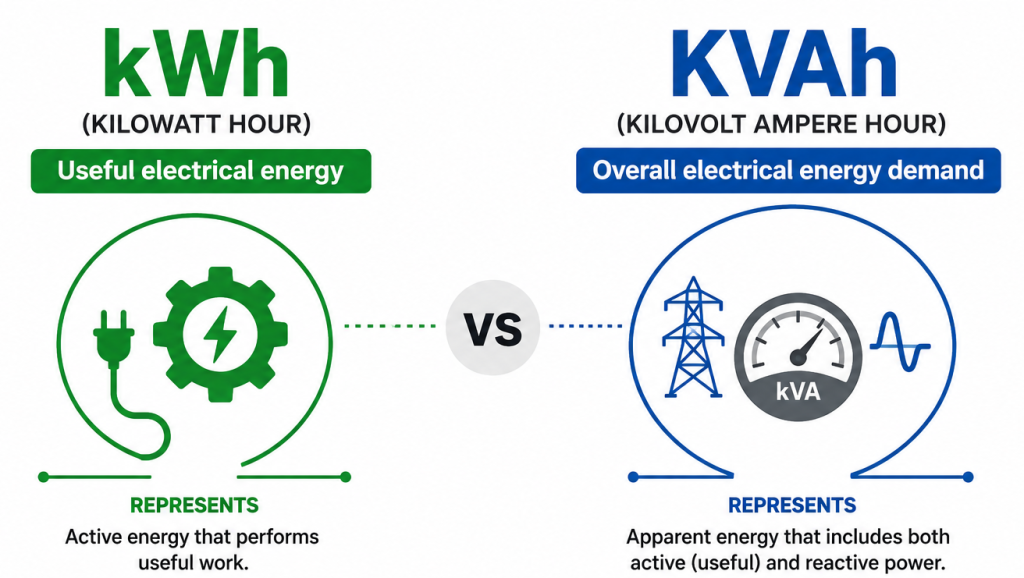
kWh represents the active electrical energy consumed by the equipment to perform useful work. For example, motors use active power to produce mechanical output, while pumps and compressors use it to perform their intended operation. KVAh, however, considers the overall apparent power supplied to the electrical system.
In a practical industrial system, the electrical load is not always purely resistive. Many machines, particularly motors and other inductive equipment, also require reactive power. Reactive power does not directly perform useful mechanical work, but it is necessary for establishing magnetic fields in many electrical machines. Therefore, when reactive power demand increases, the apparent power requirement also increases. So, reducing unnecessary reactive power demand can help an industry manage its KVAh consumption more effectively.
Why Does KVAh Increase?
The electrical demand of a modern industrial facility is rarely constant.
Consider a manufacturing plant operating several large motors. Some motors may be running continuously, while others start and stop depending on the production process. At one moment, the plant may have a high reactive power requirement. A few minutes later, the requirement may decrease. Variable speed drives, compressors, pumps, welding equipment and automated machinery can make these changes even more noticeable. When the power factor decreases, more apparent power is required to deliver the same useful active power. For example, if an installation needs a certain amount of active power, a lower power factor means the electrical system must supply a higher apparent power.
This can contribute to:
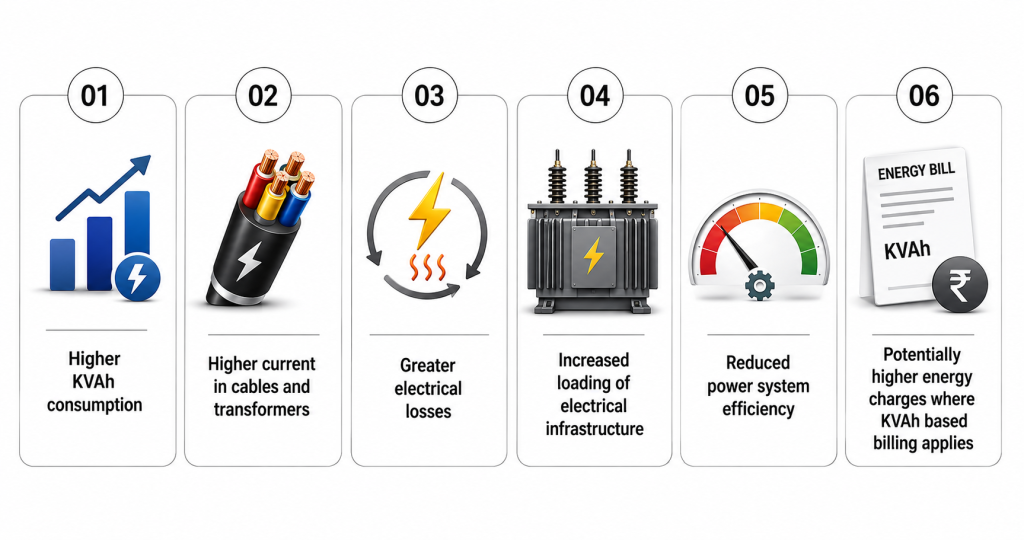
Therefore, simply looking at active energy consumption does not always provide the complete picture.
The question is not only how much useful energy the industry consumes, but also how efficiently the electrical system uses the supplied power.
Why Is Power Factor Important for KVAh?
Power factor indicates how effectively the supplied electrical power is being utilized. A power factor closer to unity means that a greater portion of the apparent power is being used as active power. When the power factor is low, the system requires more apparent power for the same active power requirement.
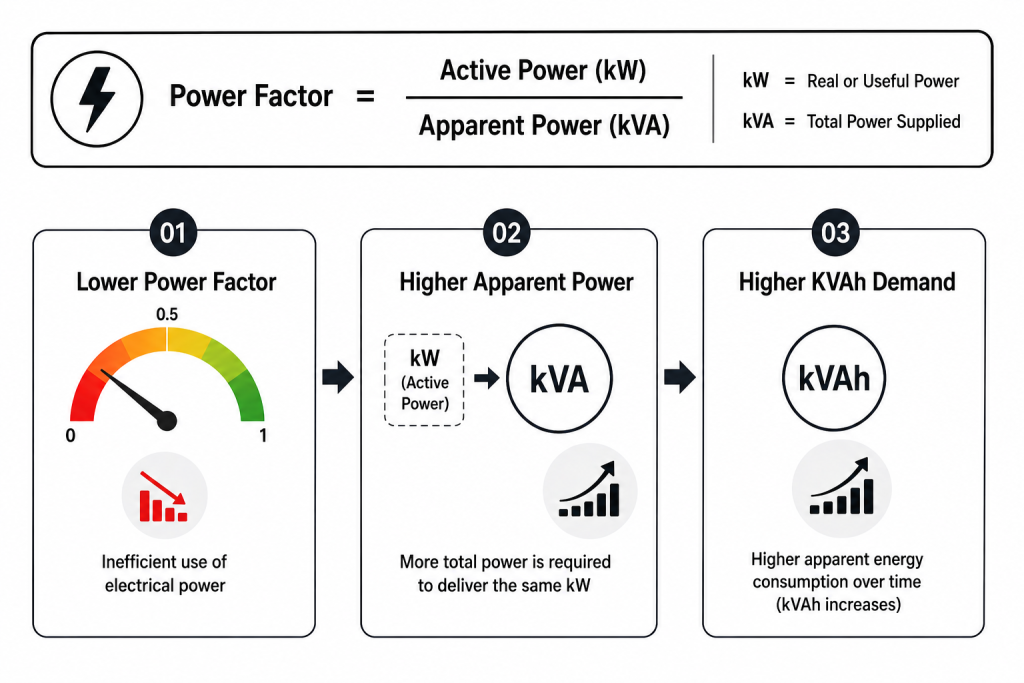
This is why improving the power factor can play an important role in KVAh management.
For industries operating large inductive loads, maintaining a good power factor can help reduce unnecessary reactive power demand and make better use of the available electrical infrastructure. But there is another challenge.
Industrial loads keep changing.
And this is where the choice of power factor correction method becomes important.
Can Conventional Power Factor Correction Solve the Problem?
Traditional power factor correction methods such as capacitor banks and Automatic Power Factor Correction (APFC) panels have been widely used in industrial electrical systems. Capacitor banks provide reactive power compensation to reduce the reactive power drawn from the upstream electrical system. For installations where the reactive power requirement remains relatively stable, this can be a simple and economical solution.
APFC provides a more flexible approach. It monitors the system power factor and automatically switches capacitor stages according to the reactive power requirement. This makes APFC suitable for many industrial applications where the load varies but remains reasonably predictable.
However, APFC still works through discrete capacitor steps.
While choosing a suitable method on power factor correction, industries also need to consider overall electrical power quality. IEEE 519 provides recommended practices for maintaining power quality and limiting harmonic distortion in electrical systems.
When the reactive power requirement changes rapidly, the available capacitor stages may not exactly match the requirement at every moment. This does not mean APFC is unsuitable. Rather, it means that the effectiveness of a compensation method depends on the nature of the electrical load.
For stable loads, conventional compensation can be effective.
But what happens when the load keeps changing?
This is where dynamic power factor correction becomes important.
SVG: A Smarter Approach to KVAh Management
A Static VAR Generator (SVG) provides a dynamic approach to reactive power compensation. Unlike conventional capacitor based methods, an SVG uses power electronic technology to respond to changing reactive power requirements.
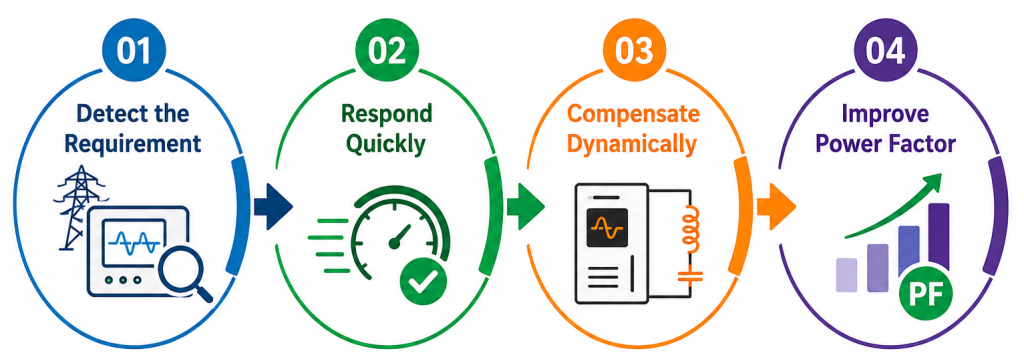
The SVG continuously monitors the electrical system and adjusts its reactive power compensation according to the changing load condition. When the reactive power demand increases, the SVG increases its compensation. When the demand decreases, the SVG reduces its compensation accordingly. This allows the compensation to follow the actual requirement of the electrical system more effectively.
The objective is not simply to add more compensation.
The objective is to provide the right compensation when it is required.
For industries with rapidly changing loads, this dynamic response can help maintain a high power factor and reduce unnecessary reactive power demand. As a result, SVG technology can support better KVAh management and more efficient utilization of the electrical system.
Why Choose InPhase SVG?
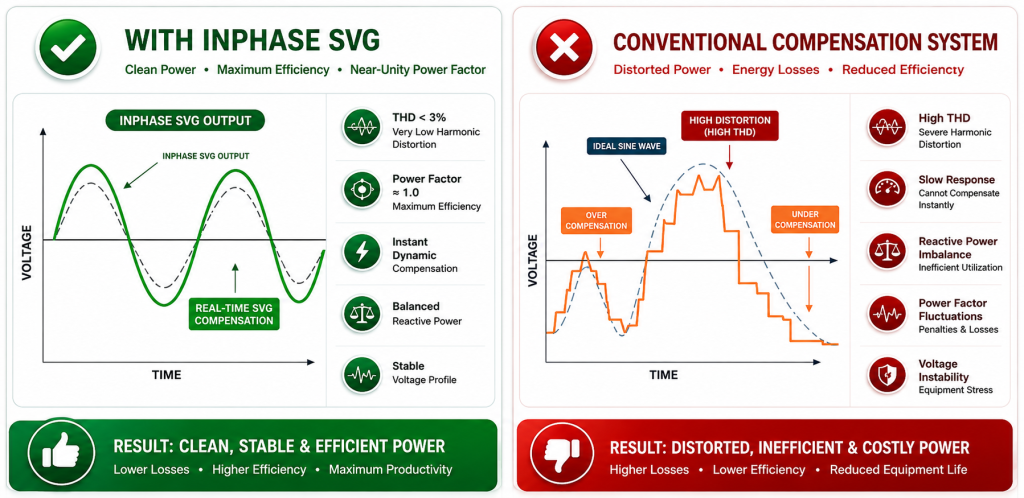
When reactive power demand changes rapidly, conventional compensation systems may struggle to match the actual requirement, resulting in under compensation or over compensation. This can keep the power factor away from its optimum level and increase the apparent power drawn by the system, contributing to higher KVAh consumption.
InPhase SVG addresses this challenge through fast, dynamic reactive power compensation. Unlike conventional step based compensation, the SVG continuously adjusts its output according to the actual reactive power requirement. This helps maintain a high power factor even when industrial loads change rapidly, thereby reducing unnecessary apparent power demand and supporting lower KVAh consumption.
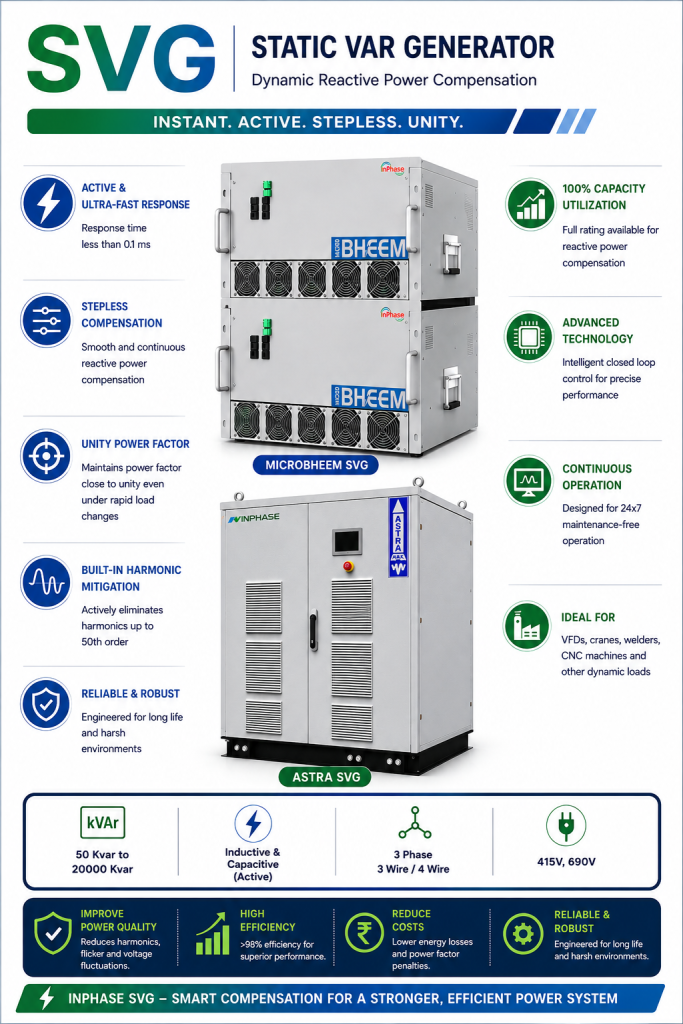
Built with 3-Level IGBT technology, InPhase SVG delivers:
- Over 98% efficiency.
- Response time of less than 0.1 ms.
- Power factor above 0.99.
- Fast and accurate dynamic reactive power compensation.
- Reduced risk of over-compensation and under-compensation.
- Improved voltage stability and system efficiency.
Learn more about our Static VAR Generator solutions at InPhase Power Technologies.