
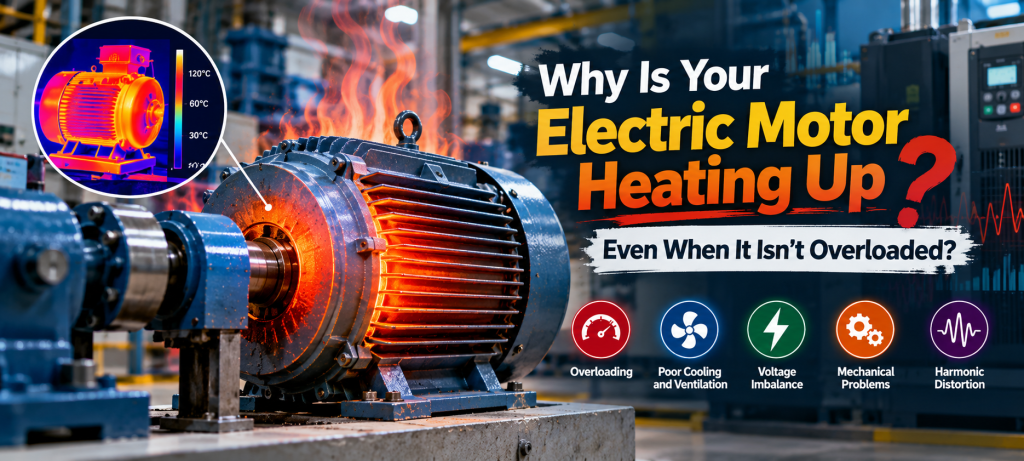
Industrial motors are essential for running conveyor belts, pumps, compressors, and production machinery. However, excessive motor heating can reduce equipment reliability, accelerate insulation ageing, and lead to unexpected downtime. While overloading is a common cause, poor ventilation, mechanical friction, voltage imbalance, and electrical disturbances can also contribute to overheating.
So, what causes motor heating, how can you identify the underlying problem, and what steps can help prevent it?
Let’s take a closer look.
What Is Motor Heating, and Why Does It Matter?
Motor heating refers to the rise in temperature of an electric motor during operation. Although some heat is generated during normal operation, excessive temperature rise can indicate an underlying problem.
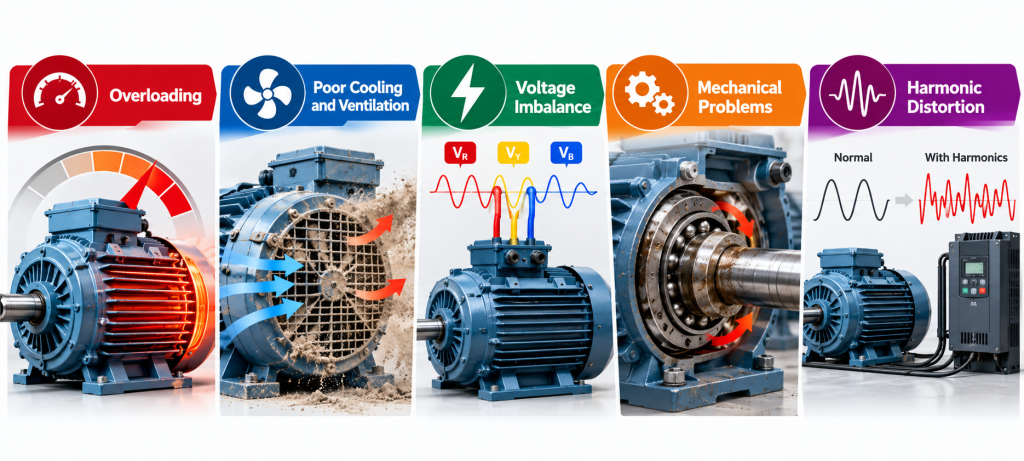
Common causes include:
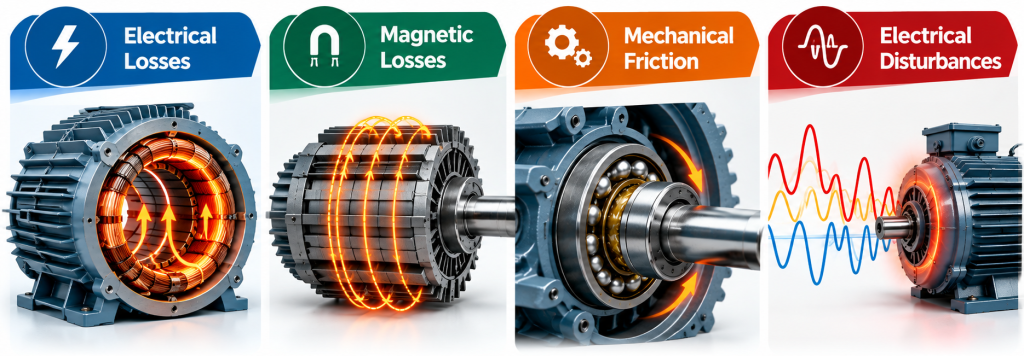
5 Warning Signs of Motor Heating
Recognising the warning signs early can help maintenance teams investigate the problem before it affects production.
1) Unusually High Motor Temperature
A motor that operates hotter than its normal baseline may be experiencing excessive losses or inadequate cooling. Temperature should be evaluated against the manufacturer’s specified limits, considering the motor design, ambient conditions, and operating load. A temperature rise alone does not identify the exact cause, but it signals the need for further inspection.
2) Frequent Thermal Trips
Motor protection devices may disconnect a motor when excessive temperature or current conditions persist. Repeated thermal trips can indicate overloading, cooling problems, phase imbalance, or other electrical or mechanical faults. Instead of repeatedly resetting the protection device, investigate the underlying cause.
3) Increased Operating Current
Excessive current can increase winding losses and contribute to motor heating. Measure the current in all three phases and compare the readings with the motor’s rated values and actual load. If the current is unexpectedly high or unbalanced, investigate the supply, load, motor condition, and harmonic characteristics where appropriate.
4) Unusual Noise or Vibration
Unusual noise and vibration may indicate worn bearings, shaft misalignment, loose mounting, or other mechanical problems. These conditions can increase friction and contribute to heating. Inspecting the motor and its driven equipment helps distinguish mechanical issues from electrical problems.
5) Repeated Overheating Despite Normal Loading
A motor that repeatedly overheats despite operating within its expected load range requires a more detailed investigation. Cooling restrictions, voltage imbalance, supply disturbances, and harmonic distortion may need to be examined. In facilities with multiple VFDs and nonlinear loads, harmonic measurements can help determine whether distorted current is contributing to additional losses.
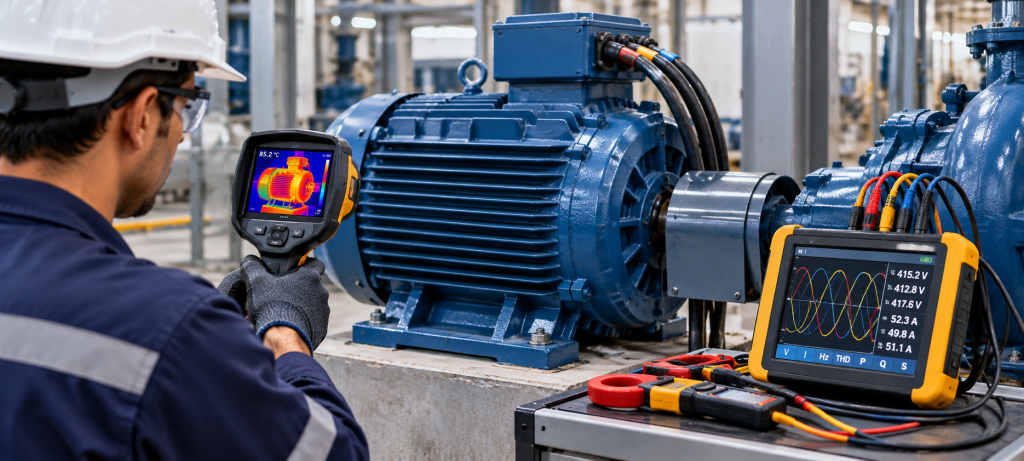
What Causes Motor Heating in Industrial Facilities?
Several operating conditions can cause excessive motor temperature rise. Understanding these causes is essential before selecting a corrective measure. The causes are :
How Do Harmonics Contribute to Motor Heating?
Harmonics are voltage or current components at frequencies that are integer multiples of the fundamental supply frequency. For a 50 Hz electrical system, the 3rd harmonic is 150 Hz, the 5th harmonic is 250 Hz, and the 7th harmonic is 350 Hz.
When nonlinear loads such as VFDs and rectifiers operate, they can introduce harmonic currents into the electrical network. These currents may increase losses in electrical equipment and affect motor operating conditions. For example, consider a manufacturing facility with several VFD driven machines operating simultaneously. Depending on the electrical network and the characteristics of the connected loads, the resulting harmonic distortion may contribute to additional motor losses. The extent of the effect depends on the individual harmonic components, motor characteristics, loading, and system impedance.
The important point is that motor heating should not automatically be attributed to harmonics. A power quality assessment can help determine whether harmonic distortion is a significant contributing factor.
How Can You Identify the Cause of Motor Heating?
Before choosing a solution, inspect the motor and measure the relevant electrical parameters.
| Inspection | What to check |
|---|---|
| Motor loading | Compare actual load with rated capacity |
| Temperature | Compare measured temperature with manufacturer limits |
| Cooling system | Check fans, ventilation, and dust accumulation |
| Voltage supply | Measure phase voltages and voltage imbalance |
| Operating current | Compare three phase current readings |
| Harmonic distortion | Measure current and voltage distortion with a suitable power quality analyser |
| Mechanical condition | Inspect bearings, lubrication, and shaft alignment |
A power quality analyser can identify harmonic components and measure the level of distortion under representative operating conditions. If the measurements show significant harmonic distortion, an engineer can assess whether it contributes to the motor’s additional losses and whether harmonic mitigation is appropriate.
For industrial installations, harmonic assessment can also be considered alongside IEEE Std 519-2022, which provides recommendations and requirements for harmonic control in electric power systems.
Can an Active Harmonic Filter Help Reduce Motor Heating?
When harmonic distortion is confirmed to be contributing to excessive electrical losses, an Active Harmonic Filter (AHF) may help address that part of the problem. An AHF monitors the electrical current and injects compensating currents to counteract targeted harmonic components. This helps reduce harmonic current distortion in the electrical network.
For industrial facilities, an appropriately selected AHF can offer several potential benefits:
Reducing harmonic current distortion.
Helping reduce harmonic-related losses in affected equipment.
Improving the overall current waveform.
Supporting reliable operation of industrial electrical systems.
The actual benefit depends on the measured harmonic spectrum, filter capacity, system configuration, and operating conditions. An AHF does not directly repair a motor or resolve every cause of motor heating. Overloading, inadequate cooling, mechanical defects, and voltage imbalance must be addressed separately when they are responsible for the problem.
How InPhase AHF Can Support Industrial Power Quality
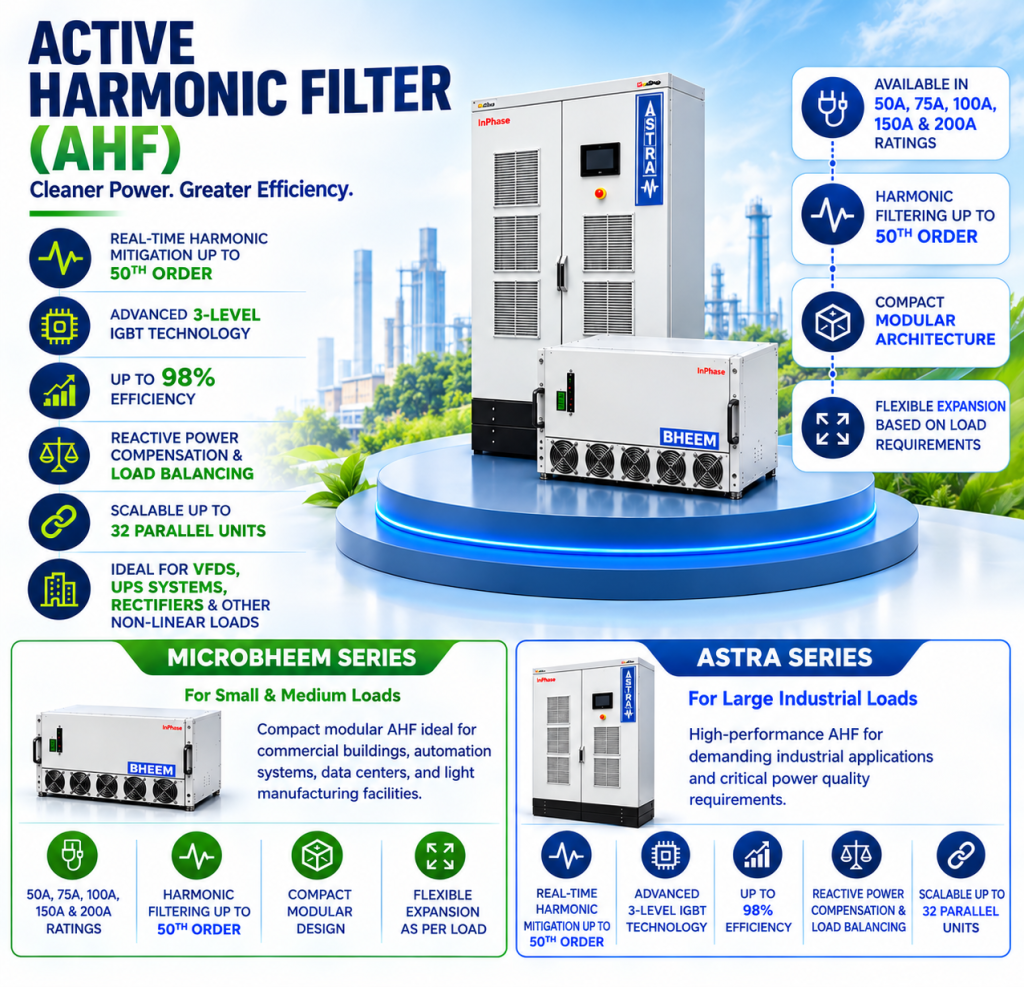
InPhase Power Technologies offers Active Harmonic Filter solutions designed to mitigate harmonic distortion in industrial electrical systems. Where VFDs, rectifiers, and other nonlinear loads contribute significant harmonic currents, an appropriately selected InPhase AHF can help reduce distortion and improve power quality.
Key features include:
- Harmonic mitigation up to the 50th harmonic
- Fast response of approximately 1 to 5 ms
- Around 98% efficiency
- Suitable for 415 V ±10% systems
- Modbus RTU, TCP/IP, and Ethernet communication
- Suitable for industrial applications with changing loads
InPhase currently offers AHF solutions through its MicroBheem and ASTRA platforms for different industrial applications. The current MicroBheem AHF platform uses 3 Level IGBT technology and offers harmonic filtering, with the AHF specification listing up to 25th order harmonic filtering and the AHF+ version extending up to the 50th order. The platform also supports power factor correction and other compensation modes depending on the configuration. This makes the solution suitable for industries where harmonic distortion, changing loads, and electrical efficiency need to be considered together.
Explore InPhase Active Harmonic Filter solutions to reduce harmonic distortion and take a smarter step towards improved power quality and reliable industrial motor performance.