
Engineering Innovations Driving the Next Generation of Power Quality Solutions
Modern Trends in Active Harmonic Filters and Static VAR Generators are redefining power quality management in industrial electrical systems. Modern industrial power systems are no longer dominated by conventional electrical loads. Over the past two decades, the widespread adoption of Variable Frequency Drives (VFDs), servo systems, industrial robotics, renewable energy converters, data centres, electric vehicle charging infrastructure and switched-mode power supplies has fundamentally changed the way electrical energy is consumed. These technologies have enabled higher energy efficiency, greater process automation and improved operational flexibility, but they have also introduced new challenges that were relatively uncommon in traditional power systems.
The common characteristic of these modern loads is the extensive use of power electronic converters. Unlike conventional induction motors connected directly to the grid, power electronic converters draw non-linear current, resulting in harmonic distortion, rapidly varying reactive power demand, current imbalance, increased neutral currents and voltage quality issues. Consequently, maintaining power quality has evolved from a simple power factor correction exercise into a comprehensive engineering challenge involving harmonic mitigation, dynamic reactive power compensation and continuous system monitoring.
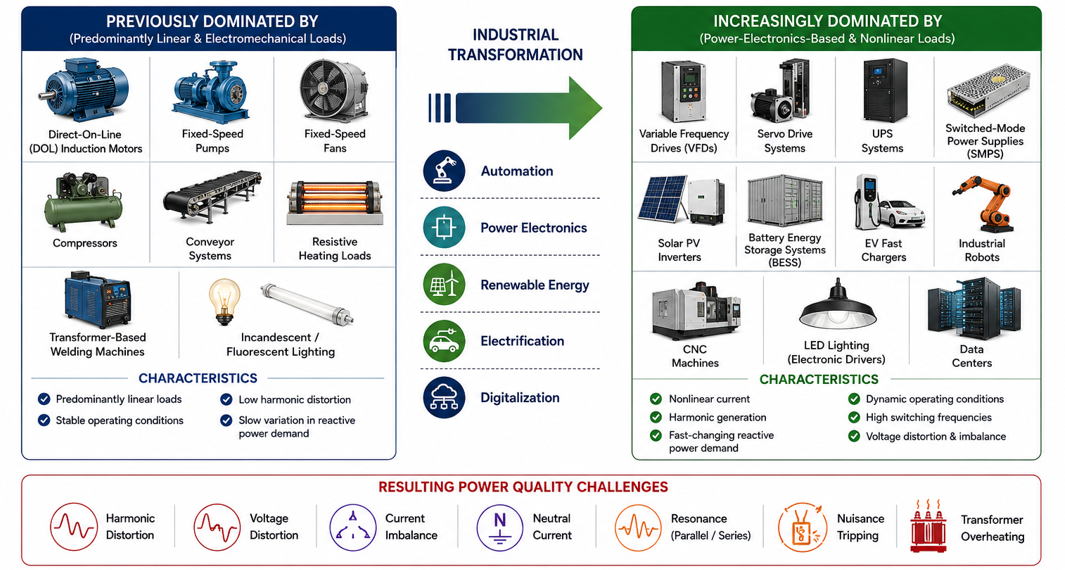
For many years, capacitor banks and passive harmonic filters provided effective solutions for conventional industrial installations. Their operating principles were well suited to electrical networks where loads changed gradually and harmonic levels remained relatively low. However, modern electrical systems rarely operate under such conditions. Automated production lines, high-speed servo drives, renewable energy integration and continuously varying industrial processes demand compensation systems capable of responding within milliseconds while simultaneously addressing multiple power quality issues.
This changing electrical environment has accelerated the development of two advanced compensation technologies: Active Harmonic Filters (AHFs) and Static VAR Generators (SVGs). The technological evolution of Active Harmonic Filters and Static VAR Generators has been driven by continuous innovation in power electronics, digital control and system engineering. Companies such as InPhase Power Technologies have contributed to this advancement by developing intelligent power quality solutions that combine high-performance converter technology, advanced control algorithms and modular architectures to address the evolving requirements of modern industrial electrical systems.
These developments represent more than incremental product improvements. They reflect a fundamental shift in the philosophy of power quality compensation. Modern compensation systems are no longer designed solely to correct power factor or reduce harmonic distortion. They are increasingly expected to function as intelligent power quality platforms capable of monitoring, analysing and responding to continuously changing electrical conditions in real time.
This article examines the major modern trends shaping Active Harmonic Filters and Static VAR Generators from an engineering perspective. Instead of presenting a catalogue of product features, it explores why these technologies have evolved, the engineering principles driving their development, and the practical benefits they offer to modern industrial power systems. Each trend is supported, where appropriate, by mathematical analysis, engineering calculations, technical comparisons and practical examples to provide a comprehensive understanding of the technologies defining the next generation of power quality solutions.
Article Structure
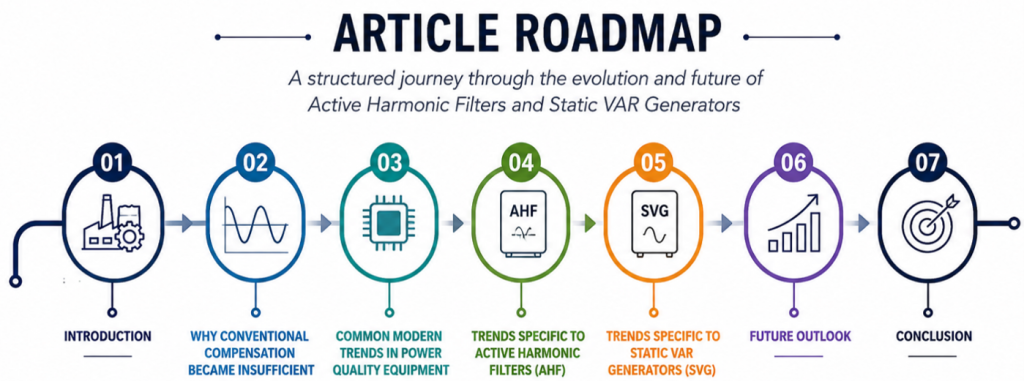
The following sections guide the reader from the evolution of industrial power quality challenges to the latest technological trends shaping modern Active Harmonic Filters and Static VAR Generators.
Why Conventional Compensation Became Insufficient
For several decades, conventional compensation methods such as capacitor banks and passive filters successfully addressed the power quality requirements of industrial electrical systems. Their effectiveness was based on one important assumption: industrial loads were predominantly linear, operating conditions changed relatively slowly, and reactive power demand remained reasonably stable. Under these conditions, step-wise reactive power compensation was technically adequate and economically attractive.
That assumption no longer reflects today’s industrial environment.
Modern electrical networks are increasingly dominated by Variable Frequency Drives (VFDs), servo systems, UPS units, renewable energy converters, battery energy storage systems (BESS), EV charging infrastructure and other power-electronic-based equipment. While these technologies improve process efficiency and controllability, they also introduce operating characteristics that conventional compensation systems were never designed to handle.
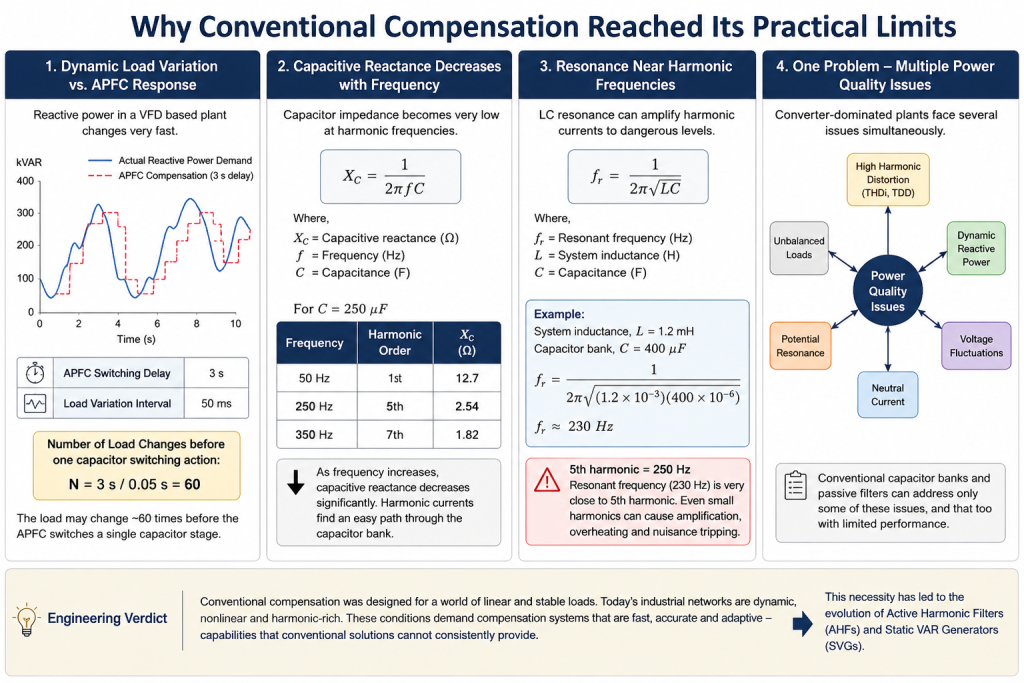
One of the most significant changes is the dynamic nature of reactive power demand. Consider an industrial production line where the reactive power requirement fluctuates between 80 kVAR and 320 kVAR as multiple VFDs and servo drives continuously accelerate, decelerate and change operating conditions. A conventional APFC panel with a typical switching delay of 3 seconds attempts to compensate a system whose electrical characteristics may change every 50 ms.
The mismatch can be quantified as:
Number of Load Changes (N) = APFC Response Time / Load Variation Interval
N = 3 s ÷ 0.05 s = 60
where:
- 3 s = APFC switching delay
- 0.05 s (50 ms) = Load variation interval
This indicates that the electrical load may change approximately 60 times before a single capacitor stage is switched. Consequently, the compensation system is continuously responding to previous operating conditions rather than the present electrical state of the network.
Dynamic reactive power is only part of the challenge.
The increasing penetration of nonlinear loads has significantly increased harmonic current levels in many industrial installations. Capacitor banks exhibit a frequency-dependent impedance described by:
Capacitive Reactance
XC = 1 / (2πfC)
where:
- XC = Capacitive Reactance (Ω)
- f = Frequency (Hz)
- C = Capacitance (F)
For a capacitor of 250 μF, the capacitive reactance is:
| Frequency | Reactance |
|---|---|
| 50 Hz | 12.7 Ω |
| 250 Hz (5th Harmonic) | 2.54 Ω |
| 350 Hz (7th Harmonic) | 1.82 Ω |
As frequency increases, capacitive reactance decreases substantially. Consequently, harmonic currents encounter a progressively lower impedance path through the capacitor bank. While capacitors do not generate harmonics, they can unintentionally attract and amplify existing harmonic currents when installed in networks containing significant nonlinear loads.
An additional challenge arises from system resonance. Every electrical network possesses inherent inductance contributed by transformers, cables and other inductive components. When capacitor banks are connected, the combined inductance-capacitance (LC) network exhibits a natural resonant frequency:
Resonant Frequency
fr = 1 / (2π√LC)
where:
- fr = Resonant Frequency (Hz)
- L = System Inductance (H)
- C = Capacitance (F)
If this resonant frequency approaches a dominant harmonic frequency, harmonic amplification may occur, resulting in excessive capacitor currents, transformer overheating, nuisance tripping and reduced equipment life. Consequently, simply increasing capacitor capacity is not always an effective solution for improving power quality in converter-dominated installations.
Conventional compensation technologies have not become obsolete. They continue to provide an efficient and economical solution for electrical systems dominated by linear and relatively stable loads. However, the electrical characteristics of modern industrial networks have evolved beyond the operating conditions for which these technologies were originally developed. This evolution has driven the development of actively controlled compensation systems capable of responding in real time to rapidly changing power quality conditions.
Common Modern Trends in AHF & SVG
The rapid evolution of Active Harmonic Filters (AHFs) and Static VAR Generators (SVGs) has been driven by advances in power electronics, semiconductor technology and digital control systems. While these technologies perform different functions, they share a common objective: to continuously analyse electrical conditions and respond in real time with a level of speed and accuracy that conventional compensation methods cannot achieve.
Several technological developments have played a crucial role in this transformation. Digital Signal Processing (DSP), advanced control algorithms, multilevel converter topologies, wide-bandgap semiconductor devices and intelligent communication platforms have collectively redefined the performance, flexibility and reliability of modern power quality equipment.
The following sections examine these common technological trends and explain how each has contributed to the evolution of next-generation power quality solutions.
1. Digital Signal Processing (DSP): The Intelligence Behind Modern Compensation
One of the most significant developments in modern Active Harmonic Filters and Static VAR Generators has been the transition from conventional analogue control circuits and low-performance microcontrollers to high-speed Digital Signal Processors (DSPs). This transition was not driven by technological advancement alone; it was driven by the increasing complexity of modern electrical networks.
Conventional compensation systems primarily responded to slowly varying electrical conditions. Modern compensation systems operate in an environment where harmonic content, reactive power demand and load conditions may change several times within a single electrical cycle. Detecting these changes, analysing them and generating an appropriate compensation signal requires computational capabilities that conventional controllers cannot provide.
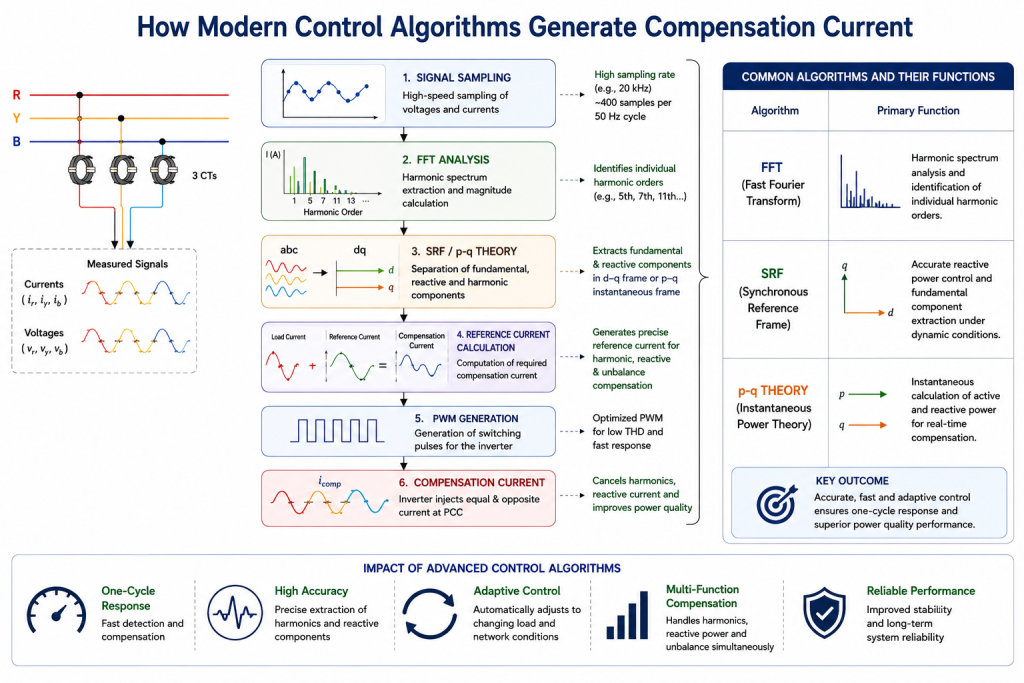
A DSP continuously acquires three-phase voltage and current signals from the electrical network through voltage and current sensors. These analogue signals are converted into digital values by high-speed Analog-to-Digital Converters (ADCs), allowing the controller to analyse the electrical system in real time. Advanced algorithms identify the fundamental current component, separate harmonic and reactive current components, calculate the required compensation current and generate Pulse Width Modulation (PWM) signals to control the power converter.
The effectiveness of this approach depends largely on the controller’s sampling capability.
Consider a system operating at 50 Hz with a DSP sampling frequency of 20 kHz.
The duration of one electrical cycle is:
T = 1 / f
T = 1 / 50 = 0.02 s = 20 ms
The number of measurements obtained during one cycle is:
Number of Samples = Sampling Frequency × Cycle Time
Number of Samples = 20,000 × 0.02 = 400 Samples
This means the controller receives approximately 400 measurement points during every electrical cycle, enabling it to detect waveform distortions, calculate compensation currents and respond before significant power quality deterioration occurs.
The increasing computational capability of modern DSP platforms has also enabled the implementation of advanced harmonic detection techniques, adaptive control algorithms, multifunction compensation strategies and one-cycle response times that were previously impractical using conventional control hardware.
Engineering Perspective
The evolution from analogue controllers to Digital Signal Processors represents more than a hardware upgrade. It marks the transition from fixed-function compensation systems to intelligent platforms capable of continuously measuring, analysing and adapting to changing electrical conditions. As industrial networks become increasingly dynamic, controller performance has become just as important as the power converter itself.
2. The Shift Towards Three-Level Converter Topologies
As the performance expectations of Active Harmonic Filters (AHFs) and Static VAR Generators (SVGs) continued to increase, conventional two-level voltage source converters began approaching their practical limits. Higher switching frequencies, lower harmonic distortion, improved efficiency and higher power ratings demanded converter architectures capable of delivering superior electrical performance without significantly increasing switching losses.
This requirement has accelerated the adoption of three-level converter topologies, making them one of the most significant trends in modern power quality equipment.
Unlike a conventional two-level converter, where each phase output switches directly between +Vdc/2 and −Vdc/2, a three-level converter introduces an additional voltage level at 0 V. This produces an output waveform closer to a sine wave, reducing voltage step magnitude (dv/dt), switching ripple and converter-generated harmonics. Additionally, each switching device blocks only half the DC bus voltage, reducing switching stress, lowering losses and improving overall efficiency.
The reduction in voltage step can be illustrated simply.
For a DC bus voltage of 800 V:
Two-Level Converter
Output transitions:
+400 V → −400 V
Voltage step:
ΔV = 800 V
Three-Level Converter
Output transitions:
+400 V → 0 V → −400 V
Maximum voltage step:
ΔV = 400 V
The maximum switching voltage experienced during each transition is therefore reduced by 50%.
This topology offers several engineering advantages. The additional voltage level reduces dv/dt, switching ripple and converter-generated harmonics, resulting in lower electromagnetic interference (EMI), reduced insulation stress and lower switching losses. It also enables the output LCL filter to achieve lower Total Harmonic Distortion (THD) more efficiently.
Another key advantage is reduced voltage stress across individual switching devices. In a three-level converter, the DC bus voltage is shared among multiple semiconductor devices, allowing lower-voltage switches with improved switching performance, higher efficiency and better thermal reliability. These benefits make three-level converters the preferred choice for modern Active Harmonic Filters (AHFs) and Static VAR Generators (SVGs) used in high-power industrial applications.
| Parameter | Two-Level | Three-Level |
|---|---|---|
| Voltage Levels | 2 | 3 |
| Maximum Voltage Step | 800 V | 400 V |
| dv/dt | Higher | Lower |
| Switching Losses | Higher | Lower |
| Output Waveform | Coarser | Closer to Sinusoidal |
| THD Performance | Good | Better |
Engineering Perspective
The transition from two-level to three-level converter topologies represents more than an incremental hardware improvement. It fundamentally improves waveform quality, reduces electrical stress on power electronic devices and enables higher switching performance with lower losses. For modern power quality equipment, this architectural shift has become a key enabler for achieving high efficiency, low harmonic distortion and reliable long-term operation.
3. Evolution of Advanced Control Algorithms
High-speed Digital Signal Processors (DSPs) alone cannot improve power quality; their performance depends on the control algorithms used to analyse electrical signals and generate the required compensation current. As industrial power systems became more dynamic, conventional fixed compensation strategies were no longer adequate, leading to the adoption of advanced digital control algorithms capable of responding within a single electrical cycle.
Modern Active Harmonic Filters (AHFs) and Static VAR Generators (SVGs) continuously monitor three-phase voltage and current, separating load current into harmonic, reactive and unbalanced components. The controller then calculates the precise reference current required for effective compensation.
Several algorithms are widely used in commercial power quality equipment. Fast Fourier Transform (FFT) identifies the magnitude and order of harmonic components, Synchronous Reference Frame (SRF) control transforms three-phase quantities into rotating d-q coordinates for accurate reactive power control, while Instantaneous Power Theory (p-q Theory) calculates instantaneous active and reactive power for real-time harmonic and reactive current compensation.
Modern DSPs execute these algorithms at high sampling rates. For example, at 20 kHz, approximately 400 samples are acquired during each 50 Hz electrical cycle, allowing the controller to analyse system conditions, calculate the reference current and update PWM signals in real time.
Rather than relying on a single technique, many modern AHFs and SVGs combine multiple control algorithms with adaptive tuning to maintain high compensation accuracy under varying load and network conditions.
Engineering Perspective
The evolution of control algorithms has transformed power quality equipment from simple compensation devices into intelligent real-time control systems. While the DSP provides the computational platform, advanced algorithms determine how effectively the system identifies disturbances and generates accurate compensation currents. Consequently, control software has become just as critical to overall performance as the converter hardware itself.
4. Modular Architecture: Building Scalable and Reliable Power Quality Systems
As industrial facilities expand, harmonic levels and reactive power demand rarely remain constant. New production lines, Variable Frequency Drives (VFDs), EV charging infrastructure and renewable energy integration often require higher compensation capacity. Modern Active Harmonic Filters (AHFs) and Static VAR Generators (SVGs) therefore adopt a modular architecture, allowing systems to grow without replacing the complete installation.
Unlike conventional fixed-capacity systems, modular designs consist of multiple independent power modules operating in parallel under a central controller. For example, the InPhase Micro BHEEM Modular Active Harmonic Filter is available in 36 A, 75 A, 100 A, 150 A and 210 A modules, enabling engineers to size the system according to the application’s harmonic compensation requirements.
Consider an installation initially requiring 150 A of harmonic compensation. This requirement can be met using a single 150 A Micro BHEEM AHF module. If the facility later expands and the compensation requirement increases to 250 A, the system can be upgraded simply by adding a 100 A module, increasing the total capacity to 250 A without replacing the existing installation.
Similarly, InPhase Micro BHEEM Modular Static VAR Generators are available in 25 kVAR, 50 kVAR, 70 kVAR, 100 kVAR and 150 kVAR modules. Engineers can increase reactive power compensation by adding additional SVG modules as plant demand grows, providing a flexible and scalable solution for changing electrical networks.
Modular architecture also improves system availability. Since each module operates independently, the remaining modules continue providing compensation even if one module is temporarily unavailable. Maintenance can often be performed by replacing a single module rather than shutting down the entire system.
Engineering Perspective
Modular architecture combines scalability, reliability and simplified maintenance, making it the preferred design approach for modern power quality equipment. By allowing compensation capacity to expand using standard module ratings, it minimizes lifecycle costs while ensuring the electrical system can adapt to future growth without major redesign.
5.Advancements in Power Semiconductor Technology
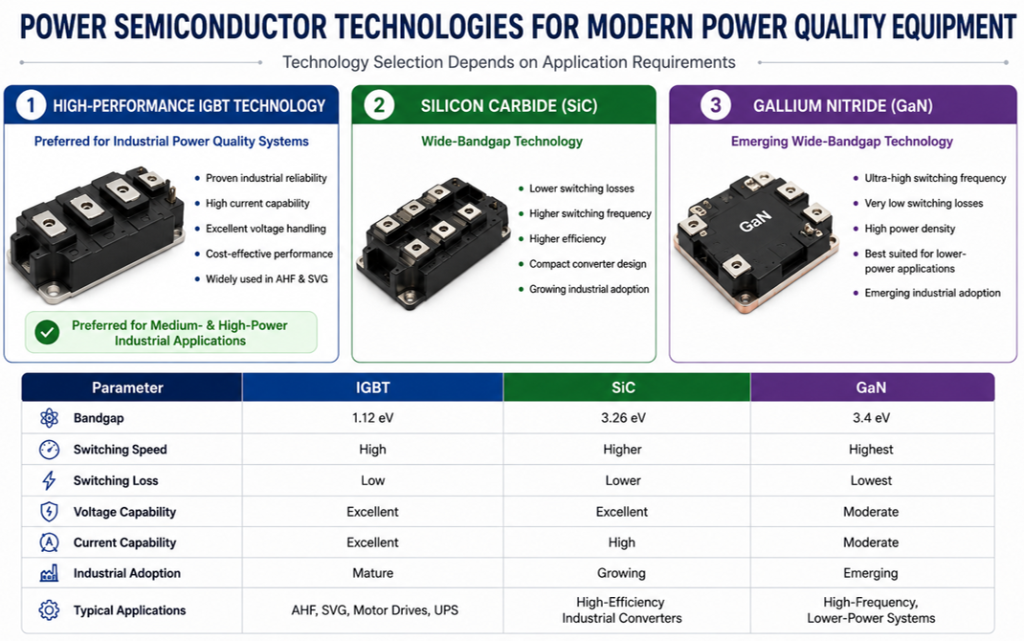
Power semiconductor devices are the foundation of modern Active Harmonic Filters (AHFs) and Static VAR Generators (SVGs). Their switching characteristics directly influence converter efficiency, harmonic compensation accuracy, thermal performance and overall system reliability. As power electronics continue to evolve, manufacturers can choose from multiple semiconductor technologies, each offering distinct advantages depending on the application.
For medium- and high-power industrial power quality equipment, high-performance Insulated Gate Bipolar Transistors (IGBTs) remain the most widely adopted technology. They provide an excellent balance of voltage capability, current handling, switching performance, proven reliability and cost-effectiveness. Operating at high switching frequencies, modern IGBTs enable converters to generate output waveforms that closely approximate a sinusoid, reducing harmonic distortion while improving compensation accuracy and overall power quality.
Silicon Carbide (SiC) devices represent the next generation of wide-bandgap semiconductors. Compared with conventional silicon devices, SiC offers lower switching losses, higher switching frequencies and improved efficiency, enabling more compact converter designs with reduced cooling requirements. These advantages have accelerated their adoption in high-efficiency industrial converters.
Another emerging wide-bandgap technology is Gallium Nitride (GaN). GaN devices offer extremely high switching speeds and very low switching losses, making them particularly suitable for high-frequency, lower-power applications. Although their industrial adoption is increasing, they are currently used less frequently than IGBTs and SiC devices in medium- and high-power power quality equipment.
Rather than replacing one another, these semiconductor technologies serve different application requirements. The selection depends on factors such as voltage level, current rating, switching frequency, efficiency targets and overall system cost.
Industry Perspective
InPhase Power Technologies employs advanced IGBT-based converter technology in its Active Harmonic Filters and Static VAR Generators, delivering proven industrial reliability, high current capability and efficient power conversion for demanding harmonic mitigation and dynamic reactive power compensation applications.
Engineering Perspective
Power semiconductor selection is a critical design decision that directly influences converter efficiency, switching performance, thermal management and long-term reliability. While IGBTs, Silicon Carbide (SiC) and Gallium Nitride (GaN) each offer distinct advantages, the optimal choice depends on application requirements such as voltage level, current rating, switching frequency and efficiency targets. Selecting the appropriate semiconductor technology enables modern power quality equipment to achieve reliable operation, high efficiency and superior compensation performance.
6. Industry 4.0 Integration and Smart Connectivity
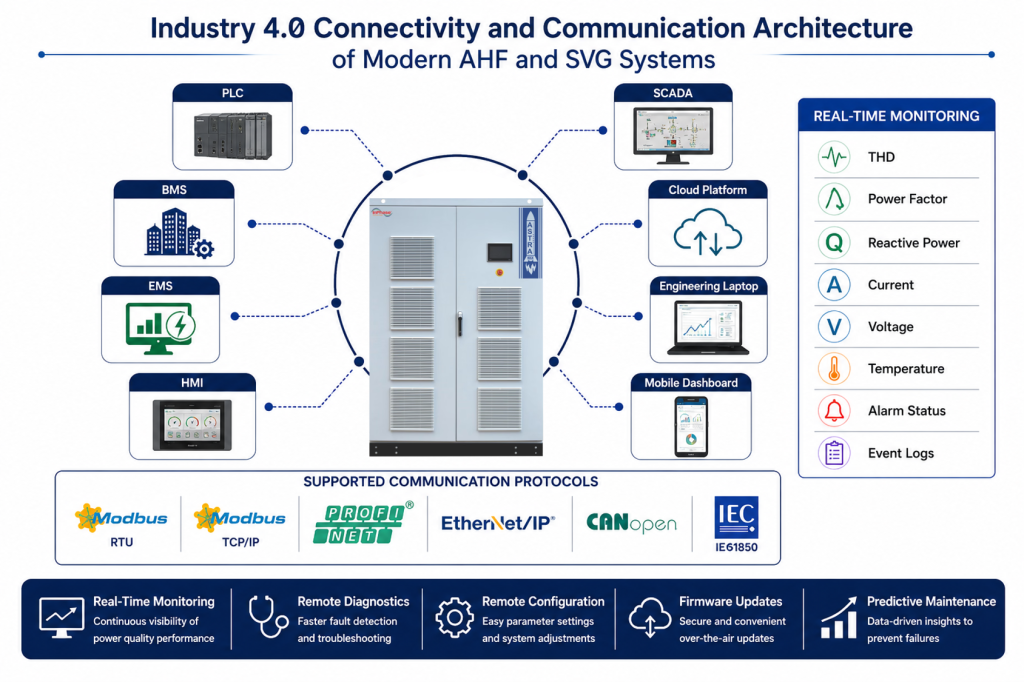
Modern Active Harmonic Filters (AHFs) and Static VAR Generators (SVGs) have evolved from standalone compensation devices into intelligent components of Industry 4.0 electrical infrastructures. Real-time communication, remote monitoring and seamless integration with automation systems are now essential requirements for efficient power quality management.
Unlike conventional systems with limited local indication, modern AHF and SVG solutions continuously exchange operational data with PLCs, SCADA, Building Management Systems (BMS) and Energy Management Systems (EMS). Industrial communication protocols such as Modbus RTU, Modbus TCP/IP, PROFINET, EtherNet/IP, CANopen and IEC 61850 enable seamless integration with existing automation and electrical networks.
This connectivity allows engineers to monitor Total Harmonic Distortion (THD), power factor, reactive power compensation, load current, module status, temperature, alarms and fault history in real time. Continuous access to operational data supports faster fault diagnosis, predictive maintenance, remote commissioning and firmware updates, reducing downtime and improving system reliability.
As industrial facilities continue their digital transformation, modern AHFs and SVGs function as intelligent nodes within connected electrical networks, enabling improved visibility, operational efficiency and data-driven maintenance.
Engineering Perspective
The evolution of communication technology has transformed modern AHF and SVG systems from isolated compensation equipment into connected assets that actively contribute to industrial automation, energy management and predictive maintenance strategies. Connectivity has therefore become a key enabler of smarter, more efficient and highly reliable power quality management.
7. Cloud-Based Monitoring and Predictive Maintenance
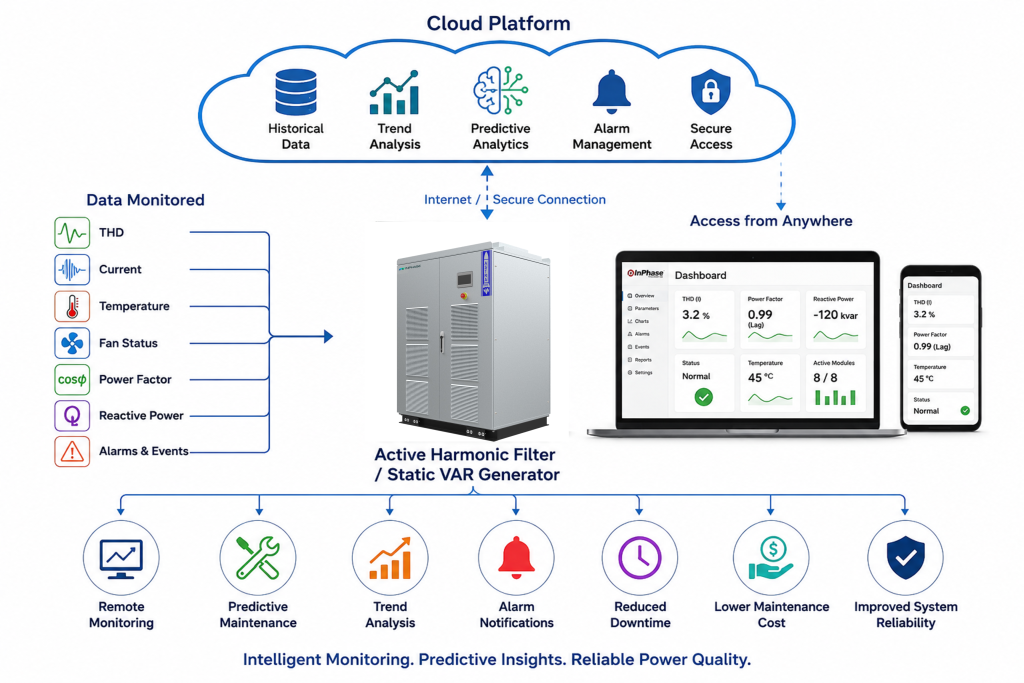
One of the most significant advancements in modern Active Harmonic Filters (AHFs) and Static VAR Generators (SVGs) is the shift from reactive to predictive maintenance. Instead of relying on periodic inspections or responding only after a fault occurs, cloud-connected systems continuously monitor equipment health and electrical performance in real time.
Modern AHF and SVG solutions collect operational data such as Total Harmonic Distortion (THD), power factor, reactive power compensation, load current, DC bus voltage, IGBT temperature, cooling fan status, module availability and alarm history. This data is securely transmitted to cloud platforms, enabling engineers to monitor system performance remotely through web dashboards or mobile applications.
By analysing historical operating trends, cloud platforms can identify gradual performance degradation before a failure occurs. For example, a steady rise in IGBT temperature or abnormal cooling fan operation may indicate declining cooling performance, while increasing harmonic compensation demand can signal expanding nonlinear loads and the need for future capacity upgrades.
This predictive approach enables condition-based maintenance, reducing unplanned downtime, lowering maintenance costs and extending the service life of critical power electronic components. For industries where continuous operation is essential, cloud monitoring also simplifies troubleshooting, improves asset management and enhances overall system reliability.
As industrial digitalization accelerates, cloud connectivity has become an integral feature of intelligent power quality equipment, enabling more efficient lifecycle management and data-driven maintenance decisions.
Engineering Perspective
Cloud connectivity transforms modern Active Harmonic Filters and Static VAR Generators from maintenance-intensive equipment into intelligent, self-monitoring assets. By combining continuous power quality monitoring, historical trend analysis and predictive maintenance, modern systems improve reliability, reduce operational costs and maximize equipment availability in critical industrial applications.
8. Artificial Intelligence, Machine Learning and Self-Adaptive Control
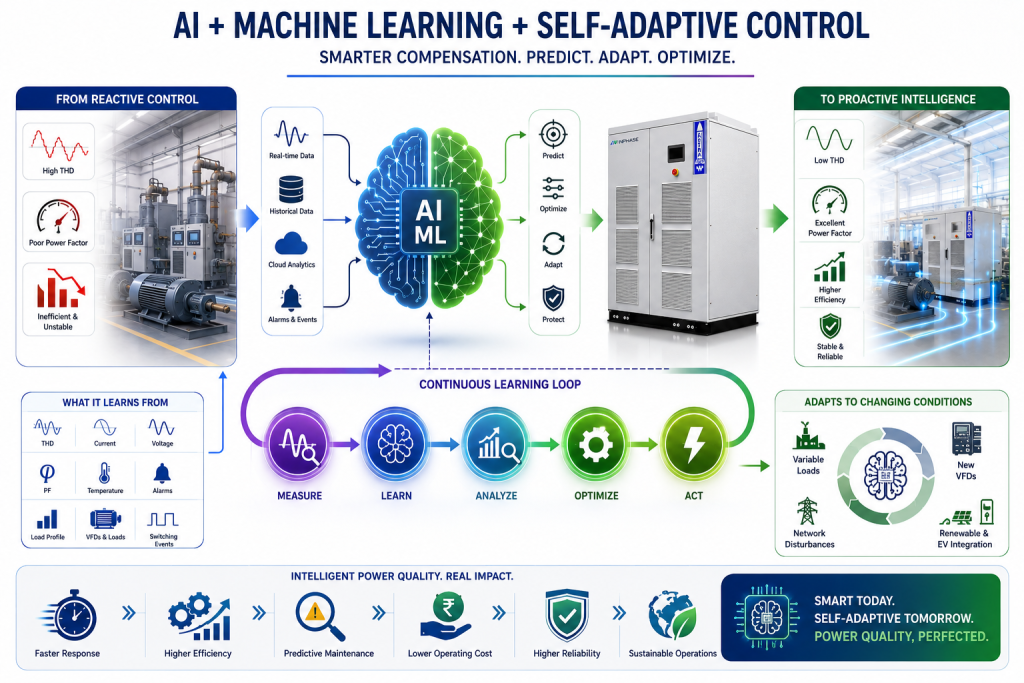
Artificial Intelligence (AI) and Machine Learning (ML) are emerging as the next frontier in Active Harmonic Filters (AHFs) and Static VAR Generators (SVGs). While today’s commercial systems primarily rely on high-speed Digital Signal Processing (DSP) algorithms for harmonic mitigation and reactive power compensation, advances in AI are enabling more intelligent, adaptive and predictive power quality solutions.
Unlike conventional controllers that respond only to present electrical conditions using predefined control parameters, AI-enabled systems analyse historical operating data, recognize recurring load patterns and continuously optimize compensation strategies as network conditions evolve.
For example, an industrial facility may experience a predictable increase in harmonic distortion every weekday morning when multiple Variable Frequency Drives (VFDs) and production lines start simultaneously. After learning this operating pattern, an AI-assisted controller can anticipate the increased harmonic demand and optimize compensation before harmonic levels peak, improving power quality and system stability.
Machine Learning also enhances equipment diagnostics by continuously analysing parameters such as Total Harmonic Distortion (THD), current imbalance, IGBT temperature, cooling system performance, switching frequency and historical alarms. By identifying subtle deviations from normal operating conditions, AI enables earlier fault detection and more effective predictive maintenance.
Modern AI-assisted controllers are also moving toward self-adaptive compensation. Instead of relying on manual parameter adjustments after commissioning, the controller continuously evaluates harmonic spectra, reactive power demand and compensation performance to refine its operating strategy automatically. If additional nonlinear loads or VFDs are introduced over time, the system can adapt its compensation strategy to maintain low THD and stable power factor without manual retuning.
Another emerging capability is adaptive optimization, where AI continuously learns load characteristics, distinguishes between normal and abnormal operating conditions and optimizes current control, switching strategies and compensation priorities. This improves compensation accuracy, reduces unnecessary switching, enhances converter efficiency and supports long-term system reliability.
Although AI-assisted and fully autonomous power quality systems are still evolving, these technologies represent one of the most significant trends in modern industrial power quality solutions. As AI, Machine Learning and high-performance DSP platforms continue to advance, future AHFs and SVGs are expected to become increasingly self-optimizing, delivering maximum harmonic mitigation, dynamic reactive power compensation and predictive maintenance with minimal human intervention.
Engineering Perspective
The future of power quality equipment extends beyond faster hardware to intelligent control. By combining DSP, Artificial Intelligence and Machine Learning, next-generation AHFs and SVGs will not only compensate harmonics and reactive power in real time but also learn from operating conditions, predict disturbances and continuously optimize their own performance, improving efficiency, reliability and long-term system availability.
Industry Perspective
The technological advancements discussed throughout this section are increasingly reflected in commercial power quality solutions. Modern systems developed by InPhase Power Technologies incorporate technologies such as DSP-based control, three-level converter topology, modular architecture, Industry 4.0 connectivity and intelligent compensation algorithms to deliver reliable, efficient and future-ready power quality solutions for industrial applications.
Modern Trends Specific to Active Harmonic Filters (AHFs)
While many technological developments-such as Digital Signal Processing (DSP), three-level converter topologies and Artificial Intelligence (AI)-benefit both Active Harmonic Filters (AHFs) and Static VAR Generators (SVGs), Active Harmonic Filters have also undergone significant technology-specific advancements. Modern AHFs are no longer limited to harmonic current mitigation alone. They have evolved into intelligent multifunctional power quality devices capable of addressing a broader range of electrical disturbances with higher accuracy, faster response and greater operational flexibility.
Driven by the rapid growth of nonlinear loads, increasing compliance with IEEE 519, stricter power quality requirements and the expansion of highly automated industrial facilities, manufacturers continue to enhance the performance and capabilities of Active Harmonic Filters. Improvements in harmonic detection, dynamic response, operating modes and multifunction compensation have significantly expanded the role of AHFs in modern industrial power systems.
The following sections examine the key technological trends that are shaping the next generation of Active Harmonic Filters.
1. Higher Harmonic Compensation Capability
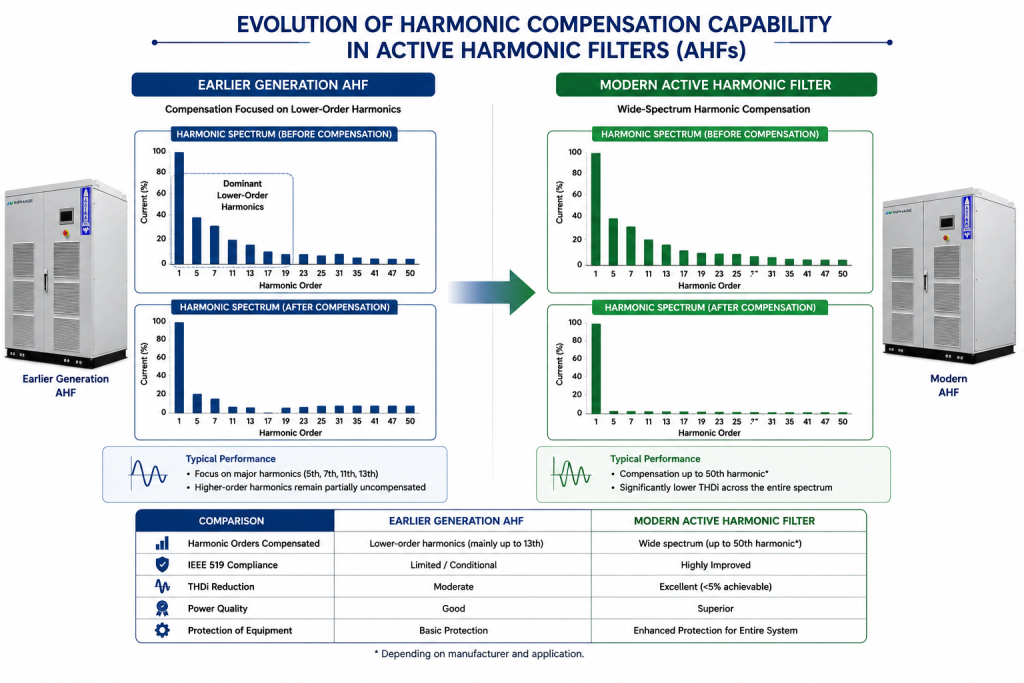
The rapid adoption of Variable Frequency Drives (VFDs), switched-mode power supplies, UPS systems, industrial robotics and renewable energy converters has significantly increased harmonic distortion in modern electrical networks. Unlike earlier installations dominated by lower-order harmonics (5th, 7th, 11th and 13th), today’s industrial facilities generate a much wider harmonic spectrum due to diverse nonlinear loads operating at different switching frequencies.
To address these evolving power quality challenges, modern Active Harmonic Filters (AHFs) compensate harmonic currents up to the 50th harmonic, with some advanced systems supporting even higher harmonic orders depending on the application. This wider compensation capability helps achieve IEEE 519 compliance, reduce Total Harmonic Distortion (THD) and protect transformers, cables, switchgear and other critical electrical equipment.
The effectiveness of harmonic mitigation is commonly evaluated using Total Harmonic Current Distortion (THDi).
THDi (%) = [ √(I₂² + I₃² + I₄² + … + Iₙ²) / I₁ ] × 100
Where:
- I₁ = Fundamental current
- I₂–Iₙ = Harmonic current components
Example Calculation
Consider an industrial feeder with:
- Fundamental current = 500 A
- Harmonic current = 175 A
THDi = (175 ÷ 500) × 100
After installing an appropriately sized InPhase Active Harmonic Filter, the harmonic current is reduced to 20 A.
THDi = (20 ÷ 500) × 100
THDi = 4%
This reduces THDi from 35% to 4%, enabling compliance with the IEEE 519 recommended limit of less than 5% at the Point of Common Coupling (PCC) while improving overall power quality and reducing thermal stress on critical electrical equipment.
Industry Perspective
InPhase Active Harmonic Filters are engineered to compensate a wide harmonic spectrum, enabling reliable operation in facilities with continuously changing nonlinear loads while helping maintain low THDi and long-term compliance with IEEE 519.
Engineering Perspective
The evolution from compensating only lower-order harmonics to providing wide-spectrum harmonic mitigation represents one of the most significant advancements in Active Harmonic Filter technology. Higher harmonic compensation capability enables improved IEEE 519 compliance, lower THDi, greater equipment reliability and more effective protection of modern industrial electrical systems.
2. Ultra-Fast Dynamic Response
One of the most significant advancements in modern Active Harmonic Filters (AHFs) is their ability to respond almost instantaneously to rapidly changing harmonic currents. As industrial facilities increasingly rely on Variable Frequency Drives (VFDs), welding machines, robotics, UPS systems and other nonlinear loads, harmonic distortion can change within milliseconds, requiring real-time compensation to maintain stable power quality.
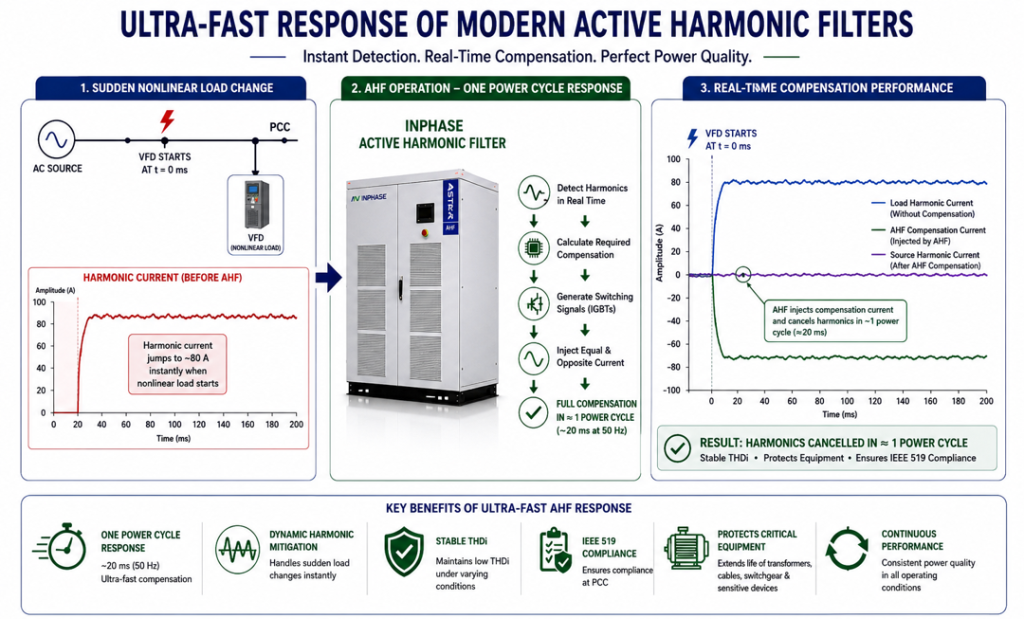
Unlike conventional compensation methods that operate using fixed electrical characteristics or discrete switching, modern AHFs continuously measure load current through Current Transformers (CTs), analyse the harmonic spectrum using high-speed Digital Signal Processing (DSP) and inject an equal and opposite harmonic current through a voltage source inverter. This closed-loop process enables harmonic mitigation within approximately one power cycle (≈20 ms at 50 Hz), although actual response time depends on the controller architecture and manufacturer.
This ultra-fast response minimizes temporary increases in Total Harmonic Distortion (THD) during sudden load changes, helping maintain IEEE 519 compliance while protecting transformers, cables, switchgear and other critical electrical equipment.
Industry Perspective
Modern InPhase Active Harmonic Filters deliver one power cycle response, providing continuous harmonic mitigation for dynamic industrial environments such as data centres, semiconductor manufacturing, automotive plants and highly automated production facilities.
Engineering Perspective
The transition from slow, step-based compensation to continuous real-time current injection represents one of the defining characteristics of modern Active Harmonic Filter technology. Ultra-fast response enables effective harmonic mitigation under highly dynamic operating conditions, ensuring stable power quality, lower THDi and improved electrical system reliability.
3. Multi-Function Operating Modes
Early Active Harmonic Filters (AHFs) were primarily designed for a single purpose: harmonic current mitigation. Their control algorithms focused exclusively on detecting harmonic currents and injecting equal but opposite compensation currents to reduce Total Harmonic Distortion (THD). While effective for harmonic suppression, these systems could not address other power quality issues such as reactive power demand or current imbalance.
Modern Active Harmonic Filters have evolved into multifunctional power quality devices capable of operating in multiple compensation modes. Rather than performing a single task, advanced AHFs can dynamically allocate their available compensation capacity to meet different power quality requirements depending on system operating conditions.
The three most common operating modes are:
1. Harmonic Compensation Mode
In this mode, the entire converter capacity is dedicated to harmonic mitigation. The controller continuously measures harmonic currents and injects compensation currents to minimize THDi, helping industrial facilities comply with IEEE 519 while protecting transformers, cables and other electrical equipment.
2. Reactive Power Compensation Mode
When harmonic levels are relatively low, the same Active Harmonic Filter can utilize its converter capacity to provide dynamic reactive power compensation. This improves the overall power factor, reduces reactive power demand and minimizes utility penalties without requiring a separate compensation device.
3. Hybrid Compensation Mode
The most advanced systems operate in Hybrid Mode, where converter capacity is intelligently shared between harmonic mitigation and reactive power compensation. The controller continuously evaluates electrical network conditions and dynamically prioritizes compensation based on real-time system requirements.
For example, during periods of high harmonic distortion, a larger proportion of converter capacity may be allocated to harmonic compensation. As harmonic levels decrease, unused capacity can automatically be redirected toward reactive power compensation, maximizing overall utilization of the converter.
This operational flexibility allows a single Active Harmonic Filter to solve multiple power quality problems simultaneously, reducing equipment count, simplifying installation and improving the return on investment for industrial facilities.
Engineering Perspective
The evolution from single-function harmonic filters to multifunction compensation platforms represents one of the most important developments in modern Active Harmonic Filter technology. By intelligently allocating converter capacity between harmonic mitigation and reactive power compensation, modern AHFs provide greater operational flexibility, improved equipment utilization and enhanced overall power quality.
4. Simultaneous Compensation of Multiple Power Quality Problems
Modern industrial electrical systems rarely suffer from a single power quality issue. Facilities containing Variable Frequency Drives (VFDs), UPS systems, servo drives, welding equipment and renewable energy converters often experience multiple disturbances simultaneously, including harmonic distortion, poor power factor, current imbalance and neutral current. Addressing each issue using separate compensation devices increases installation complexity, panel space requirements and overall project cost.
Earlier generations of Active Harmonic Filters (AHFs) primarily focused on harmonic mitigation. Modern AHFs, however, have evolved into multifunction power quality solutions capable of compensating several electrical disturbances simultaneously through a single converter platform.
Using high-speed Digital Signal Processing (DSP) and advanced control algorithms, the controller continuously analyses the three-phase electrical network and independently identifies harmonic currents, reactive current components, phase imbalance and neutral current. The converter then generates precisely controlled compensation currents that address multiple power quality issues in real time.
A modern Active Harmonic Filter can typically provide:
- Harmonic Mitigation – Reduces current harmonic distortion and supports IEEE 519 compliance.
- Reactive Power Compensation – Improves power factor and minimizes utility penalties.
- Current Balancing – Reduces phase current imbalance, improving transformer loading and overall system stability.
- Neutral Current Compensation – Cancels excessive neutral current caused by triplen harmonics in four-wire systems, reducing conductor overheating and improving electrical safety.
The ability to perform these functions simultaneously significantly simplifies electrical system design. Instead of installing separate harmonic filters, capacitor banks and balancing equipment, a single Active Harmonic Filter can deliver comprehensive power quality improvement while reducing installation footprint, commissioning effort and maintenance requirements.
This multifunction capability is particularly valuable in commercial buildings, data centres, hospitals, semiconductor facilities and modern manufacturing plants where electrical loads continuously change and multiple power quality issues coexist.
Engineering Perspective
The evolution toward simultaneous multi-parameter compensation has transformed the Active Harmonic Filter from a dedicated harmonic mitigation device into a comprehensive industrial power quality solution. By correcting harmonics, reactive power, current imbalance and neutral current simultaneously, modern AHFs provide greater system reliability, improved energy efficiency and simplified electrical infrastructure.
5. Higher Current Ratings and Scalable Modular Systems
As industrial facilities continue to expand, electrical loads rarely remain constant throughout the lifetime of a plant. Production capacity increases, additional Variable Frequency Drives (VFDs) are installed, new production lines are commissioned and renewable energy systems are integrated into existing electrical networks. Consequently, the harmonic compensation capacity required today may no longer be sufficient a few years later.
Earlier Active Harmonic Filters (AHFs) were typically manufactured as fixed-capacity units. When the harmonic load exceeded the rated compensation current, expanding the system often required replacing the entire filter with a larger unit. This increased project cost, installation time and operational downtime.
Modern Active Harmonic Filters increasingly adopt modular architectures, allowing compensation capacity to be expanded incrementally by adding additional power modules rather than replacing the complete system. Each module operates in parallel under a common controller, sharing compensation current automatically while maintaining synchronized operation.
For example, an industrial facility may initially require 150 A of harmonic compensation. Instead of installing a significantly oversized system, the plant can begin with two 75 A modules. If future expansion increases the harmonic load to 250 A, additional modules can simply be installed without modifying the existing electrical infrastructure.
The scalability of modular AHFs provides several important engineering advantages:
- Incremental capacity expansion as plant loads grow.
- Redundancy, allowing remaining modules to continue operating if one module is removed for maintenance.
- Simplified maintenance, since individual modules can be serviced or replaced without shutting down the complete system.
- Higher availability, reducing downtime in critical industrial applications.
- Lower lifecycle cost, eliminating the need to replace entire systems during future expansions.
Modern modular architectures also simplify transportation, installation and commissioning, particularly in high-current applications where a single large converter would be difficult to handle. As a result, scalable modular Active Harmonic Filters are increasingly used in steel plants, cement plants, data centres, semiconductor facilities, renewable energy installations and other large industrial applications requiring continuous power quality improvement.
Engineering Perspective
The transition from fixed-capacity equipment to scalable modular architectures represents one of the most significant developments in modern Active Harmonic Filter technology. Modular systems enable future-ready industrial power quality solutions, allowing compensation capacity to grow alongside plant expansion while improving reliability, maintainability and overall return on investment.
Industry Example
Modern Active Harmonic Filter solutions developed by InPhase Power Technologies demonstrate how advanced engineering can effectively address harmonic distortion in today’s industrial power systems. Features such as wide-spectrum harmonic compensation, ultra-fast response, modular scalability and multifunction operating modes enable reliable harmonic mitigation while supporting compliance with IEEE 519 and improving overall power quality.
Modern Trends Specific to Static VAR Generators (SVGs)
Although Active Harmonic Filters (AHFs) and Static VAR Generators (SVGs) share several common technologies—including high-speed Digital Signal Processing (DSP), three-level converter topologies and modular architectures—their primary objectives are fundamentally different. While AHFs are designed to mitigate harmonic distortion, SVGs are dedicated to providing fast, continuous and highly accurate reactive power compensation.
The increasing deployment of renewable energy systems, electric vehicle charging infrastructure, high-efficiency motors and rapidly varying industrial loads has significantly increased the demand for dynamic reactive power compensation. Traditional capacitor banks, although effective under relatively stable operating conditions, cannot respond fast enough to rapidly changing reactive power demand and often suffer from switching transients, resonance issues and reduced compensation accuracy.
Modern Static VAR Generators overcome these limitations by using fully controlled power electronic converters capable of generating or absorbing reactive current continuously in real time. As a result, SVGs have become one of the most effective technologies for power factor improvement, voltage stabilization and power quality enhancement in modern industrial and commercial electrical systems.
The following sections examine the key technological trends shaping the next generation of Static VAR Generators.
1. Ultra-Fast Dynamic Reactive Power Compensation
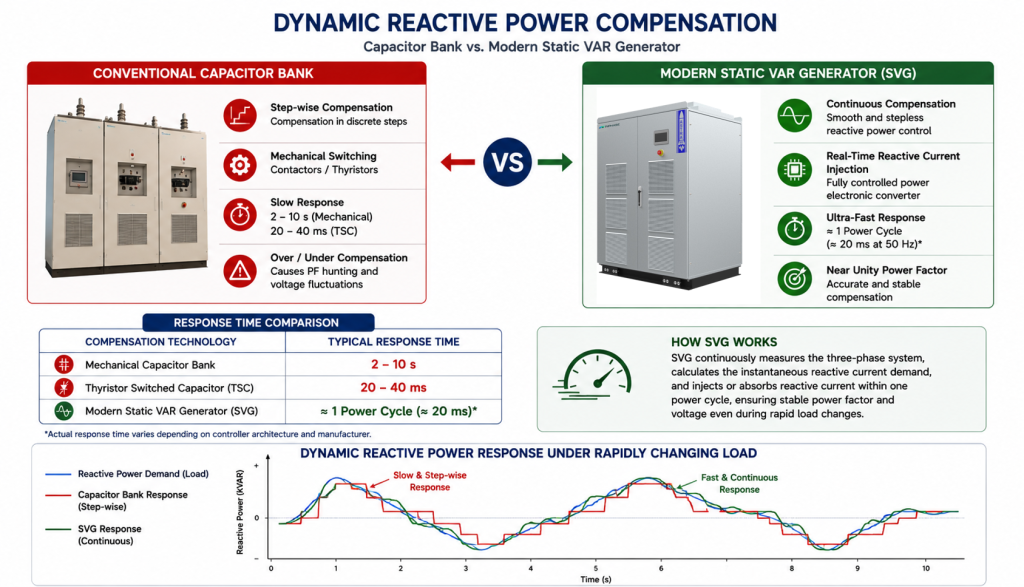
One of the most significant advancements in modern Static VAR Generators (SVGs) is their ability to provide dynamic reactive power compensation almost instantaneously. Unlike conventional capacitor banks that compensate reactive power in discrete switching steps, SVGs continuously generate or absorb reactive current using fully controlled power electronic converters. This enables smooth, accurate and real-time compensation under rapidly changing load conditions.
Modern industrial facilities rarely operate under constant loading conditions. Equipment such as Variable Frequency Drives (VFDs), servo motors, welding machines, rolling mills, cranes and electric arc furnaces can cause reactive power demand to change within a few milliseconds. Under these conditions, conventional capacitor banks may respond too slowly, resulting in temporary power factor deterioration and voltage fluctuations.
A modern Static VAR Generator continuously measures the three-phase electrical network using high-speed current and voltage sensing circuits. Digital Signal Processors (DSPs) calculate the instantaneous reactive current requirement, and the converter injects or absorbs reactive current within approximately one power cycle (≈20 ms at 50 Hz). This closed-loop control enables the SVG to maintain a stable power factor even during sudden load variations.
The performance difference becomes particularly evident when comparing response times.
| Compensation Technology | Typical Response Time |
|---|---|
| Mechanical Capacitor Bank | 2–10 s |
| Thyristor Switched Capacitor (TSC) | 20–40 ms |
| Modern Static VAR Generator | ≈1 Power Cycle (≈20 ms)* |
*Actual response time varies depending on controller architecture and manufacturer.
Because compensation is continuous rather than step-based, SVGs eliminate overcompensation, undercompensation and switching transients commonly associated with conventional capacitor banks. This results in smoother power factor improvement, improved voltage stability and more reliable operation of sensitive electrical equipment.
Ultra-fast reactive power compensation is especially valuable in steel plants, cement plants, renewable energy installations, semiconductor manufacturing facilities and data centres where load conditions fluctuate continuously and maintaining stable power quality is critical.
Engineering Perspective
The evolution from discrete capacitor switching to continuous real-time current injection represents one of the defining characteristics of modern Static VAR Generator technology. Ultra-fast dynamic reactive power compensation enables precise power factor correction, improved voltage stability and higher electrical system reliability under rapidly changing operating conditions.
2. Bidirectional Reactive Power Compensation
Traditional capacitor banks can supply only capacitive reactive power. They are highly effective when the electrical system is predominantly inductive, such as facilities with induction motors and transformers. However, modern industrial power systems often contain a combination of inductive and capacitive loads, causing the reactive power requirement to change continuously throughout the day.
For example, a manufacturing facility may operate large induction motors during production, creating an inductive reactive power demand. During periods of low production, the same facility may have lightly loaded cables, power factor correction capacitors or renewable energy inverters connected to the network, causing the system to become capacitive. Conventional capacitor banks cannot absorb excess capacitive reactive power, often resulting in overcompensation, leading power factor and voltage rise.
Modern Static VAR Generators (SVGs) eliminate this limitation by providing bidirectional reactive power compensation. Using fully controlled power electronic converters, SVGs can both generate capacitive reactive current and absorb inductive reactive current in real time. This allows the system to maintain the desired power factor regardless of whether the connected load is inductive or capacitive.
The operating principle can be expressed as:
Q > 0 → SVG supplies capacitive reactive power (supports inductive loads)
Q < 0 → SVG absorbs reactive power (compensates capacitive loads)
where:
- Q = Reactive Power (kVAR)
Unlike step-switched capacitor banks, the transition between supplying and absorbing reactive power is smooth and continuous, with no mechanical switching or transient disturbances. This enables precise power factor correction, improved voltage regulation and enhanced power quality under continuously changing operating conditions.
Bidirectional compensation is particularly valuable in solar power plants, wind farms, Battery Energy Storage Systems (BESS), data centres, electric vehicle charging infrastructure and floating-grid power systems, where the direction of reactive power flow can change frequently due to varying generation and load conditions.
Engineering Perspective
Bidirectional reactive power compensation is one of the defining capabilities of modern Static VAR Generators. By seamlessly transitioning between capacitive and inductive compensation, SVGs provide accurate reactive power compensation, stable voltage and near-unity power factor across a wide range of operating conditions.
3. Renewable Energy and Weak Grid Integration
The rapid expansion of solar photovoltaic (PV) systems, wind farms, Battery Energy Storage Systems (BESS) and green hydrogen facilities has fundamentally changed the operating characteristics of electrical power systems. Unlike conventional power plants, renewable energy sources are highly variable and are interfaced with the grid through power electronic converters. Consequently, maintaining stable voltage and reactive power compensation has become increasingly challenging, particularly in weak distribution networks.
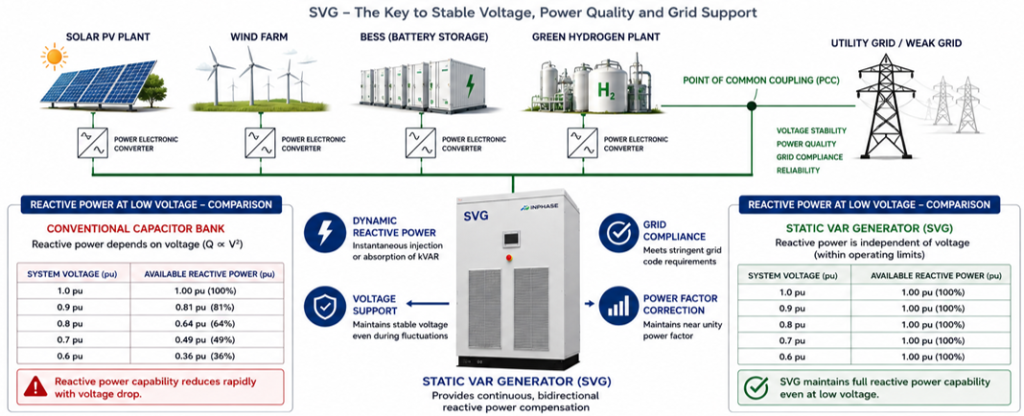
Modern Static VAR Generators (SVGs) have become a key technology for supporting renewable energy integration by providing continuous and dynamic reactive power compensation independent of the active power generated by renewable sources. Unlike conventional capacitor banks, SVGs can maintain stable voltage even during rapid fluctuations in solar irradiance, wind speed or sudden load variations.
One of the major advantages of SVG technology is its ability to provide full reactive power output even at low grid voltage. Capacitor banks produce reactive power proportional to the square of the supply voltage.
QC∝V2Q_C \propto V^2QC∝V2
where:
- Q₍C₎ = Capacitive reactive power
- V = System voltage
For example, if the system voltage drops from 1.0 pu to 0.8 pu:
Qnew=(0.8)2=0.64Q_{new}=(0.8)^2=0.64Qnew=(0.8)2=0.64
This means a conventional capacitor bank can deliver only 64% of its rated reactive power, precisely when the electrical network requires additional voltage support.
In contrast, a Static VAR Generator uses a voltage source inverter to electronically generate or absorb reactive current. Within its operating limits, its reactive power capability remains largely independent of system voltage, allowing effective voltage regulation during low-voltage conditions and improving overall grid stability.
This capability makes SVGs particularly valuable in:
- Solar PV power plants
- Wind farms
- Battery Energy Storage Systems (BESS)
- Green hydrogen production facilities
- Weak utility grids
- Remote industrial installations
- Microgrids
Many modern grid codes also require renewable energy plants to provide dynamic reactive power support and maintain acceptable voltage profiles under varying operating conditions. SVGs help meet these requirements while improving power quality, reducing voltage fluctuations and enhancing grid reliability.
Engineering Perspective
The increasing penetration of renewable energy has transformed the role of Static VAR Generators from industrial power factor correction devices into essential grid-support equipment. Their ability to deliver fast, continuous reactive power compensation, even under weak-grid and low-voltage conditions, makes SVGs indispensable for modern renewable energy integration.
4. Accurate Power Factor Correction at All Load Conditions
One of the key limitations of conventional capacitor banks is their dependence on fixed compensation steps. Since capacitors are switched in discrete stages, the supplied reactive power often does not exactly match the instantaneous reactive power demand of the electrical system. This results in under-compensation, over-compensation and frequent capacitor switching, particularly under fluctuating load conditions.
Modern Static VAR Generators (SVGs) overcome this limitation by providing continuously variable reactive power compensation. Rather than switching capacitor stages ON or OFF, SVGs precisely generate or absorb only the reactive current required at any instant, allowing the system to maintain a power factor close to unity under both light-load and full-load conditions.
The reactive power required for power factor correction can be estimated using:
Q = P (tan φ₁ − tan φ₂)
Where:
Q = Required reactive power (kVAR)
P = Active power (kW)
φ₁ = Initial power factor angle
φ₂ = Target power factor angle
Example
Consider an industrial facility operating with:
Active Power = 500 kW
Initial Power Factor = 0.80
Target Power Factor = 0.99
Since,
tan(cos⁻¹ 0.80) = 0.75
tan(cos⁻¹ 0.99) = 0.142
Therefore,
Q = 500 × (0.75 − 0.142)
Q = 304 kVAR
A conventional capacitor bank would normally compensate this requirement using fixed capacitor steps, for example 300 kVAR or 325 kVAR, resulting in slight under-compensation or over-compensation depending on the operating condition.
A modern Static VAR Generator, however, continuously adjusts its output and supplies exactly the required 304 kVAR, maintaining a stable power factor without unnecessary switching or compensation errors.
Because SVG output is continuously controllable, the power factor remains consistently close to unity even when the reactive power demand changes rapidly. This reduces utility penalties, minimizes reactive current flowing through transformers and cables, improves voltage regulation and enhances overall power quality.
This capability is particularly beneficial in industries with rapidly varying loads, including steel plants, cement plants, rolling mills, paper mills, semiconductor manufacturing facilities and data centres, where accurate power factor correction directly improves electrical system efficiency and operational reliability.
Engineering Perspective
Accurate reactive power control is one of the defining advantages of modern Static VAR Generators. By continuously matching the system’s reactive power demand instead of relying on fixed compensation steps, SVGs maintain near-unity power factor under all operating conditions. This improves electrical efficiency, reduces system losses, minimizes utility penalties and delivers superior power quality compared with conventional capacitor-based compensation systems.
5. Voltage Stability and Weak Grid Support
Maintaining a stable voltage profile has become increasingly challenging in modern electrical networks due to the rapid growth of renewable energy generation, long distribution feeders, fluctuating industrial loads and weak utility grids. Voltage variations not only affect the efficiency of electrical equipment but can also lead to production interruptions, equipment malfunction and reduced power quality.
Conventional capacitor banks provide voltage support by supplying reactive power. However, their performance is highly dependent on system voltage. Since the reactive power produced by a capacitor is proportional to the square of the supply voltage, its effectiveness decreases significantly during voltage sags, precisely when additional voltage support is most needed.
The relationship is given by:
Q ∝ V²
where:
- Q = Reactive Power
- V = System Voltage
For example, if the system voltage falls from 1.0 pu to 0.85 pu, the available reactive power from a capacitor bank becomes:
Q = (0.85)² = 0.7225
or approximately 72% of its rated reactive power.
In contrast, a Static VAR Generator (SVG) regulates voltage by electronically injecting or absorbing reactive current through a fully controlled voltage source inverter. Unlike capacitor banks, its reactive power capability remains largely independent of system voltage within its operating range, enabling effective voltage regulation even during severe load fluctuations and low-voltage conditions.
Modern SVG controllers continuously monitor system voltage, current and reactive power demand. When voltage begins to decrease due to a sudden increase in inductive loading, the SVG immediately injects capacitive reactive current to support the voltage. Conversely, during overvoltage conditions caused by light loading or excess reactive power, the SVG absorbs reactive current, helping restore the voltage to its desired operating range.
This dynamic voltage support is particularly valuable in:
- Renewable energy plants
- Weak utility grids
- Long cable distribution networks
- Mining operations
- Remote industrial facilities
- Green hydrogen plants
- Battery Energy Storage Systems (BESS)
- Microgrids
As modern electrical grids continue to transition toward distributed generation and inverter-based resources, voltage regulation has become one of the primary applications of Static VAR Generators, extending their role well beyond traditional power factor correction.
Engineering Perspective
Modern Static VAR Generators are no longer used solely for reactive power compensation. They have become essential voltage support devices capable of maintaining stable voltage profiles under rapidly changing operating conditions. Their ability to provide fast, continuous and bidirectional reactive power control significantly improves power quality, strengthens weak electrical networks and supports reliable integration of renewable energy systems.
Industry Example
Modern Static VAR Generator solutions developed by InPhase Power Technologies incorporate advanced converter technology and intelligent control systems to provide continuous reactive power compensation, accurate power factor correction and dynamic voltage support. These capabilities help industries maintain stable electrical networks while improving energy efficiency and overall power quality under rapidly changing operating conditions.
6. Future Outlook
The evolution of Active Harmonic Filters (AHFs) and Static VAR Generators (SVGs) is moving beyond harmonic mitigation and reactive power compensation toward intelligent, connected and autonomous power quality management.
Future systems will increasingly leverage Artificial Intelligence (AI) and Machine Learning (ML) to analyse historical data, predict network behaviour and automatically optimize compensation strategies as operating conditions change. Advances in Silicon Carbide (SiC) and future Gallium Nitride (GaN) semiconductor technologies will enable more compact, efficient and higher-power converters with lower switching losses.
Another emerging trend is the adoption of Digital Twins, allowing engineers to simulate operating conditions, predict failures and optimize maintenance without interrupting plant operation. At the same time, AHFs and SVGs will become integral components of smart grids, microgrids, renewable energy plants, Battery Energy Storage Systems (BESS) and EV charging infrastructure, working alongside Energy Management Systems (EMS) and Distributed Energy Resources (DERs) to improve grid stability and energy efficiency.
Rather than operating as standalone devices, next-generation power quality systems are expected to communicate, learn and optimize continuously, enabling predictive maintenance, adaptive compensation and autonomous power quality management.
Technology to Practical Implementation
The engineering trends discussed throughout this article are already influencing the design of commercial power quality solutions. InPhase Power Technologies continues to integrate these advancements into its Active Harmonic Filter and Static VAR Generator portfolio, enabling industries to improve power quality, achieve IEEE 519 compliance, optimize energy efficiency and support reliable operation across manufacturing facilities, renewable energy installations, data centres and other mission-critical applications.
7. Conclusion
The rapid evolution of modern industrial electrical systems has significantly increased the importance of effective power quality management. The widespread adoption of Variable Frequency Drives (VFDs), renewable energy systems, electric vehicle charging infrastructure, data centres and advanced automation has made traditional compensation methods inadequate for many modern applications.
In response, Active Harmonic Filters (AHFs) and Static VAR Generators (SVGs) have evolved into intelligent power quality solutions capable of delivering real-time harmonic mitigation, dynamic reactive power compensation and comprehensive electrical system optimization. Continuous advancements in power electronics, Digital Signal Processing (DSP), communication technologies and intelligent control have further improved their performance, efficiency and reliability.
Today, AHFs and SVGs play a vital role in reducing harmonic distortion, improving power factor, stabilizing voltage, protecting critical electrical equipment and supporting compliance with standards such as IEEE 519. Their importance will continue to grow as industrial facilities become increasingly digital, automated and interconnected.
Looking ahead, the integration of Artificial Intelligence, Digital Twins and smart grid technologies will enable the next generation of power quality equipment to become more autonomous, predictive and self-optimizing. Rather than functioning solely as compensation devices, future AHFs and SVGs will become intelligent components of connected electrical infrastructures, helping industries achieve higher efficiency, reliability and sustainability.
To learn more about Active Harmonic Filter, Static VAR Generator and other advanced power quality solutions, explore the complete product portfolio and technical resources available from InPhase Power Technologies.