How to Select the Right Active Harmonic Filter
Knowing how to select the right Active Harmonic Filter is essential for maintaining power quality in modern electrical systems. A transformer operating at only 60% of its rated capacity should not be overheating. Yet, this is a common observation in facilities dominated by Variable Frequency Drives (VFDs), UPS systems, welding machines, EV chargers, rectifiers, and other power electronic loads. In many cases, the root cause is not overload but harmonic distortion.
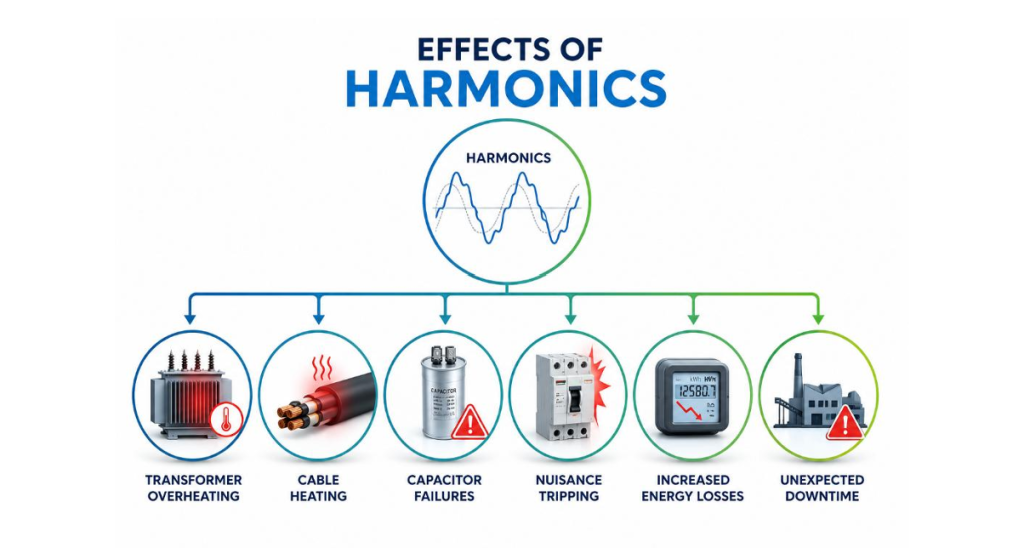
As industries increasingly adopt energy-efficient and digitally controlled equipment, maintaining power quality has become more challenging than ever. Harmonics generated by power electronic loads can lead to transformer overheating, cable heating, capacitor failures, nuisance tripping, higher energy losses, reduced equipment life, and unplanned downtime. In addition, excessive harmonic distortion can make it difficult to comply with IEEE 519 harmonic standards.
An Active Harmonic Filter (AHF) is one of the most effective solutions for mitigating harmonics and improving power quality. However, selecting the right Active Harmonic Filter involves much more than choosing a current rating from a catalogue. A reliable selection process begins with understanding the harmonic problem, accurately determining the required compensation, and evaluating the technology that will deliver long-term performance and system reliability.
Step 1: Understand Your Harmonic Problem
Before selecting any Active Harmonic Filter, it is important to determine whether harmonics
are actually causing the issue.
Many facilities encounter symptoms such as:
• Transformer overheating
• Excessive cable heating
• Frequent capacitor failures
• Nuisance tripping
• Poor power factor performance
• Reduced equipment reliability
While these symptoms often point toward harmonics, they should never be used as the sole
basis for selecting a filter. Similar issues can also result from overloaded equipment, poor
connections, or incorrect system design.
The first step should always be a Power Quality Study.
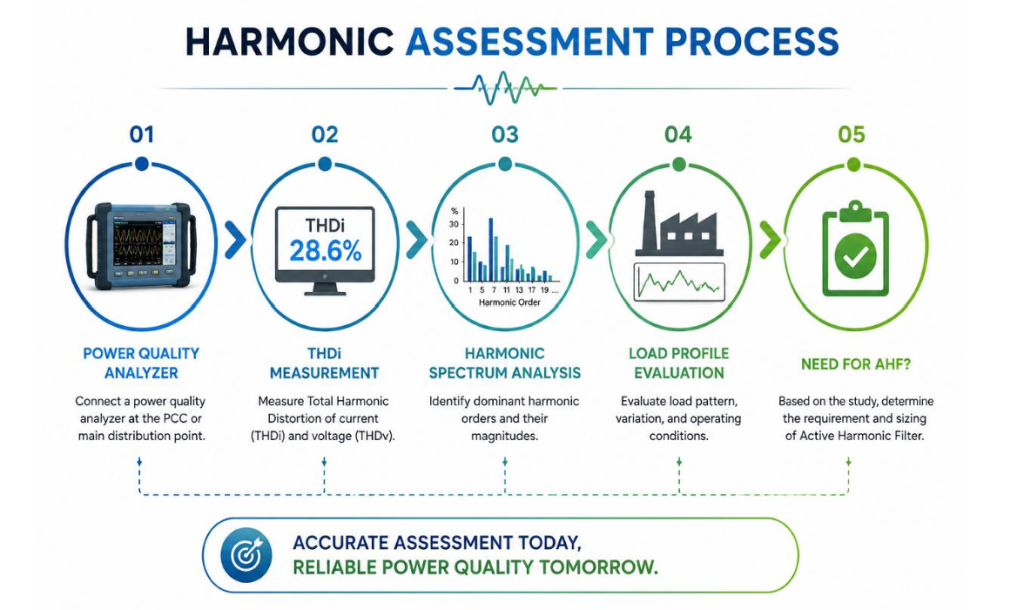
Using a Power Quality Analyzer, engineers can measure THDi, identify dominant harmonic
orders, understand load variation, and determine how harmonics behave during normal plant
operation.
A proper measurement not only confirms whether an AHF is required but also prevents costly
mistakes later in the selection process.
Selection Tip: Don’t start with a catalogue. Start with measurements.
Step 2: Determine How Much Compensation You Need
Once harmonic measurements are available, the next step is determining the required
compensation capacity.
One of the most common mistakes is selecting an AHF based on total load current. In reality,
the filter compensates harmonic current, not the entire load current.
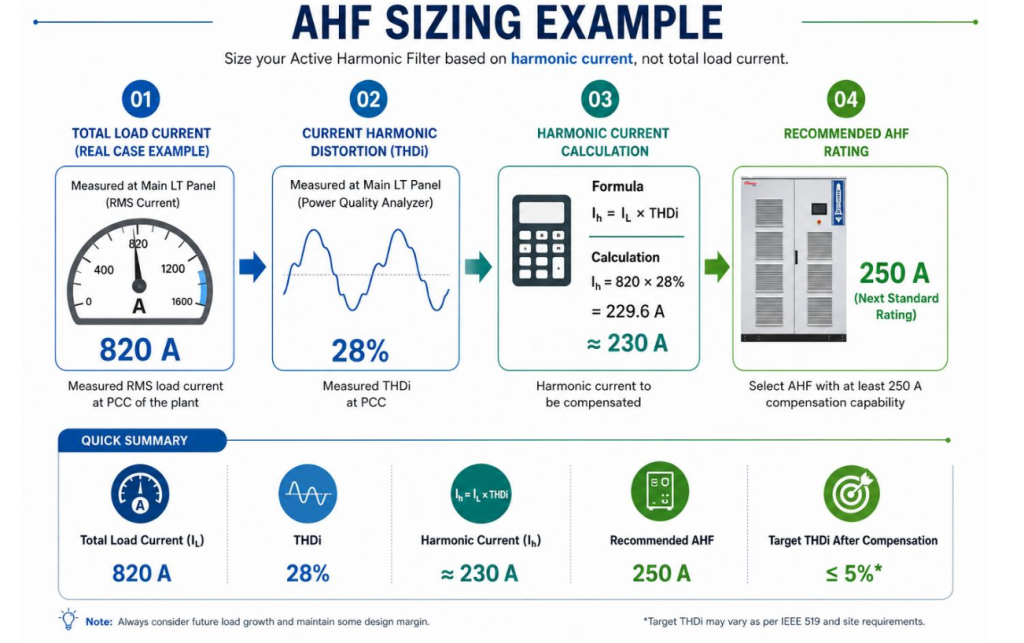
Consider an automotive manufacturing plant with:
• Load Current = 820 A
• THDi = 28%
Using the formula:
Harmonic Current (𝐼ℎ)=Load Current×THDi
100
𝐼ℎ=820×28
100≈230 A
This indicates approximately 230 A of harmonic current.
If the objective is to reduce THDi to acceptable levels, an Active Harmonic Filter with
approximately 250 A compensation capability would be sufficient. Installing an 800 A AHF would unnecessarily increase the investment cost without providing additional harmonic compensation benefits.
At the same time, future load additions must be considered. Additional VFDs, UPS systems, EV chargers, or production equipment can increase harmonic levels over time. Therefore, sizing should balance present requirements with realistic future growth.
Selection Tip: Size the filter according to harmonic current, not load current.
Step 3: Select the Right Type of AHF
After determining the required compensation capacity, the next step in how to select the right Active Harmonic Filter is choosing the appropriate architecture.
For facilities with relatively stable loads and limited expansion plans, a standalone Active Harmonic Filter (AHF) is often the most economical solution. These systems are compact, easy to install, and well suited for fixed applications.
However, many industrial facilities continue to grow throughout their operating life. Additional production lines, process upgrades, and new electrical loads can significantly increase harmonic levels. When selecting the right Active Harmonic Filter, it is important to consider not only current operating conditions but also future expansion requirements.
In such cases, a modular Active Harmonic Filter architecture provides greater flexibility because compensation capacity can be expanded without replacing the entire system. This makes modular solutions an excellent choice for facilities expecting long-term growth.
To address different application requirements, InPhase offers the following Active Harmonic Filter solutions:
ASTRA AHF
Ideal for:
- Fixed load applications
- Compact installations
- Medium compensation requirements
Modular AHF / AHF+
Ideal for:
- Growing facilities
- Higher current ratings
- Redundancy requirements
- Expansion up to 32 modules
Selecting the right Active Harmonic Filter architecture at an early stage can prevent costly upgrades later while ensuring the system remains scalable and reliable throughout the plant’s lifecycle.
Selection Tip: Match the architecture to the plant’s growth strategy, not just today’s requirements.
Step 4: Evaluate the Technology Behind the Rating
Another important step in how to select the right Active Harmonic Filter is evaluating the technology behind the current rating. Two Active Harmonic Filters (AHFs) with identical ratings can perform very differently under real operating conditions.
The current rating indicates how much harmonic current a filter can compensate. However, it does not indicate how effectively the Active Harmonic Filter will perform under varying load conditions or dynamic operating environments.
When evaluating an Active Harmonic Filter, engineers should consider:
- Converter topology
- Controller technology
- Response time
- Compensation range
- Efficiency
- Reliability
| Parameter | Basic AHF | Advanced AHF |
|---|---|---|
| Topology | 2-Level | 3-Level |
| Controller | Single DSP | 2-Core DSP |
| Response | Slower | 1 Power Cycle |
| Harmonic Range | Limited | Up to 50th Order |
Modern Active Harmonic Filters increasingly utilize 3-Level Topology because it offers lower switching losses, reduced thermal stress, and improved waveform quality.
Controller technology is equally important. The Active Harmonic Filter must continuously detect harmonics, calculate the required compensation current, and respond rapidly to changing load conditions. This becomes especially important in facilities with dynamic loads such as welding machines, cranes, and large VFDs.
Response time and compensation range also play a significant role when selecting the right Active Harmonic Filter. A filter that reacts slowly or compensates only lower-order harmonics may struggle to maintain power quality under varying operating conditions.
To address these challenges, InPhase Active Harmonic Filters incorporate:
- 3-Level Topology
- Dual-Core DSP Technology
- One Power-Cycle Response
- Harmonic Compensation up to the 50th Order
- Efficiency greater than 98.5%
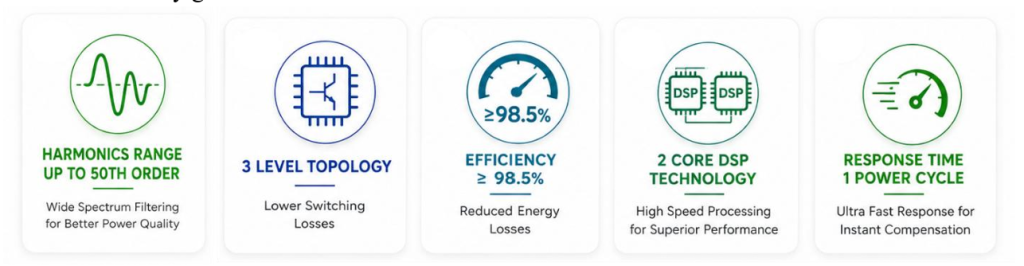
Together, these technologies help ensure stable compensation across a wide range of industrial applications.
Selection Tip: Capacity tells you how much. Technology determines how well.
Step 5: Look Beyond Harmonic Compensation
Another important aspect of how to select the right Active Harmonic Filter is looking beyond harmonic compensation alone. In many facilities, harmonics are only one part of the overall power quality challenge.
Additional power quality requirements may include:
- Reactive power compensation
- Power factor correction
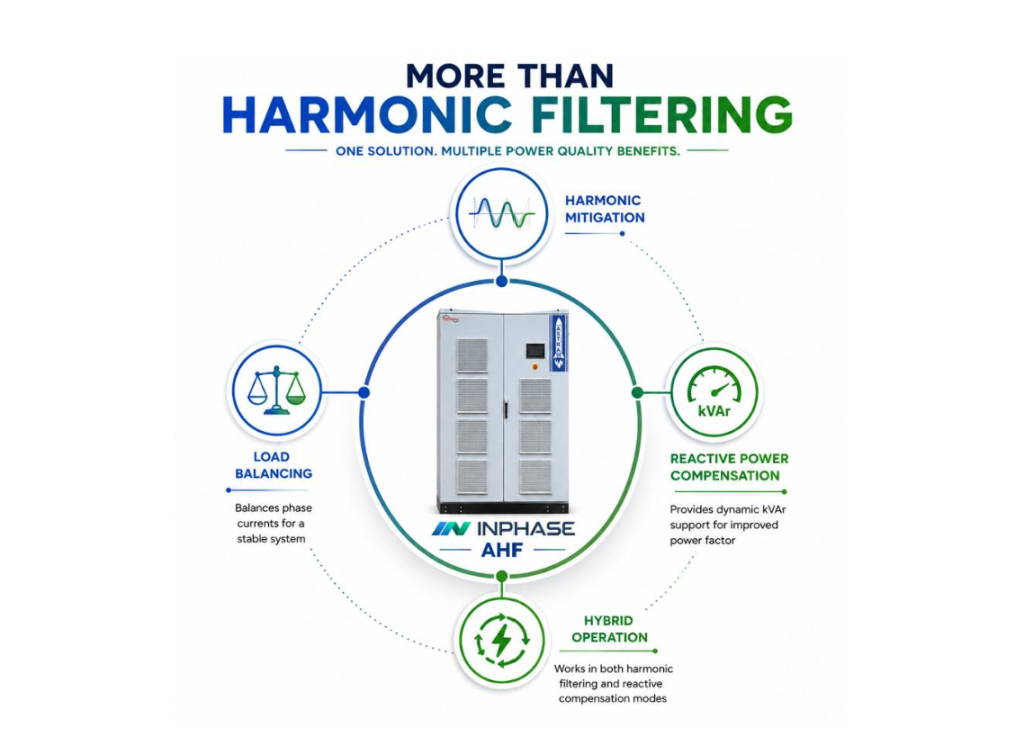
- Load balancing
- Hybrid operation
Installing separate solutions for each issue can increase both cost and system complexity. When selecting the right Active Harmonic Filter, it is important to consider whether a single solution can address multiple power quality challenges.
Modern Active Harmonic Filters and power quality platforms increasingly combine multiple functions within a single system, allowing users to solve several problems simultaneously while simplifying installation and maintenance.
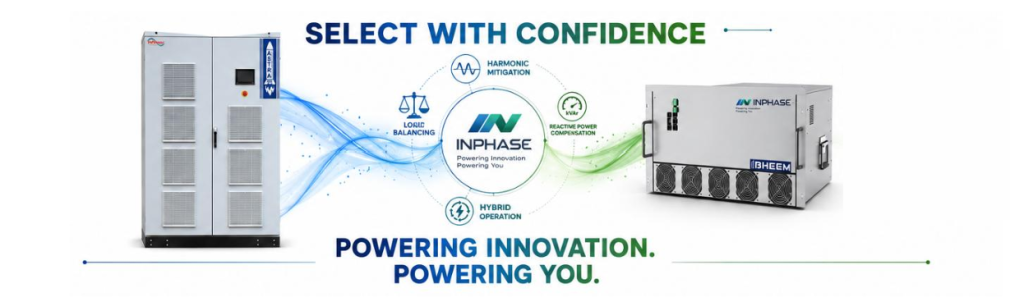
InPhase Active Harmonic Filter (AHF) supports harmonic mitigation, reactive power compensation, load balancing, and hybrid operating modes, helping facilities improve overall power quality from a single platform.
Selection Tip: Evaluate the complete power quality requirement rather than focusing on harmonics alone.
Step 6: Think About Tomorrow's Plant
A key part of how to select the right Active Harmonic Filter is planning for future expansion. Electrical systems rarely remain unchanged, and today’s power quality requirements may not reflect tomorrow’s operating conditions.
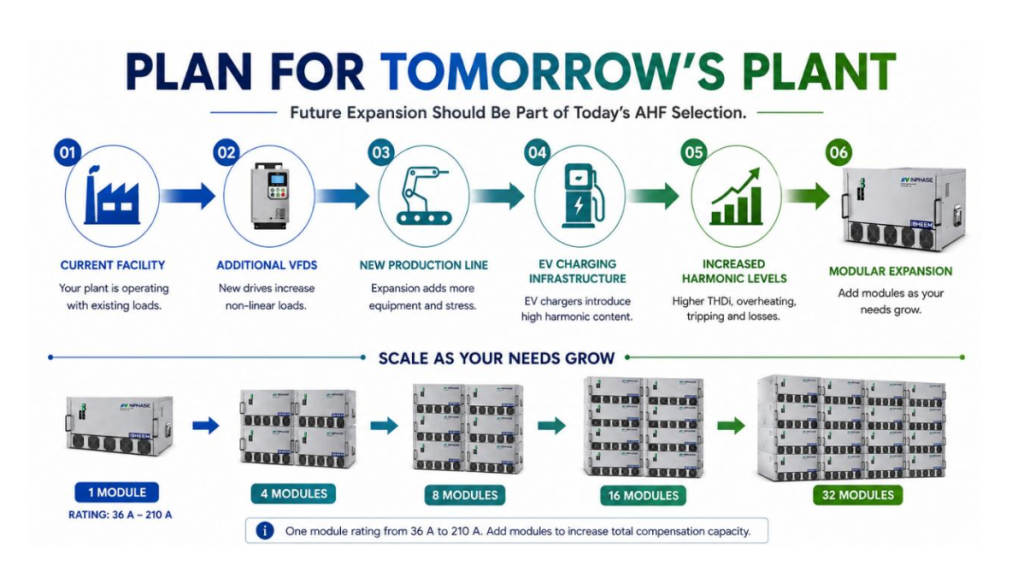
Future expansion may include:
- Additional VFDs
- New production lines
- EV charging infrastructure
- Data center equipment
- Automation upgrades
Every new nonlinear load added to a facility contributes additional harmonic current. As the plant grows, the harmonic mitigation requirement often grows with it. This direct relationship between plant expansion and harmonic growth should be considered when selecting the right Active Harmonic Filter.
A solution that meets today’s requirements may become inadequate tomorrow. Communication capability is equally important. Integration with PMS, SCADA, and modern monitoring platforms allows operators to continuously monitor system performance, simplify maintenance, and optimize overall power quality.
InPhase Modular Active Harmonic Filter (AHF) supports expansion up to 32 modules while providing compatibility with modern monitoring and power management systems, making it a future-ready solution for growing industrial facilities.
Selection Tip: Plan for realistic growth and future operational requirements.
Step 7: Evaluate Engineering Support and After-Sales Service
An often-overlooked aspect of how to select the right Active Harmonic Filter is evaluating the engineering expertise and support offered by the supplier. Selecting the right Active Harmonic Filter does not end with choosing the correct rating or technology. Proper engineering support plays a critical role in ensuring that the system delivers the expected performance throughout its operating life.
A reliable Active Harmonic Filter supplier should offer:
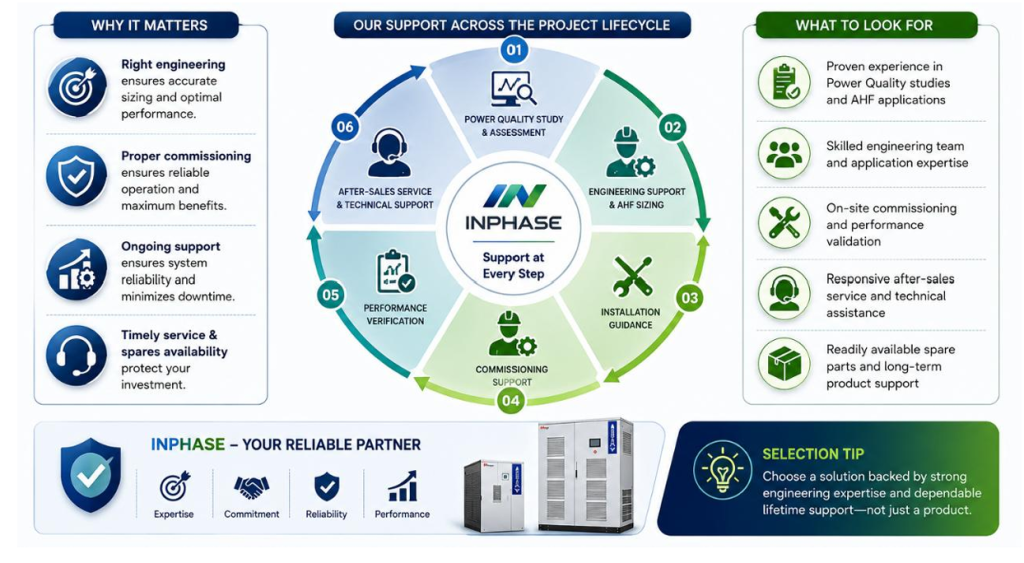
- Power Quality Studies and harmonic assessment
- Engineering support for accurate AHF sizing
- Installation guidance and commissioning support
- Performance verification after commissioning
- Responsive after-sales service and technical assistance
- Readily available spare parts and long-term product support
Without proper commissioning and engineering expertise, even a correctly sized Active Harmonic Filter may not achieve the desired level of harmonic mitigation or overall power quality improvement.
To support customers throughout the project lifecycle, InPhase Active Harmonic Filter solutions are backed by end-to-end engineering assistance from initial harmonic analysis and product selection to commissioning, performance validation, and dedicated after-sales support. This ensures every installation operates reliably and continues to deliver long-term power quality improvements.
Selection Tip: Choose a solution backed by strong engineering expertise and dependable lifetime support-not just a product.
Step 8: Evaluate the Return on Investment (ROI)
The final step in how to select the right Active Harmonic Filter is evaluating its long-term value rather than focusing only on the initial purchase price. When selecting the right Active Harmonic Filter, the real value lies in the long-term technical improvements it delivers and the financial savings it generates throughout its service life.
A properly selected Active Harmonic Filter can provide measurable technical ROI by:
- Reducing transformer and cable heating
- Eliminating nuisance tripping
- Improving equipment reliability
- Lowering harmonic losses
- Extending the life of transformers, capacitors, motors, and other electrical equipment
- Maintaining compliance with IEEE 519 recommendations
These technical improvements translate directly into commercial ROI, including:
- Reduced maintenance and replacement costs
- Lower production downtime
- Improved plant productivity
- Reduced lifecycle cost of electrical assets
- Better utilization of existing infrastructure
- Faster payback on the investment
Therefore, when selecting the right Active Harmonic Filter, the evaluation should focus on the Total Cost of Ownership (TCO) rather than only the purchase price. A solution that performs reliably over many years often delivers significantly greater value than a lower-cost alternative that requires frequent maintenance or early replacement.
In addition to advanced harmonic compensation, InPhase Active Harmonic Filters combine high efficiency (>98.5%), one power-cycle response, 3-Level Topology, Dual-Core DSP technology, and scalable modular architecture. These features help industries achieve superior power quality while maximizing long-term return on investment.
Selection Tip: Don’t compare only the purchase price. Compare the total value an Active Harmonic Filter delivers over its entire lifecycle.
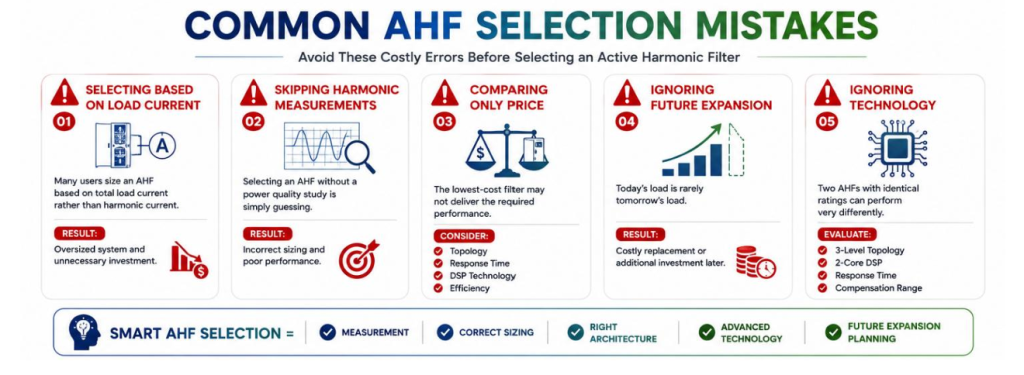
Common Selection Mistakes
Understanding how to select the right Active Harmonic Filter also means avoiding the common mistakes that can affect long-term system performance. Even well-designed projects can encounter problems when a few critical factors are overlooked.
Some of the most common mistakes when selecting the right Active Harmonic Filter include:
- Selecting based on load current instead of harmonic current
- Choosing solely on purchase price
- Ignoring future expansion requirements
- Comparing ratings without evaluating technology
- Ignoring response time
- Skipping harmonic measurements
Avoiding these mistakes helps ensure you select the right Active Harmonic Filter for your application, improving long-term system performance, reducing lifecycle costs, and maximizing the return on your investment.
Final Thoughts
Understanding how to select the right Active Harmonic Filter is essential for achieving reliable power quality and long-term system performance. Selecting the right Active Harmonic Filter is ultimately an engineering decision rather than simply a purchasing decision.
The process should begin with understanding the harmonic problem, determining the required compensation, selecting the appropriate architecture, and evaluating the technology behind the solution.
A well-selected Active Harmonic Filter (AHF) not only reduces harmonic distortion but also improves equipment reliability, minimizes downtime, extends equipment life, and supports long-term power quality objectives.
Whether your application requires a standalone ASTRA Active Harmonic Filter or a scalable Modular AHF/AHF+ platform, the key to selecting the right Active Harmonic Filter always begins with one thing: understanding your electrical system before choosing the solution.