
Active Harmonic Filter Installation in Industrial Panel
Active Harmonic Filter Installation in Industrial Panel is essential for reducing harmonic distortion, improving power quality, and ensuring IEEE 519 compliance in modern industrial electrical systems. Non-linear loads such as VFDs, UPS systems, rectifiers, and welding machines generate harmonics that can affect equipment reliability and energy efficiency.
This image illustrates a typical Active Harmonic Filter Installation in Industrial Panel used for harmonic mitigation and power quality improvement in industrial facilities.
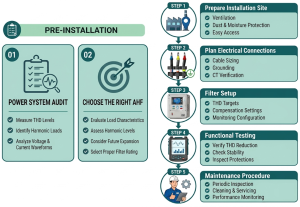
Key Components Shown in the Installation
Incoming Power Supply
The three-phase incoming supply feeds the main distribution panel and supplies power to both the load and the Active Harmonic Filter (AHF).
Current Transformers (CTs)
Current Transformers are installed on the load side to continuously measure load current and harmonic content. These measurements are sent to the Active Harmonic Filter controller for real-time analysis.
Active Harmonic Filter (AHF)
The Active Harmonic Filter detects harmonic currents generated by non-linear loads and injects equal and opposite compensating currents to cancel harmonic distortion.
Industrial Loads
Typical industrial loads connected to the panel include:
Variable Frequency Drives (VFDs)
UPS Systems
Welding Machines
Rectifiers
Induction Furnaces
CNC Machines
PLC-Controlled Equipment
These loads are major sources of harmonic distortion in industrial electrical systems.
Communication Interface
Modern Active Harmonic Filters support:
Modbus RTU
Modbus TCP/IP
Ethernet Communication
SCADA Integration
This enables remote monitoring and performance analysis.
Benefits of Active Harmonic Filter Installation in Industrial Panel
Reduced Harmonic Distortion
The filter continuously mitigates harmonics generated by non-linear loads, helping maintain Total Harmonic Distortion (THD) within acceptable limits.
IEEE 519 Compliance
Proper Active Harmonic Filter Installation in Industrial Panel helps industries comply with IEEE 519 harmonic standards and utility requirements.
Improved Equipment Life
Reduced harmonics minimize overheating in transformers, cables, motors, and capacitor banks, extending equipment lifespan.
Better Energy Efficiency
Lower harmonic losses improve overall system efficiency and reduce energy waste.
Enhanced System Reliability
Stable voltage and current waveforms reduce nuisance tripping and unplanned downtime.
Typical Installation Location
Active Harmonic Filter Installation in Industrial Panel is commonly performed at:
Main LT Panels
PCC (Point of Common Coupling)
MCC Panels
VFD Distribution Panels
Data Center Electrical Rooms
Process Plant Power Distribution Systems
Recommended Installation Practices
Install the AHF as close as possible to the harmonic-generating loads.
Ensure proper CT orientation and wiring.
Provide adequate ventilation and clearance.
Verify grounding and bonding connections.
Perform harmonic measurements before and after commissioning.
Configure compensation settings according to load characteristics.
Common Challenges During Active Harmonic Filter Installation in Industrial Panel
- Incorrect CT polarity
- Improper grounding
- Inadequate ventilation
- Wrong filter sizing
- Poor cable routing
Benefits of Active Harmonic Filter Installation in Industrial Panel
- Lower THD
- Improved transformer life
- Better power factor
- Reduced downtime
- Energy savings
- IEEE 519 compliance
Industries That Require Active Harmonic Filter Installation in Industrial Panel
- Steel Plants
- Cement Plants
- Automotive Manufacturing
- Data Centers
- Hospitals
- Water Treatment Plants
A properly designed Active Harmonic Filter Installation in Industrial Panel significantly improves power quality, reduces harmonic distortion, protects electrical equipment, and ensures IEEE 519 compliance. By following best installation practices, industries can achieve reliable operation, lower maintenance costs, and improved energy efficiency.