Poor Power Factor is one of the most overlooked causes of energy inefficiency in industrial facilities. While most organizations focus on reducing electricity consumption, many fail to recognize how poor power factor silently increases current flow, overloads infrastructure, wastes energy, and raises operating costs.
These losses are often invisible on the production floor, making them difficult to identify until they begin affecting equipment performance, energy bills, and future plant expansion plans also it effect the regulatory standards like EEE519, IEC 61999-3-2/3-12.
Imagine filling a water tank through a pipe with a small leak. The tank eventually fills, but more water is required because part of it is wasted along the way. Similarly, poor power factor forces electrical systems to draw more current than necessary to deliver the same useful power.
Understanding and correcting poor power factor is essential for improving energy efficiency and maximizing the performance of industrial electrical systems.
 A power factor close to 1.0 indicates efficient utilization of electrical power. A low or poor power factor means additional current must flow through the system to deliver the required output.
Common causes of poor power factor include:
A power factor close to 1.0 indicates efficient utilization of electrical power. A low or poor power factor means additional current must flow through the system to deliver the required output.
Common causes of poor power factor include:
What Is Poor Power Factor?
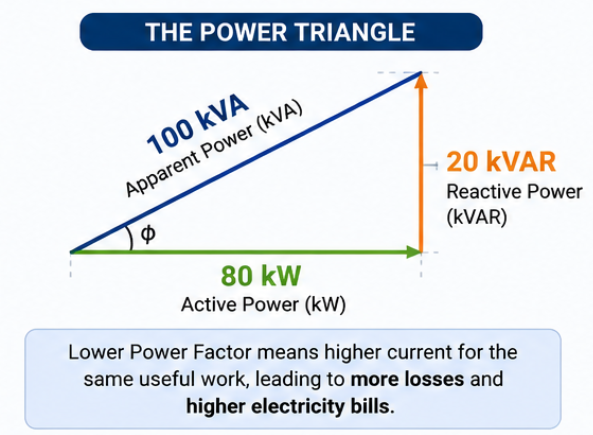
Power factor is the ratio between useful power (kW) and total power supplied (kVA).
A power factor close to 1.0 indicates efficient utilization of electrical power. A low or poor power factor means additional current must flow through the system to deliver the required output.
Common causes of poor power factor include:
- Induction motors
- Variable Frequency Drives (VFDs)
- Welding equipment
- Compressors
- HVAC systems
- Industrial furnaces
The Real Cost of Poor Power Factor
1. Higher Energy Losses
Poor power factor increases current flow throughout the electrical network. Higher current results in increased losses in transformers, cables, and switchgear. This means industries consume more energy to achieve the same production output.2. Increased Electricity Bills
Many utilities impose penalties when facilities operate with poor power factor. Maintaining a low power factor can result in:- Additional demand charges
- Power factor penalties
- Higher operating expenses
3. Transformer Overloading
Poor power factor causes transformers to carry additional current, increasing heating and reducing available capacity. This can lead to:- Reduced transformer life
- Increased maintenance requirements
- Premature equipment replacement
4. Reduced System Capacity
Electrical infrastructure has finite current-carrying capacity. Poor power factor consumes valuable capacity that could otherwise support:- New machinery
- Production expansion
- Additional process loads
5. Excessive Voltage Drop
As current increases, voltage drop across cables also increases. This can negatively impact:- Motor performance
- Automation systems
- Process stability
- Equipment efficiency
6. Equipment Overheating
Poor power factor contributes to excessive heating in:- Motors
- Cables
- Transformers
- Switchboards
7. Reduced Operational Efficiency
Ultimately, poor power factor lowers overall plant efficiency and increases the cost of production.Is Your Industry Vulnerable to Poor Power Factor?
Many facilities operate with poor power factor without realizing it. Common warning signs include:- High electricity bills
- Utility penalty charges
- Transformer overheating
- Frequent capacitor failures
- Reduced system capacity
- Voltage fluctuations
- Excessive motor heating
Traditional Methods of Correcting Poor Power Factor
Fixed Capacitor Banks
Fixed capacitor banks provide a simple method for improving power factor.Limitations
- Cannot adapt to changing loads
- Risk of over-compensation
- Limited flexibility
- Reduced effectiveness during load fluctuations
Automatic Power Factor Correction Panels
Automatic Power Factor Correction (APFC) systems switch capacitor stages based on demand.Limitations
- Slower response time
- Mechanical wear of contactors
- Limited effectiveness under rapidly changing loads
- Reduced performance with modern nonlinear loads