Power Factor Improvement Methods are essential for reducing hidden electrical losses and controlling rising energy costs in industrial facilities. Every month, industries spend thousands or even lakhs of rupees on electricity, yet many facility owners don’t realize that a significant portion of these costs comes from poor power factor.Every month, industries spend thousands even lakhs of rupees on electricity. Yet many facility owners don’t realize that a significant portion of these costs comes from poor power factor.
The surprising part? Most businesses don’t notice the problem until they receive power factor penalties, experience equipment failures, or see their energy bills steadily increasing.
If your electricity bill keeps rising despite stable production levels, your power factor may be the hidden culprit.
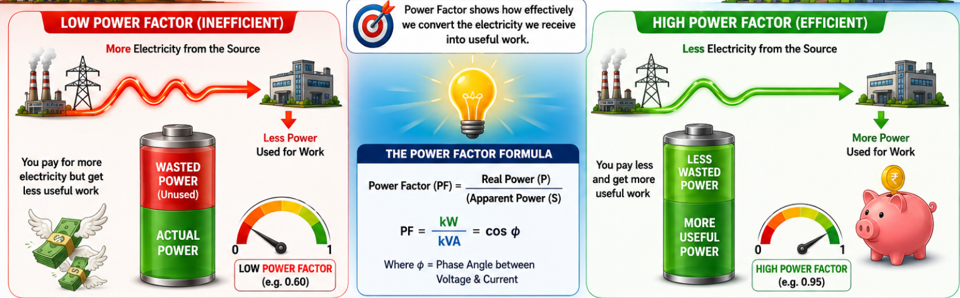
What Is Power Factor and Why Should You Care?
The right Power Factor Improvement Methods can significantly reduce these unnecessary costs. By improving power factor, industries can lower demand charges, avoid utility penalties, reduce system losses, and improve overall electrical efficiency. Selecting the appropriate power factor improvement solution depends on the load profile, operating conditions, and power quality requirements of the facility.Most industries monitor how much electricity they consume, but an equally important factor is how efficiently that electricity is used. This is measured by power factor.
Active Power (kW): The actual power that does useful work.
Reactive Power (kVAR): It does not perform any useful work or produce output.
Apparent Power (kVA): The total power supplied by the electrical system .
Power Factor (PF) = Active Power (kW) ÷ Apparent Power (kVA)
A Power Factor of 1.0 means all the supplied power is being used efficiently. The lower the Power Factor, the more power is wasted in the system.
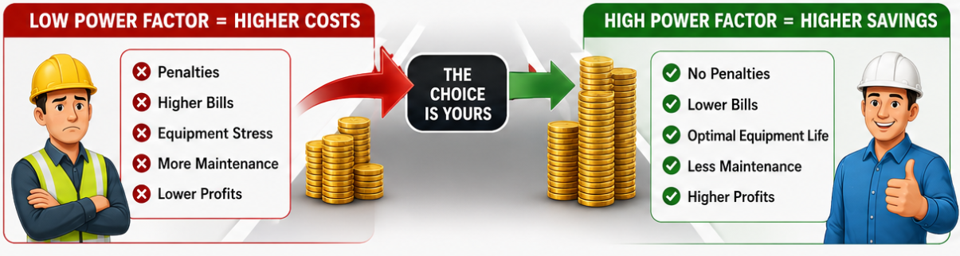
How Much Can Poor Power Factor Cost Your Business?
As industrial facilities adopt automation, VFDs, robotics, and other non-linear loads, maintaining a high power factor becomes increasingly challenging. Effective Power Factor Improvement Methods help industries reduce electrical losses, improve equipment performance, increase system capacity, and lower electricity costs. Choosing the right solution can significantly improve overall energy efficiency and long-term profitability.
What Are the Most Common Power Factor Improvement Methods?
Several Power Factor Improvement Methods are available for industrial facilities, ranging from conventional capacitor banks to advanced Static VAR Generators (SVGs). Each method offers different levels of performance, response speed, and compensation accuracy. Understanding these power factor improvement methods helps industries choose the most effective solution for reducing electrical losses and improving system efficiency.https://ieeexplore.ieee.org/document/10921165
- Capacitor Banks
Capacitor banks are one of the oldest and most widely used power factor correction solutions.
They supply reactive power locally, reducing the burden on the electrical network.
Limitations:
- Slow response
- Fixed compensation levels
- Reduced effectiveness under fluctuating loads
- Potential resonance issues
2. Automatic Power Factor Correction (APFC) Panels
APFC panels automatically switch capacitor banks on and off based on system requirements.
Limitations:
- Step-based correction
- Delayed response
- Mechanical wear of contactors
- Limited effectiveness for dynamic loads
What Is a Static VAR Generator (SVG)?
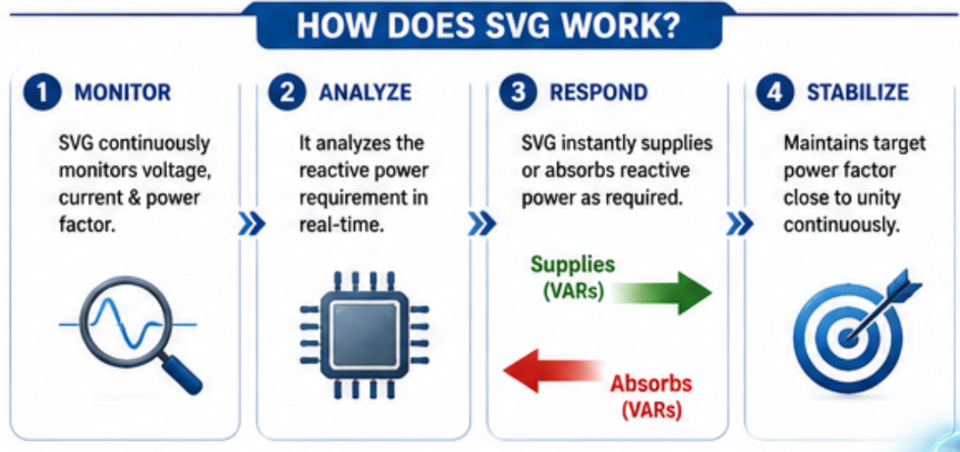
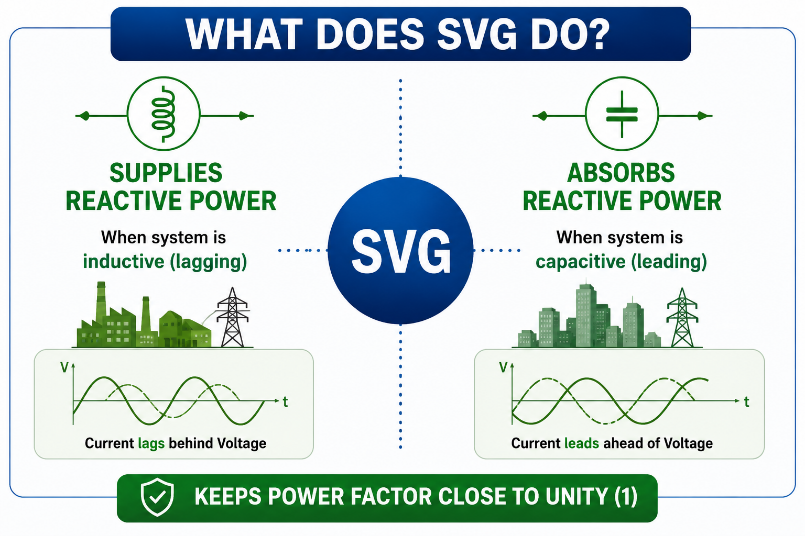
A Static VAR Generator (SVG) is a smart power factor correction device that helps industries use electricity more efficiently. It continuously monitors the electrical system and instantly supplies or absorbs reactive power based on actual demand.
Why Are More Industries Switching to SVG Technology?
Among modern Power Factor Improvement Methods, SVG technology stands out because of its ability to provide continuous and precise reactive power compensation. Unlike conventional solutions, SVG systems can maintain a near-unity power factor even during sudden load fluctuations, helping industries achieve greater energy efficiency and lower operating costs.It provides dynamic compensation without mechanical switching delays, helping facilities maintain optimal power factor even during sudden load changes.
This is why industries across manufacturing, automotive, pharmaceuticals, textiles, data centers, and commercial buildings are adopting SVG-based solutions.
Selecting the right Power Factor Improvement Methods depends on the type of electrical loads operating within a facility. Industries with relatively stable loads may achieve acceptable results using capacitor banks or APFC panels. However, facilities that rely on variable frequency drives, CNC machines, robotics, welding equipment, and automated production lines often require more advanced Power Factor Improvement Methods capable of responding to rapidly changing reactive power demands.
When evaluating Power Factor Improvement Methods, industries should consider response speed, compensation accuracy, maintenance requirements, scalability, and long-term energy savings. Modern solutions such as Static VAR Generators (SVGs) provide dynamic compensation, helping facilities maintain a consistently high power factor while reducing electrical losses and improving overall power quality. Choosing the appropriate Power Factor Improvement Methods can significantly reduce operating costs and improve electrical system reliability.
How InPhase SVG Helps Reduce Energy Costs and Improve Efficiency
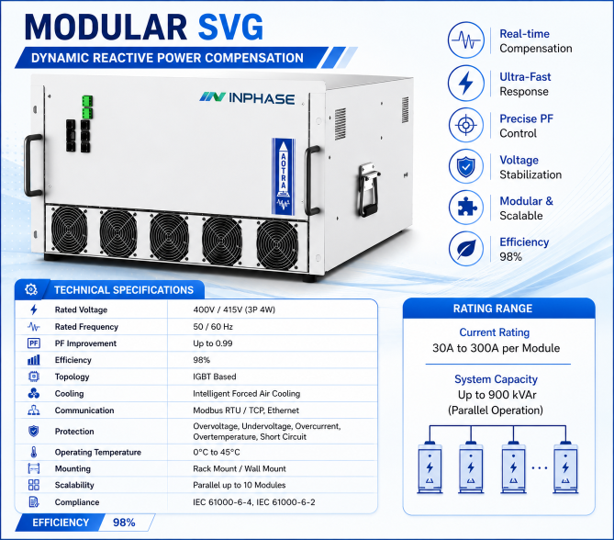
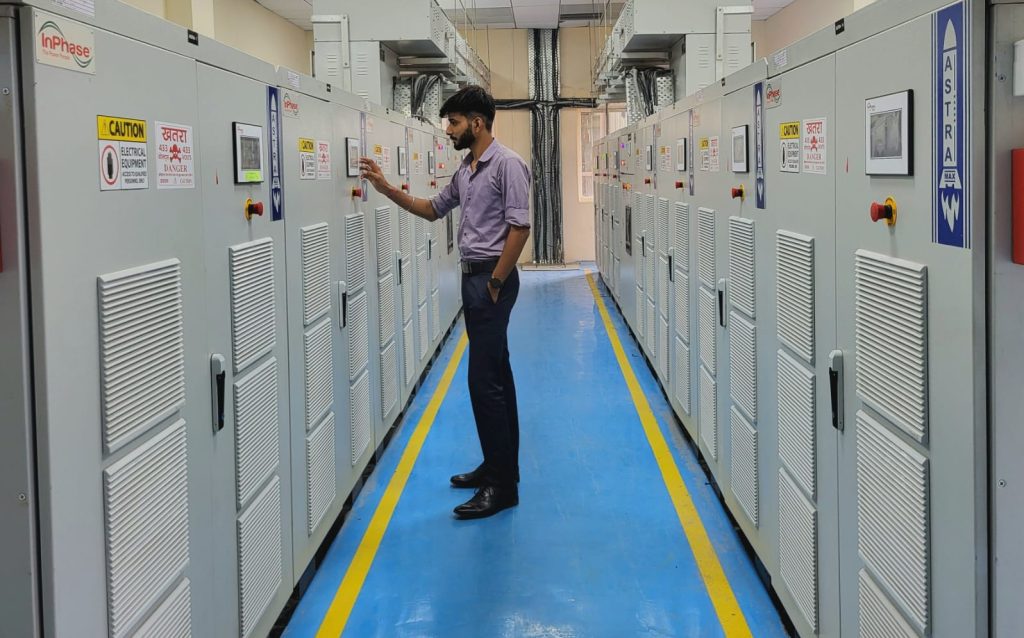
InPhase Static VAR Generator (SVG) is an advanced, electronics-based reactive power compensation solution designed to deliver precise, real-time power factor correction for modern industrial environments. Unlike traditional capacitor banks that provide stepped compensation, InPhase SVG dynamically adjusts to changing load conditions and delivers exactly the reactive power required at any moment. This helps industries reduce power factor penalties, minimize energy losses, improve voltage stability, and maximize the utilization of existing electrical infrastructure.https://inphase.in/power-quality-products
Key Features :
- Advanced Power Quality Management
- Intelligent Operation
- Smart integration
- Industrial Grade Reliability
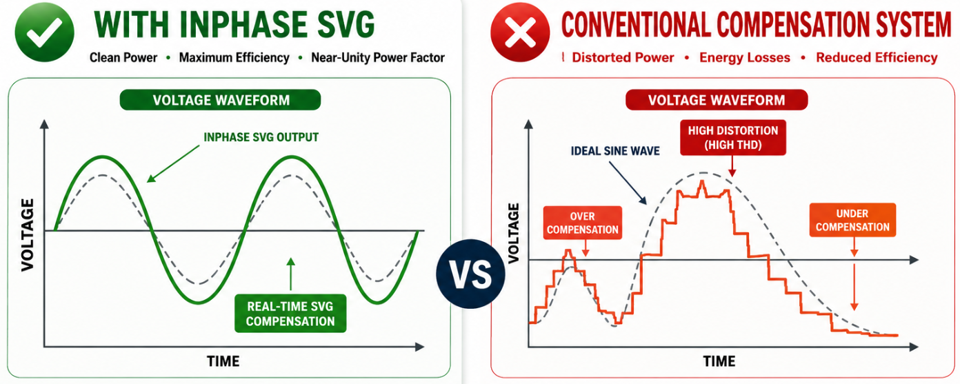
The figure above highlights the difference between InPhase SVG and a conventional compensation system under dynamic load conditions. Conventional systems often struggle to respond quickly to changing reactive power demands, leading to over-compensation, under-compensation, higher harmonic distortion, voltage instability, and increased energy losses. These issues can reduce overall system efficiency and place additional stress on electrical equipment.
With years of experience in power quality solutions, InPhase Power Technologies offers reliable SVG systems designed for modern industrial applications. Built with advanced 3-Level IGBT technology, InPhase SVGs deliver efficient and accurate reactive power compensation. With an efficiency of over 98%, a response time of less than 0.1 ms, and a power factor above 0.99, they help industries reduce power factor penalties, improve energy efficiency, and maintain stable electrical performance. Backed by strong engineering and dependable support, InPhase SVG solutions provide a simple and effective way to achieve better power quality and lower operating costs.
For industries seeking long-term energy savings, implementing the right Power Factor Improvement Methods is essential. Modern solutions such as SVG technology help reduce hidden electrical losses, improve system efficiency, and support reliable plant operations even under dynamic load conditions.