What is an Active Harmonic Filter?
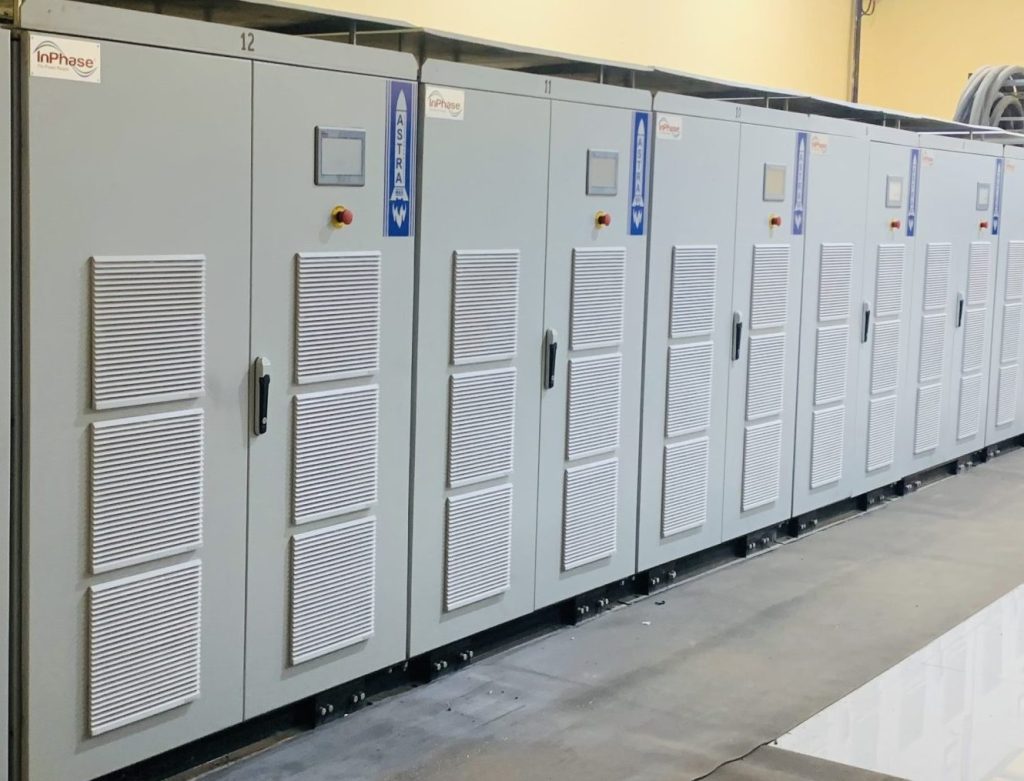
One of the best Industrial power quality solution , An Active Harmonic Filter (AHF) . It is an advanced power quality solution designed to eliminate harmonic distortion generated by non-linear electrical loads such as VFDs, UPS systems, rectifiers, and SMPS. The InPhase Active Harmonic Filter continuously monitors electrical networks and injects counter harmonic currents in real time to maintain clean and efficient power.
Why Harmonics Are a Serious Problem in Industrial Electrical Systems
Harmonic distortion can negatively impact electrical infrastructure and operational efficiency.Industries often follow the IEEE 519 standard to control harmonic distortion and maintain better power quality. Learn more about the standard from the IEEE Standards Association:
Common Problems Caused by Harmonics
 Transformer overheating
 Frequent breaker tripping
 Reduced system efficiency
 Increased energy losses
 Failure to comply with IEEE 519 standards
 Damage to CNC machines, PLCs, UPS systems and sensitive electronics
An Active Harmonic Filter helps eliminate these issues by dynamically compensating harmonic currents.
Why Active Harmonic Filters Are the Ideal Industrial Power Quality Solution
An industrial power quality solution is essential for modern industries that rely on nonlinear electrical loads such as variable frequency drives (VFDs), UPS systems, welding machines, CNC machines, robotics, and switched-mode power supplies. These loads generate harmonic distortion, making an industrial power quality solution necessary to maintain reliable electrical performance. As industries continue to automate, the need for an industrial power quality solution becomes even more critical.
An industrial power quality solution helps eliminate harmonic distortion, reduce voltage fluctuations, and improve overall electrical system stability. Among the available technologies, the Active Harmonic Filter (AHF) is considered one of the most effective industrial power quality solution options because it continuously monitors the electrical network and injects compensating currents in real time.
Unlike conventional passive filters, the Active Harmonic Filter automatically adapts to changing load conditions, making it a flexible industrial power quality solution for dynamic industrial environments. This advanced industrial power quality solution effectively reduces Total Harmonic Distortion (THD), improves power factor, minimizes neutral currents, and prevents transformer overheating.
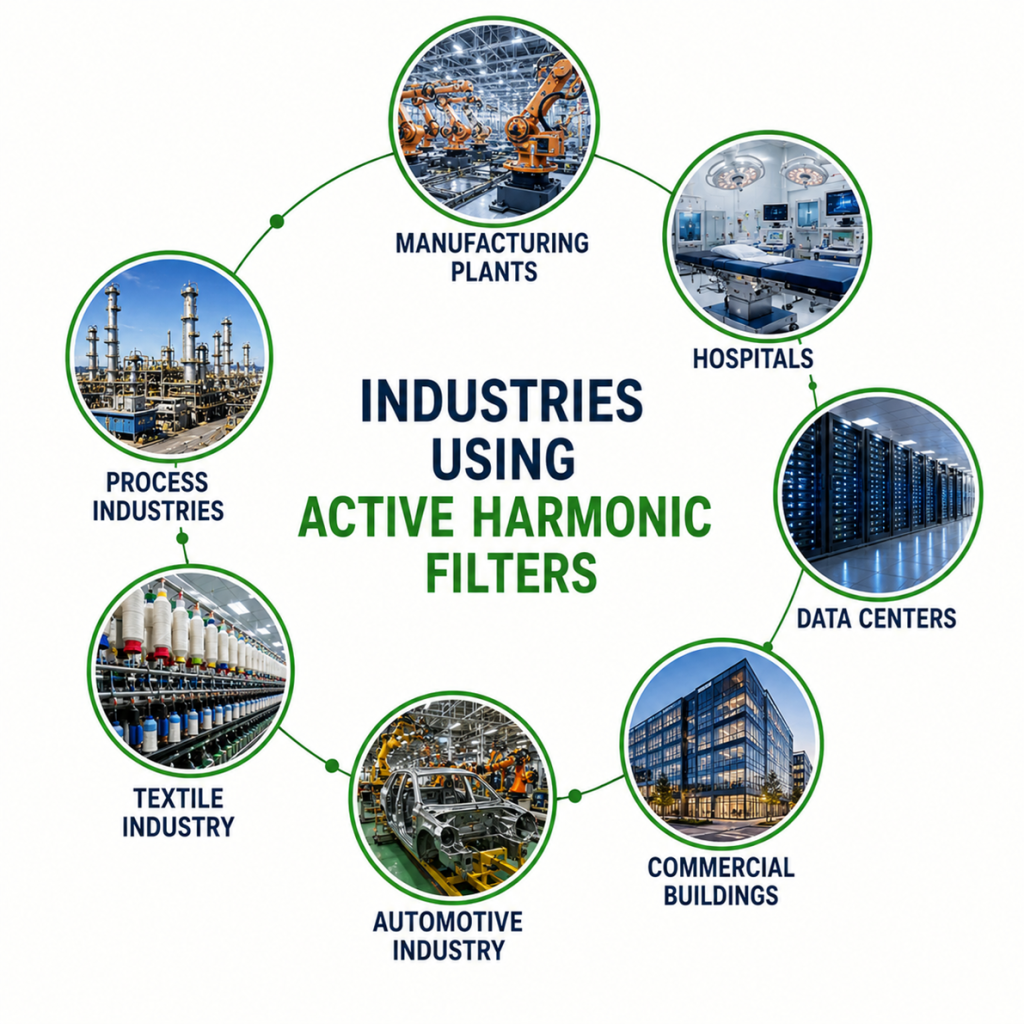
Industries such as manufacturing plants, hospitals, data centers, commercial buildings, automotive facilities, textile mills, and process industries depend on an industrial power quality solution to ensure uninterrupted operations. A reliable industrial power quality solution also supports compliance with IEEE 519 standards while improving equipment reliability.
By implementing an Active Harmonic Filter, industries gain an industrial power quality solution that extends equipment life, reduces maintenance costs, lowers energy consumption, and minimizes unexpected downtime. This industrial power quality solution also protects sensitive electrical equipment from the harmful effects of harmonics.
As industrial processes become more complex, selecting the right industrial power quality solution becomes a strategic decision. An Active Harmonic Filter provides an intelligent industrial power quality solution that responds instantly to changing electrical conditions without manual intervention.
A modern industrial power quality solution not only enhances energy efficiency but also increases productivity by ensuring stable and reliable power. The Active Harmonic Filter serves as a future-ready industrial power quality solution that supports sustainable industrial growth and long-term operational performance.
Organizations looking to optimize electrical systems recognize that investing in an industrial power quality solution is more than a maintenance decision—it is an investment in reliability and efficiency. With advanced real-time harmonic compensation, the Active Harmonic Filter delivers a complete industrial power quality solution for today’s demanding industrial applications.
Whether the objective is harmonic mitigation, power factor improvement, transformer protection, or energy savings, an Active Harmonic Filter provides a dependable industrial power quality solution. Every modern facility can benefit from an industrial power quality solution that ensures stable power quality, protects critical assets, and supports continuous production.
Ultimately, the Active Harmonic Filter has become the preferred industrial power quality solution for industries seeking higher efficiency, reduced operating costs, improved electrical reliability, and compliance with international standards. Choosing the right industrial power quality solution today ensures safer, more efficient, and more productive industrial operations tomorrow.
How an Active Harmonic Filter Works
The InPhase Active Harmonic Filter operates using advanced DSP-based technology.
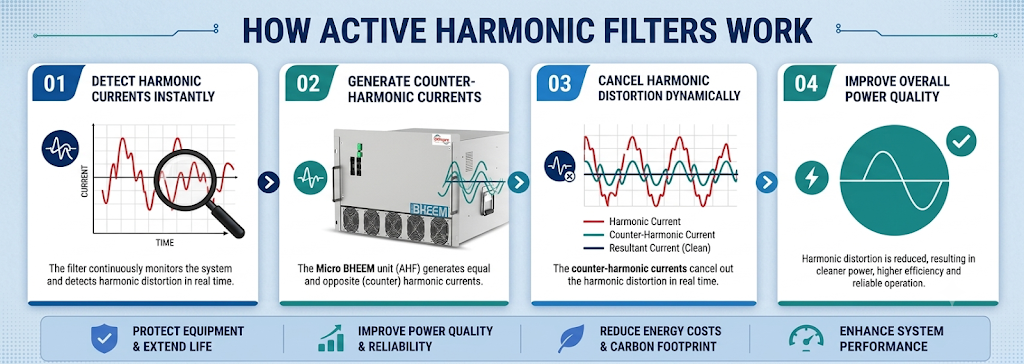
Working Principle of Active Harmonic Filter
1. Detect Harmonic Currents
The first and most important function of an Active Harmonic Filter is to continuously detect harmonic currents present in the electrical system. Modern industrial facilities contain numerous nonlinear loads such as Variable Frequency Drives (VFDs), UPS systems, rectifiers, welding machines, servo drives, induction furnaces, LED lighting, and switched-mode power supplies. These devices draw current in short pulses rather than in a smooth sinusoidal manner, creating harmonic distortion throughout the power distribution network.
To identify these harmonics, the Active Harmonic Filter uses highly accurate current transformers (CTs) or current sensors installed at strategic locations within the electrical system. These sensors measure the instantaneous load current flowing through each phase hundreds or even thousands of times every second.
The measured electrical signals are immediately transmitted to the filter’s high-speed Digital Signal Processor (DSP). The DSP continuously compares the measured current waveform with an ideal sinusoidal waveform to determine whether harmonic distortion exists.
Because industrial loads are constantly changing throughout production cycles, the detection process never stops. Every variation in motor speed, equipment startup, production load, or switching operation creates changes in harmonic levels. The Active Harmonic Filter continuously tracks these variations to ensure accurate harmonic compensation at all times.
Real-time detection is one of the major advantages of Active Harmonic Filters. Unlike passive filters, which are designed for fixed operating conditions, an Active Harmonic Filter automatically adapts to changing electrical environments without requiring manual adjustments.
Accurate harmonic detection forms the foundation of the entire filtering process. Without correctly identifying harmonic currents, effective compensation would not be possible.
2. Analyze Harmonic Frequency and Magnitude
After detecting harmonic currents, the Active Harmonic Filter immediately analyzes the characteristics of the distortion. Simply detecting the presence of harmonics is not sufficient; the system must determine exactly which harmonic frequencies are present and how severe they are.
The Digital Signal Processor performs mathematical analysis using advanced algorithms such as the Fast Fourier Transform (FFT). This technique separates the distorted current waveform into its individual frequency components.
For example, the processor identifies:
- Fundamental frequency (50 Hz or 60 Hz)
- 3rd harmonic
- 5th harmonic
- 7th harmonic
- 11th harmonic
- 13th harmonic
- Higher-order harmonics
The processor also calculates the magnitude, phase angle, and direction of every harmonic component. This information allows the Active Harmonic Filter to determine precisely how much compensation current must be generated.
Industrial electrical systems rarely operate under constant load conditions. Production machinery frequently starts and stops, motors accelerate or decelerate, and equipment operates at different capacities throughout the day. As a result, harmonic levels continuously fluctuate.
The Active Harmonic Filter performs this harmonic analysis repeatedly in real time, ensuring that every change in the electrical network is immediately recognized.
By accurately analyzing harmonic frequency and magnitude, the filter avoids overcompensation and undercompensation. This intelligent operation ensures maximum filtering efficiency while maintaining excellent power quality across the entire electrical system.
3. Generate Equal & Opposite Compensating Current
Once harmonic frequencies have been analyzed, the Active Harmonic Filter calculates the exact compensating current required to eliminate the unwanted harmonics.
The compensation follows the principle of destructive interference. For every harmonic current flowing through the electrical system, the filter generates another current having exactly the same magnitude but flowing in the opposite direction. When these two currents combine, they effectively cancel each other.
This compensating current is produced using high-speed power electronic devices such as Insulated Gate Bipolar Transistors (IGBTs). These semiconductor switches operate at extremely high switching frequencies, allowing the Active Harmonic Filter to create precise compensation currents almost instantaneously.
Unlike passive filters, which rely on fixed combinations of inductors and capacitors, Active Harmonic Filters generate only the compensation required at that specific moment. If harmonic levels increase, the filter automatically increases its output. If harmonic levels decrease, compensation is reduced accordingly.
This dynamic capability enables one Active Harmonic Filter to compensate for multiple harmonic frequencies simultaneously without requiring separate filters for different harmonic orders.
The ability to generate accurate compensating currents under varying operating conditions is what makes Active Harmonic Filters highly effective for modern industrial facilities with continuously changing electrical loads.
4. Inject Compensation Current in Real Time
After generating the required compensating current, the Active Harmonic Filter injects it directly into the electrical distribution system.
The injected current is synchronized with the existing harmonic currents but shifted by 180 degrees in phase. Because the two waveforms are equal and opposite, harmonic currents cancel each other almost instantly.
This compensation occurs continuously while industrial equipment is operating. Every time production loads change, the Active Harmonic Filter immediately adjusts its output without interrupting plant operations.
Real-time compensation is particularly valuable in industries where electrical loads fluctuate rapidly, including automotive manufacturing, steel plants, cement plants, pharmaceutical facilities, data centers, textile mills, and commercial buildings.
The response time of modern Active Harmonic Filters is typically measured in microseconds or milliseconds, allowing them to react almost instantly to sudden harmonic changes.
This fast response prevents harmonic distortion from spreading through transformers, generators, switchgear, cables, motors, and other critical electrical equipment.
Because compensation is continuous, there is no waiting period or manual intervention required. The electrical system remains protected around the clock regardless of changing operating conditions.
5. Restore the Sinusoidal Waveform
The final objective of an Active Harmonic Filter is to restore the distorted current waveform to a shape that closely resembles a pure sinusoidal waveform.
When harmonic currents are successfully cancelled, only the fundamental frequency remains. This significantly improves overall power quality and allows electrical equipment to operate more efficiently.
A cleaner sinusoidal waveform provides numerous benefits across the electrical system. Transformers operate at lower temperatures, reducing insulation stress and extending service life. Motors experience smoother torque and less vibration, improving reliability and minimizing mechanical wear. Cables carry lower RMS current, reducing heating losses and improving energy efficiency. Capacitor banks become less susceptible to harmonic-related failures, while protective devices operate more accurately without nuisance tripping.
Restoring a near-perfect sinusoidal waveform also helps facilities comply with IEEE 519 harmonic standards, reducing the risk of penalties, operational issues, and equipment malfunction.
In addition to harmonic mitigation, many modern Active Harmonic Filters also improve power factor, balance three-phase currents, reduce neutral current, and stabilize the electrical network. These additional functions make them a complete power quality solution for industrial and commercial installations.
By continuously restoring waveform quality, the Active Harmonic Filter enhances equipment reliability, reduces maintenance costs, lowers energy losses, and supports uninterrupted industrial production.
Result
 Reduced Total Harmonic Distortion (THD)
Improved power quality
Better equipment reliability
Enhanced energy efficiency
Key Features of InPhase Active Harmonic Filter
The InPhase Active Harmonic Filter offers:
- Real-time harmonic compensation
- THD reduction below 5%
- IEEE 519 compliance
- Compact modular design
- Intelligent DSP control
- Improved power factor
- Reduced electrical losses
- Easy installation and scalability
- Compatible with VFDs, UPS, Rectifiers and SMPS loads
Benefits of Installing an Active Harmonic Filter
1. Improves Power Quality
Reduces current and voltage distortion.
2. Protects Electrical Equipment
Prevents overheating and premature failures.
3. Ensures IEEE 519 Compliance
Maintains harmonic levels within recommended limits.
4. Reduces Energy Losses
Improves overall electrical efficiency.
5. Minimizes Downtime
Enhances plant reliability and productivity.
6. Improves Power Factor
Supports better electrical performance.
7. Lowers Maintenance Costs
Reduces stress on electrical infrastructure.