
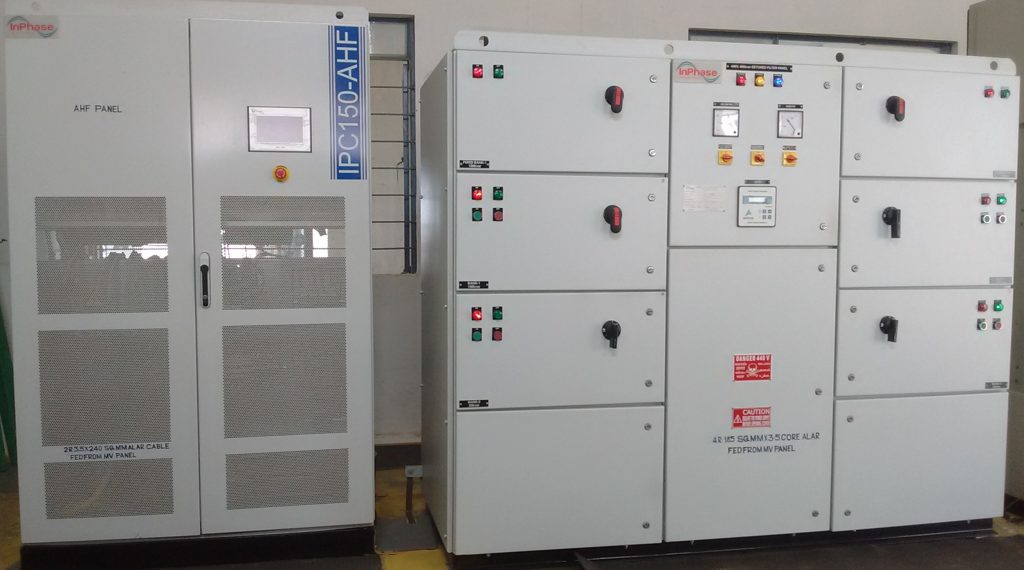
Filter Harmonics to maintain optimal power quality in modern industries. As facilities increasingly rely on VFDs, UPS systems, robotics, and automation equipment to improve productivity, these non-linear loads generate harmonics that can negatively affect electrical system performance.
Think of your electrical system as a highway. Harmonics are like unwanted traffic that creates congestion, slowing down the smooth flow of power and increasing the risk of disruptions.
“Harmonics may be invisible, but their impact can be seen in equipment failures, energy losses, and production downtime.”
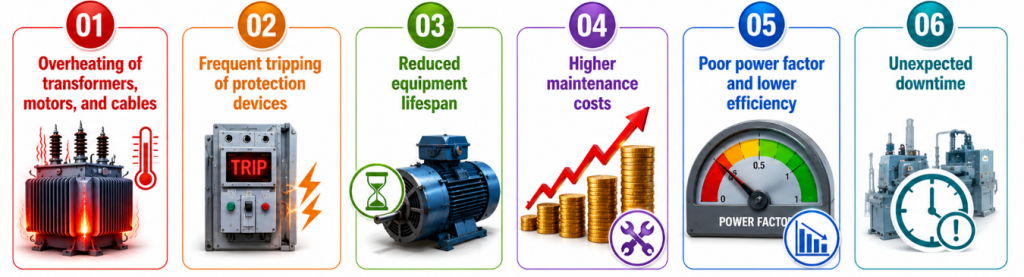
When harmonics are left uncontrolled, consequences are as follows :
To address these challenges, Active Harmonic Filters (AHFs) have become one of the most effective power quality solutions. However, achieving the full benefits of an AHF requires careful evaluation and selection of the right solution for your facility.
What is Filter Harmonic?
A Filter Harmonic solution is a power quality technology designed to reduce or eliminate harmonic distortion generated by non-linear electrical loads in an electrical distribution system. A Filter Harmonic addresses unwanted voltage and current waveforms that occur at multiples of the fundamental frequency (50 Hz or 60 Hz), restoring the ideal sinusoidal waveform and improving overall power quality.
Modern industrial facilities increasingly rely on equipment such as Variable Frequency Drives (VFDs), UPS systems, PLCs, rectifiers, welding machines, and switched-mode power supplies. While these devices improve efficiency and automation, they also draw non-linear currents that generate harmonics throughout the electrical network. As harmonic levels increase, a Filter Harmonic solution becomes essential to protect electrical infrastructure, improve system reliability, and maintain stable operation.
A Filter Harmonic works by either absorbing or actively cancelling harmonic currents before they circulate through the electrical system. By restoring a cleaner sinusoidal waveform, a Filter Harmonic improves power quality, enhances energy efficiency, extends equipment life, and reduces maintenance requirements.
Implementing a Filter Harmonic helps prevent transformer overheating, capacitor failures, nuisance tripping, cable overheating, and excessive energy losses caused by harmonic distortion. A properly selected Filter Harmonic also improves power factor, increases the lifespan of critical electrical assets, and ensures the reliable operation of sensitive industrial equipment.
Choosing the right Filter Harmonic depends on factors such as harmonic spectrum, load characteristics, system configuration, and future expansion requirements. Whether using passive or active technology, a Filter Harmonic should be designed to address the specific harmonic profile of the facility.
Today, industries across manufacturing, data centers, commercial buildings, pharmaceuticals, automotive, steel, cement, and process plants rely on Filter Harmonic solutions to maintain high power quality and uninterrupted production. Investing in a Filter Harmonic not only reduces operating costs but also enhances electrical system performance and reliability.
As industries continue to adopt advanced automation and digital technologies, the demand for Filter Harmonic solutions is steadily increasing. An effective Filter Harmonic strategy enables facilities to operate more efficiently while minimizing the risks associated with harmonic distortion.
Ultimately, a Filter Harmonic is an essential component of modern power quality management. By reducing harmonic distortion, improving electrical efficiency, protecting critical equipment, and supporting compliance with IEEE 519 standards, a Filter Harmonic delivers long-term operational and financial benefits for industrial facilities.
Why Harmonics Are a Serious Problem
Harmonic distortion is more than just a power quality issue . it directly affects the reliability, efficiency, and lifespan of industrial electrical systems. A Filter Harmonic solution is essential to control these distortions before they impact critical equipment. Without a Filter Harmonic, excessive harmonics can lead to transformer overheating, capacitor failures, nuisance tripping, and increased energy losses.
Implementing a Filter Harmonic helps maintain a clean electrical waveform, improving equipment performance and reducing unplanned downtime. A properly designed Filter Harmonic also minimizes maintenance costs, extends the life of electrical assets, and enhances overall system reliability. By investing in a Filter Harmonic, industries can ensure stable operations, improved energy efficiency, and compliance with IEEE 519 power quality standards.
Transformer Overheating
Harmonic currents increase transformer losses, causing excessive heat generation. Continuous overheating accelerates insulation ageing, reduces transformer efficiency, and shortens its service life.
Motor Overheating
Electric motors operating under harmonic distortion experience additional copper and iron losses. This results in higher operating temperatures, reduced efficiency, increased vibration, and premature motor failure.
Capacitor Failures
Power factor correction capacitors are highly sensitive to harmonics. Excessive harmonic currents can cause capacitor overheating, dielectric breakdown, resonance problems, and unexpected capacitor bank failures.
Cable Heating
Harmonic currents increase the RMS current flowing through conductors, resulting in excessive cable heating. Prolonged overheating damages insulation, reduces cable life, and increases the risk of electrical faults.
Higher Energy Costs
Harmonics contribute to additional power losses in transformers, cables, and electrical equipment. These losses reduce overall system efficiency, increase electricity consumption, and may lead to utility penalties due to poor power quality.
Equipment Downtime
Sensitive automation systems, PLCs, drives, and electronic equipment can malfunction or trip unexpectedly when exposed to high harmonic distortion. These interruptions reduce productivity, increase maintenance expenses, and result in costly unplanned downtime.
For these reasons, implementing an effective harmonic filtering solution has become essential for industries seeking reliable, energy-efficient, and uninterrupted operations.
Types of Harmonic Filters
Various harmonic filtering technologies are available to reduce harmonic distortion, each designed to meet different operational requirements and power quality challenges.
Passive Harmonic Filter
A Passive Harmonic Filter uses combinations of inductors, capacitors, and resistors that are tuned to specific harmonic frequencies. It diverts harmonic currents away from the electrical system, making it a cost-effective solution for applications with relatively stable load conditions. However, passive filters may introduce resonance issues and cannot easily adapt to changing harmonic levels.
Active Harmonic Filter (AHF)
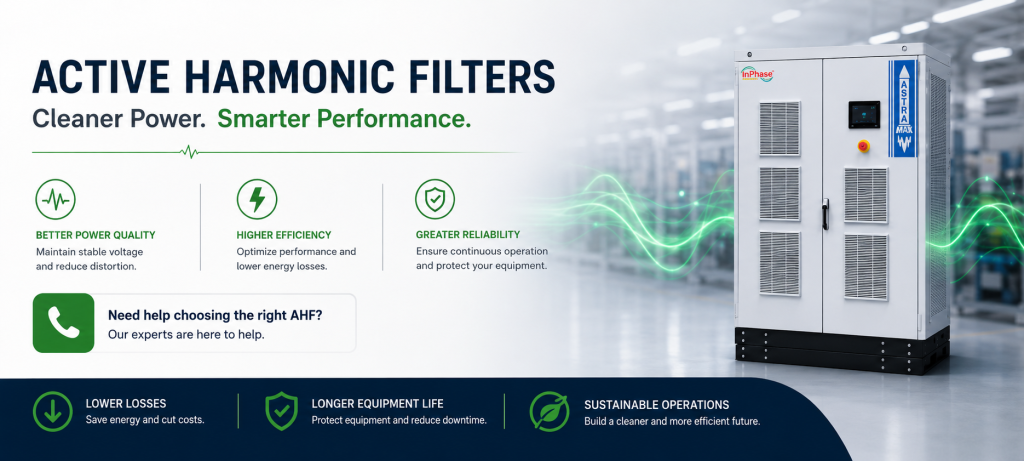
An Active Harmonic Filter (AHF) continuously monitors the electrical system, detects harmonic currents in real time, and injects equal and opposite compensation currents to cancel harmonic distortion instantly. Unlike passive filters, AHF automatically adapts to varying load conditions, filters multiple harmonic orders simultaneously, and provides consistent power quality without the risk of resonance. This makes it the preferred solution for modern industrial facilities with dynamic electrical loads.
Hybrid Harmonic Filter
A Hybrid Harmonic Filter combines the strengths of passive and active filtering technologies. Passive components handle dominant lower-order harmonics efficiently, while the active filter compensates for higher-order and varying harmonics. This combination provides enhanced harmonic mitigation, improved power factor correction, and optimized system performance for applications with complex power quality requirements.
Among these technologies, the Active Harmonic Filter (AHF) has become the preferred choice for modern industries because it delivers dynamic, real-time harmonic compensation without the limitations associated with conventional passive filters. Its ability to respond instantly to changing load conditions, eliminate multiple harmonic orders, and maintain consistent power quality makes it the most reliable solution for today’s automated industrial environments.
What is Astra Active Harmonic Filter?
The Astra Active Harmonic Filter represents a breakthrough in power quality solutions, specifically engineered to address harmonics, reactive power, and unbalance issues in industrial electrical systems. This cutting-edge technology combines multi-level inverter design with intelligent DSP processing to deliver unmatched harmonic mitigation performance.
Unlike conventional passive filters that target specific harmonic frequencies, Astra’s active filtering technology dynamically responds to changing load conditions and eliminates a broad spectrum of harmonics in real-time. The system’s 3-level topology ensures superior waveform quality while minimizing switching losses and electromagnetic interference.
How Astra Active Harmonic Filter Works
The Astra Active Harmonic Filter (AHF) operates on a closed-loop control system that continuously detects, analyzes, and compensates for harmonic currents in real time. Unlike conventional passive filters that are tuned to specific harmonic frequencies, Astra AHF dynamically responds to changing load conditions, ensuring consistent harmonic mitigation without the risk of resonance. The entire compensation process takes place within milliseconds, allowing industries to maintain excellent power quality even under rapidly varying electrical loads.
Step 1: Measure Harmonic Currents
The Astra Active Harmonic Filter continuously monitors the electrical system using high-speed current transformers (CTs). These sensors measure the load current and detect harmonic distortion generated by non-linear loads such as Variable Frequency Drives (VFDs), UPS systems, rectifiers, and other power electronic equipment.
Step 2: Analyze the Harmonic Content
The measured signals are processed by Astra’s advanced Dual Quad-Core DSP controller, which performs real-time harmonic analysis. The controller identifies the harmonic orders, calculates their magnitude and phase angle, and determines the exact compensation current required to eliminate the distortion.
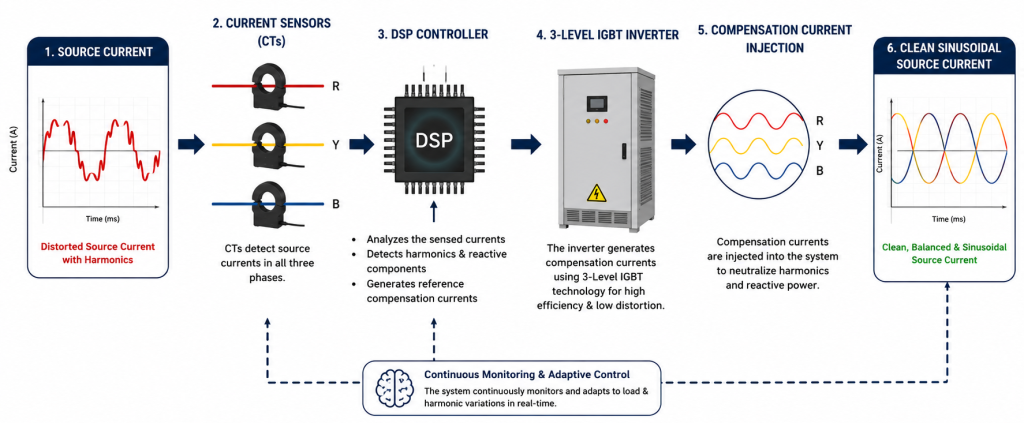
Step 3: Generate Opposite Harmonic Current
Based on the analysis, the Astra AHF commands its advanced 3-Level IGBT inverter to generate harmonic currents that are equal in magnitude but opposite in phase to the unwanted harmonic currents present in the electrical system.
Step 4: Inject the Compensation Current
The inverter injects these compensating currents directly into the electrical network. Since the injected current is 180° out of phase with the harmonic current produced by the load, the two currents effectively cancel each other.
Step 5: Cancel Harmonics and Improve Power Quality
Once the harmonic currents are cancelled, only the fundamental current is drawn from the utility supply. This significantly reduces Total Harmonic Distortion (THD), improves power quality, minimizes transformer and motor heating, reduces electrical losses, prevents nuisance tripping, and helps industries comply with IEEE 519 harmonic standards.
The entire process is continuous and automatic, enabling the Astra Active Harmonic Filter to adapt instantly to changing load conditions without manual tuning or interruption to industrial operations. This real-time compensation capability makes Astra AHF an ideal solution for modern facilities where harmonic levels fluctuate throughout the day.
Why InPhase Power Technologies?
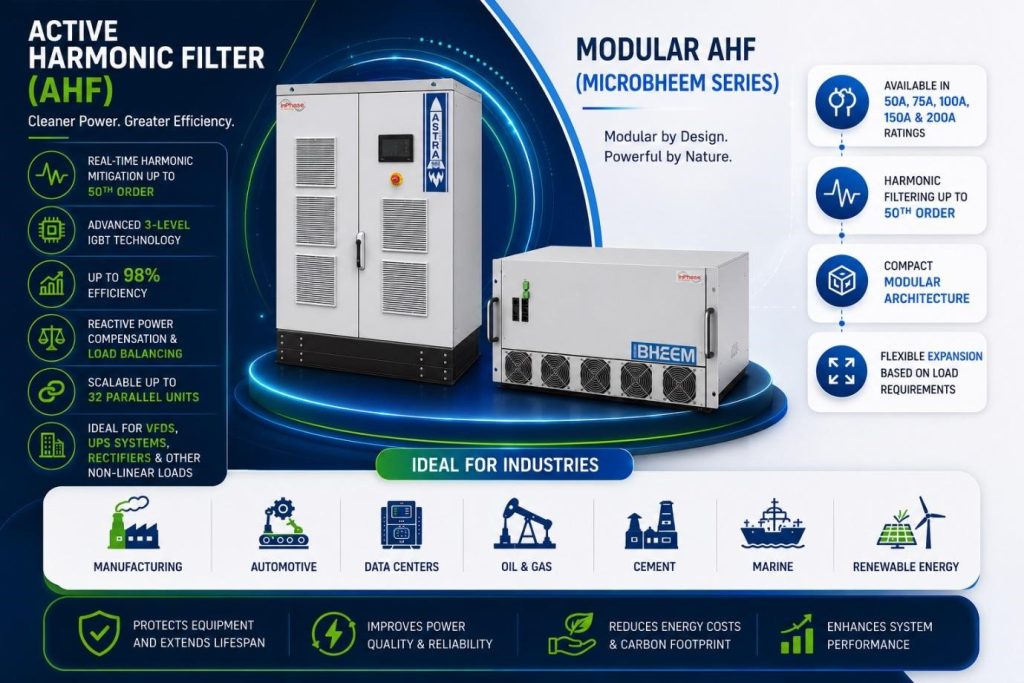
InPhase offers a complete range of Active Harmonic Filter solutions tailored to diverse power quality requirements. The MicroBheem Series is a compact, modular, and scalable solution ideal for small industries like commercial buildings, data centers, hospitals, textile units, renewable energy systems, and light manufacturing industries. For high-power applications, the ASTRA Series is engineered to deliver superior harmonic mitigation and reactive power compensation in manufacturing plants, automotive facilities, cement industries, steel plants, oil & gas operations, marine applications, and other heavy industrial sectors.
From small-scale facilities to large industrial operations, InPhase provides the right solution for cleaner, more efficient, and reliable power.
Learn more about our Active Harmonic Filter solutions at InPhase Power Technologies.