
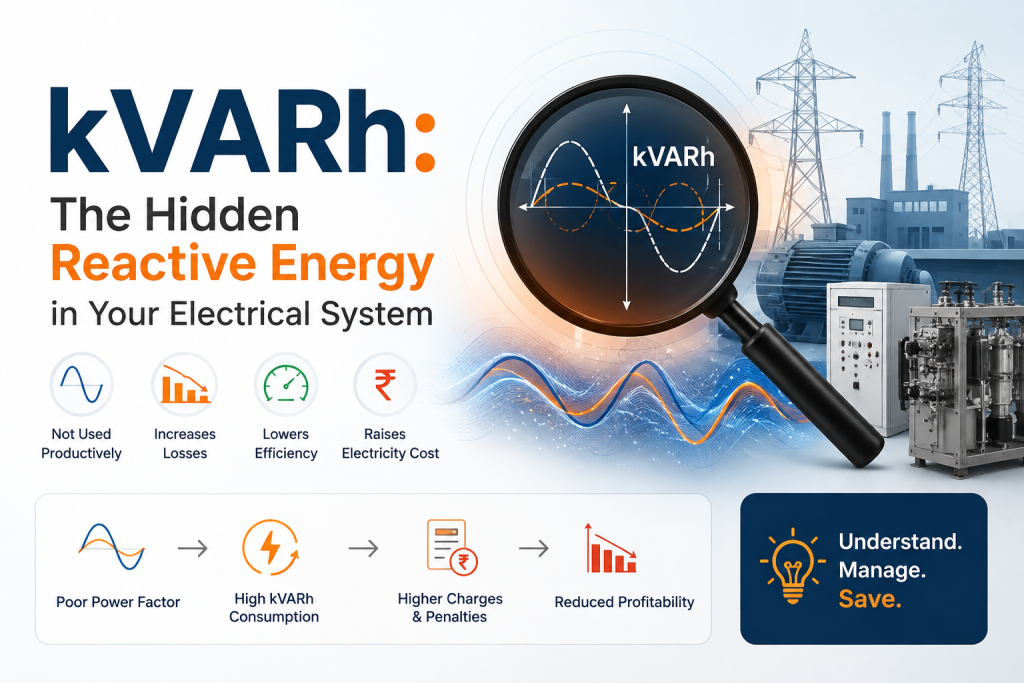
Your factory is running as usual. Motors are running, machines are operating, and the production line is continuing without interruption. But behind this normal operation, something else is happening in the electrical system that can quietly increase the overall energy demand.
Reactive energy.
This is where kVARh becomes important.
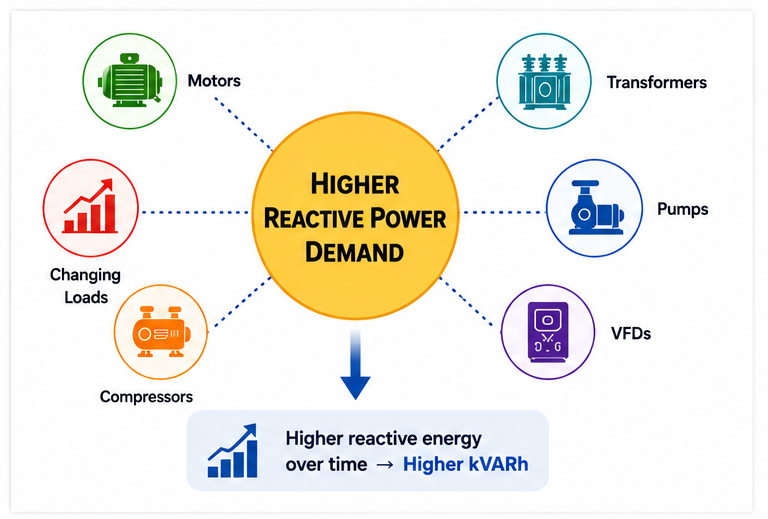
In industrial facilities, motors, transformers, pumps, compressors, variable frequency drives, and other inductive loads require reactive power during operation. When this reactive power continues to flow over time, it contributes to the total kVARh recorded by the electrical system.
So, what is kVARh, why does it increase, and how can industries manage it effectively?
Let’s take a closer look.
What Is kVARh?
kVARh stands for kilovolt ampere reactive hour.
It represents the amount of reactive energy exchanged by an electrical system over a period of time.
To understand kVARh, it helps to first distinguish between active energy and reactive energy.
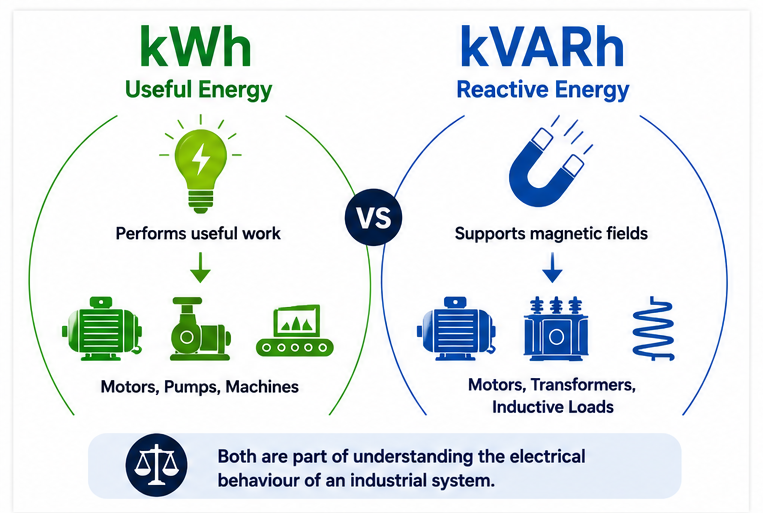
kWh → Useful electrical energy
kVARh → Reactive electrical energy
Active power is responsible for useful work such as driving a motor, operating a pump or running production equipment. Reactive power, on the other hand, is required by many inductive loads to establish the magnetic fields needed for their operation. When reactive power is required continuously over time, the corresponding reactive energy accumulates as kVARh.
Where Does Reactive Energy Come From?
Industrial facilities contain many types of electrical equipment that require reactive power.
Common examples include:
• Motors
• Transformers
• Pumps
• Compressors
• Reactors
• Variable frequency drives
• Other inductive loads
The reactive power requirement is not necessarily constant. It changes according to how the equipment operates. This means the kVARh of an industrial facility can also change with its operating conditions.
Why Does kVARh Increase?
The reactive power requirement of an industrial facility is rarely constant.
Imagine a manufacturing plant with several motors, pumps and compressors. Some machines may operate continuously, while others start and stop depending on the production process. When the operating condition changes, the reactive power requirement changes too.
For example, a lightly loaded motor can have a different power factor compared with the same motor operating closer to its rated load. Similarly, starting and stopping large motors can change the reactive power requirement of the facility.
As reactive power continues to be exchanged over time, the accumulated reactive energy increases.
This can lead to higher kVARh values.
Factors that can influence reactive energy demand include:
• Large inductive loads
• Motors operating at varying loads
• Transformer loading
• Pumps and compressors
• Variable frequency drives
• Frequently changing industrial loads
• Poor power factor conditions
So, kVARh is not just about how much equipment an industry has. It is also about how that equipment behaves while operating.
What Happens When Reactive Power Demand Is High?
Reactive power does not directly produce useful mechanical work, but it still has to flow through parts of the electrical system. When reactive power demand increases, the electrical system may experience higher current flow for the same active power requirement.
This can contribute to:
• Higher current flow
• Increased electrical losses
• Greater transformer and cable loading
• Lower power factor
• Higher apparent power demand
• Reduced overall electrical efficiency
For an industry operating large electrical loads, these effects can become more important as the reactive power requirement increases.
”The goal is not to eliminate reactive power completely. The goal is to manage unnecessary reactive power demand effectively.”
And this brings us to an important question.
Can conventional power factor correction help manage kVARh?
Can Conventional Power Factor Correction Manage kVARh?
Traditional methods such as capacitor banks and Automatic Power Factor Correction (APFC) panels are commonly used to compensate for reactive power in industrial electrical systems.
Capacitor banks supply reactive power locally, reducing the amount of reactive power that needs to be supplied from the upstream electrical system. For installations where the reactive power requirement is relatively stable, capacitor banks can provide a simple and economical solution.
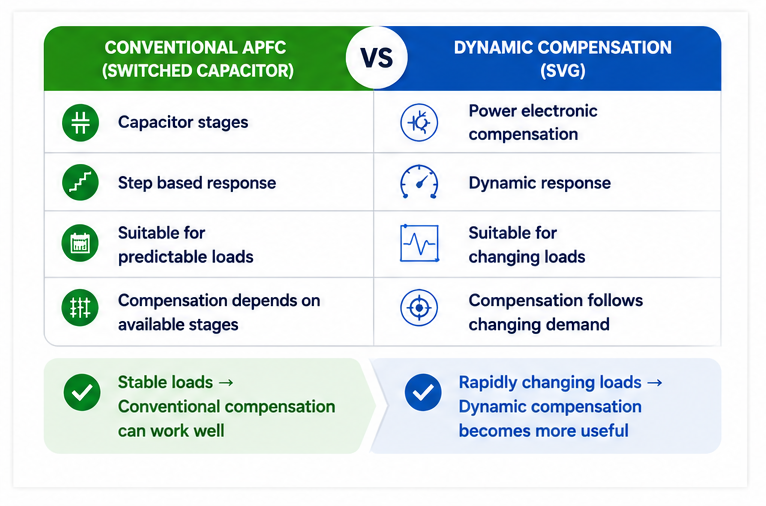
APFC provides a more flexible approach. It monitors the system power factor and automatically switches capacitor stages according to the reactive power requirement. This makes APFC suitable for many industrial applications where the load varies but remains reasonably predictable.
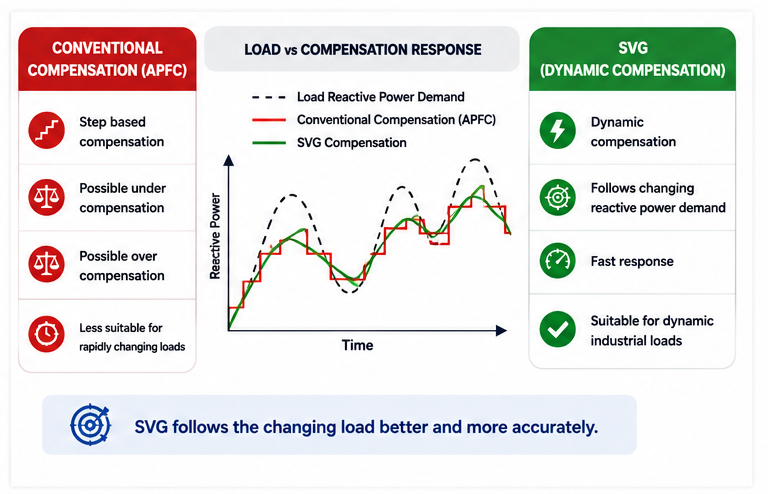
However, APFC still works through discrete capacitor steps. When the reactive power requirement changes rapidly, the available capacitor stages may not exactly match the requirement at every moment. This does not mean that APFC is unsuitable.
Rather, the right compensation method depends on how the electrical load behaves. For relatively stable loads, conventional compensation can work effectively.
But what happens when the reactive power requirement keeps changing?
This is where dynamic reactive power compensation becomes important.
Modern industrial facilities also need to consider power quality along with reactive energy management. Nonlinear loads such as variable frequency drives and power electronic equipment can introduce harmonic distortion into the electrical system. IEEE 519 provides guidelines for harmonic control in electric power systems and establishes voltage and current distortion goals at the point of common coupling (PCC).
This means that managing reactive energy is not only about improving power factor. Maintaining overall power quality is equally important for efficient and reliable industrial operation.
SVG: A Smarter Approach to kVARh Management
A Static VAR Generator (SVG) provides a dynamic approach to reactive power compensation for applications where the reactive power requirement changes frequently. Unlike conventional capacitor based methods, an SVG uses power electronic technology to monitor the electrical system and adjust reactive power compensation according to the changing load condition.
When the reactive power demand increases, the SVG increases its compensation. When the reactive power demand decreases, the SVG reduces its compensation accordingly. This allows the compensation to follow the actual reactive power requirement more effectively.
The objective is to provide the right compensation when it is required.
For industries with rapidly changing loads, this dynamic approach can support better kVARh management and more efficient utilization of the electrical system.
Why Choose InPhase SVG?
When reactive power demand changes continuously, the compensation system needs to respond accordingly. This is where InPhase SVG offers a practical solution for modern industrial applications.
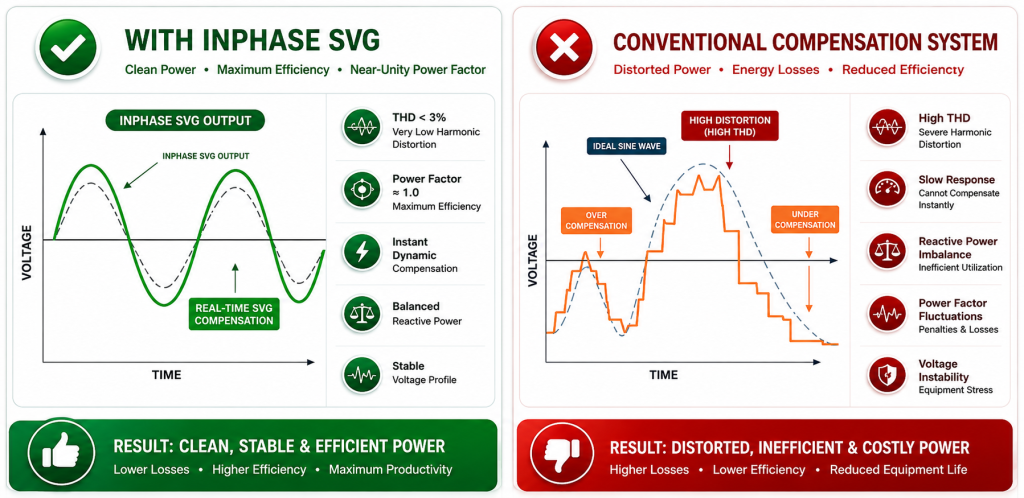
InPhase SVG continuously monitors the electrical system and dynamically adjusts reactive power compensation according to the actual requirement. This helps manage reactive power flow and supports better kVARh management in facilities with changing electrical loads.
Built with advanced 3 Level IGBT technology, InPhase SVG is designed for fast and accurate reactive power compensation.
InPhase SVG offers:
• Over 98% efficiency
• Response time of less than 0.1 ms
• Power factor above 0.99
• Dynamic reactive power compensation
• Fast response to changing load conditions
• Reduced risk of under compensation and over compensation
• Improved electrical system efficiency
For industries operating motors, pumps, compressors, VFDs and other dynamic loads, this ability to respond to changing reactive power requirements can make a significant difference.
Instead of simply adding compensation, InPhase SVG provides compensation according to the actual requirement of the electrical system.
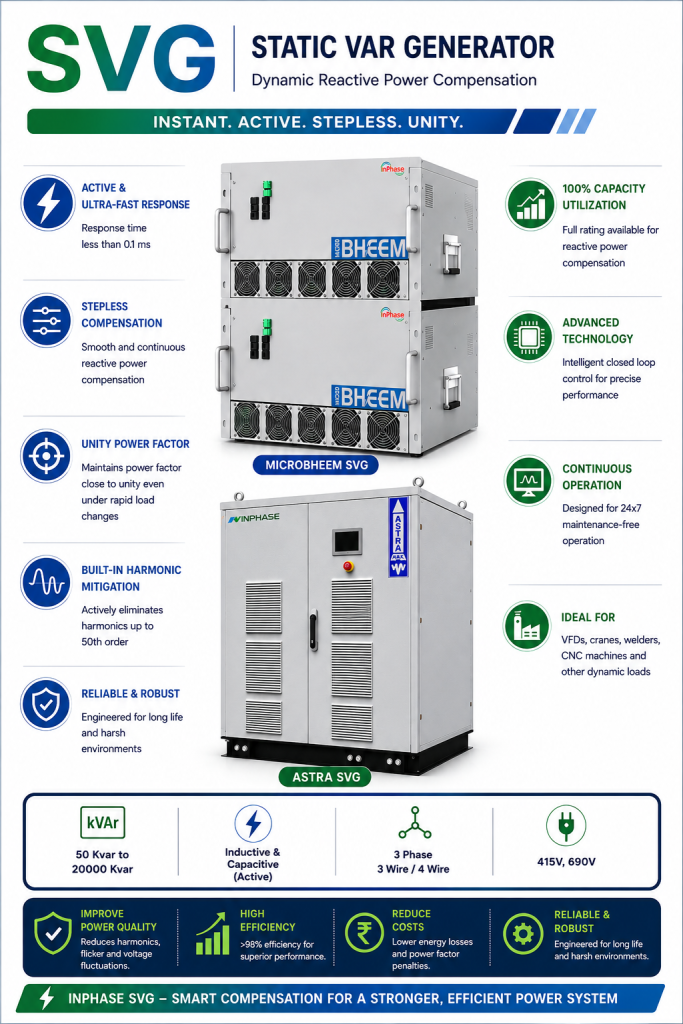
InPhase SVG solutions are designed to provide fast and dynamic reactive power compensation for modern industrial electrical systems.
Explore InPhase SVG Solutions.