
How Static VAR Generator Technology Is Changing Industrial Power Systems
Modern Static VAR Generator technology offers industries a more flexible approach to reactive power compensation. Unlike conventional capacitor banks that switch capacitor steps, an SVG dynamically adjusts reactive power compensation according to changing electrical loads.
This makes SVG technology particularly useful in facilities where electrical demand changes frequently.
Key advantages include:
-
Fast dynamic reactive power compensation
-
Improved power factor under varying load conditions
-
Reduced switching operations
-
Better voltage stability
-
Reduced dependence on conventional capacitor switching
-
Flexible integration with existing capacitor bank systems
SVG vs Capacitor Bank: Which Is Better for Your Industry?
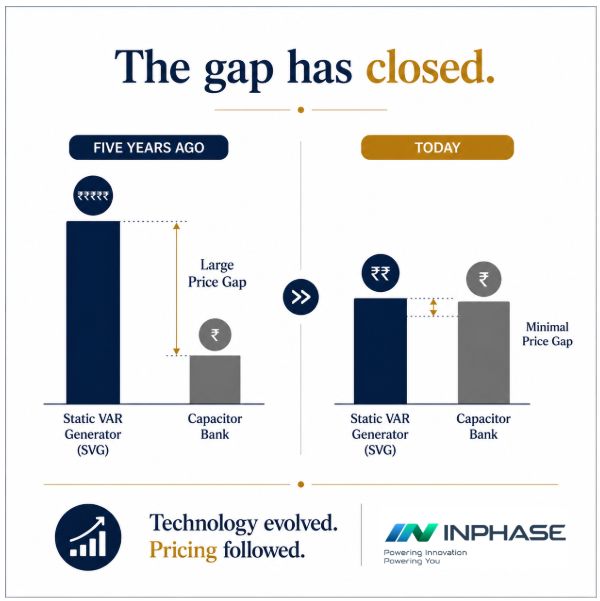
Both technologies have a role in industrial power factor correction. The right choice depends on load characteristics, required response time, system capacity and investment considerations.
A conventional capacitor bank can be suitable for stable loads with relatively predictable reactive power demand.
A Static VAR Generator is more suitable for applications involving rapidly changing loads, frequent power factor variations and demanding operating conditions.
A hybrid configuration combines the advantages of both technologies. Capacitor banks handle the relatively steady reactive power requirement, while the SVG compensates for dynamic variations.
When Should Industries Consider a Hybrid SVG System?
Industries with existing capacitor banks do not necessarily need to replace their entire power factor correction infrastructure.
A hybrid SVG solution can be considered when:
-
Existing capacitor banks are experiencing frequent switching.
-
Loads change rapidly throughout production cycles.
-
Power factor fluctuates significantly.
-
Capacitor maintenance costs are increasing.
-
More precise reactive power compensation is required.
For installations above 300 kVAr, hybrid configurations may offer an attractive solution depending on the load profile and operating conditions. For larger installations above 700 kVAr, a full SVG solution may also be worth evaluating against a conventional capacitor bank.
These are application-specific guidelines, not universal sizing rules. A detailed electrical assessment is recommended before selecting the configuration.
The Future of Static VAR Generator Technology in India
The increasing adoption of VFDs, renewable energy systems, data centres, EV charging infrastructure and automated manufacturing is changing industrial electrical demand.
As these applications expand, industries need power factor correction systems that respond quickly to changing loads.
Static VAR Generator technology is becoming an important part of this transition from conventional passive compensation towards intelligent, dynamic power management.
At InPhase, we focus on delivering application-specific SVG and hybrid power quality solutions that help industries improve electrical performance, reliability and operational efficiency.
Explore our Static VAR Generator solutions and industrial power quality products to understand the available technologies.
Frequently Asked Questions
1. What is Static VAR Generator technology?
Static VAR Generator technology is an advanced reactive power compensation technology that dynamically supplies or absorbs reactive power to maintain the desired power factor and improve electrical system performance.
2. What is the difference between an SVG and a capacitor bank?
A capacitor bank uses switched capacitor steps for reactive power compensation, while an SVG provides continuously adjustable, dynamic compensation.
3. Can an SVG work with an existing capacitor bank?
Yes. An SVG can be integrated with an existing capacitor bank in a hybrid configuration, subject to system design and electrical compatibility.
4. When should an industry choose a full SVG solution?
A full SVG solution may be appropriate when loads change rapidly, precise compensation is required and the application justifies the investment.
5. Does an SVG improve power factor?
Yes. An appropriately sized and configured SVG can dynamically compensate reactive power and help maintain a higher power factor.
6. What industries can benefit from SVG technology?
Steel, textile, cement, automotive, manufacturing, data Centre and other industries with fluctuating reactive power demand can benefit from SVG solutions.
We started building SVGs when most people thought capacitor banks were enough. Today, that belief is what drives us — the shift from passive to active compensation is real, and it’s accelerating. Learn more about our Static VAR Generator solutions.
For facilities looking to improve harmonic performance alongside power factor correction, explore our Active Harmonic Filter and complete range of Industrial Power Quality Products.
To understand common industrial electrical challenges and how they affect equipment performance, explore our Power Quality Solutions.
For technical reference, consult the official IEEE 519-2022 Standard for harmonic control in electric power systems.