
Active Harmonic Filters: Complete Industrial Power Quality Guide 2025
Power Quality Guide explains the Working Principle of Active Harmonic Filters, one of the most important concepts in modern power quality management. Industrial and commercial electrical systems face increasing harmonic distortion from nonlinear loads such as VFDs, UPS systems, LED lighting, and SMPS units. Understanding the Working Principle of Active Harmonic Filters helps industries improve efficiency, protect equipment, and achieve IEEE 519 compliance.
InPhase Active Harmonic Filters (AHFs) provide real-time harmonic detection and cancellation, delivering superior power quality and enhanced system reliability for industrial applications.
Power Quality Guide: Your Complete Resource for Reliable and Efficient Electrical Systems
A Power Quality Guide is an essential resource for understanding and improving the performance of modern electrical systems. Whether you manage an industrial plant, commercial facility, or critical infrastructure, a Power Quality Guide helps identify issues such as harmonic distortion, voltage fluctuations, poor power factor, and electrical imbalances. By following a comprehensive Power Quality Guide, engineers can implement effective solutions that improve system reliability, reduce energy losses, and extend equipment life.
A well-structured Power Quality Guide explains the causes and effects of poor power quality while providing practical methods to eliminate electrical disturbances. Every Power Quality Guide emphasizes the importance of harmonic mitigation, proper power factor correction, and compliance with IEEE 519 standards. Using a trusted Power Quality Guide, industries can make informed decisions when selecting Active Harmonic Filters, Static VAR Generators, and other power quality solutions.
A reliable Power Quality Guide also helps maintenance teams detect potential electrical problems before they result in equipment failures or costly downtime. With the support of a detailed Power Quality Guide, organizations can optimize energy efficiency, improve system performance, and ensure stable operation under varying load conditions. As electrical systems become more complex, a modern Power Quality Guide serves as a valuable reference for designing, operating, and maintaining efficient and reliable power distribution networks. Every engineer, consultant, and facility manager can benefit from a comprehensive Power Quality Guide that simplifies complex concepts and supports better decision-making for long-term electrical system performance.
Why Industrial Facilities Need Active Harmonic Filters
Industrial facilities rely heavily on modern electrical equipment such as variable frequency drives (VFDs), UPS systems, rectifiers, welding machines, and automated production lines. These nonlinear loads generate harmonic distortion, leading to poor power quality, increased energy losses, equipment overheating, nuisance tripping, and reduced system reliability. Understanding the Working Principle of Active Harmonic Filters helps industries address these challenges effectively by providing dynamic harmonic compensation instead of relying on fixed compensation methods.
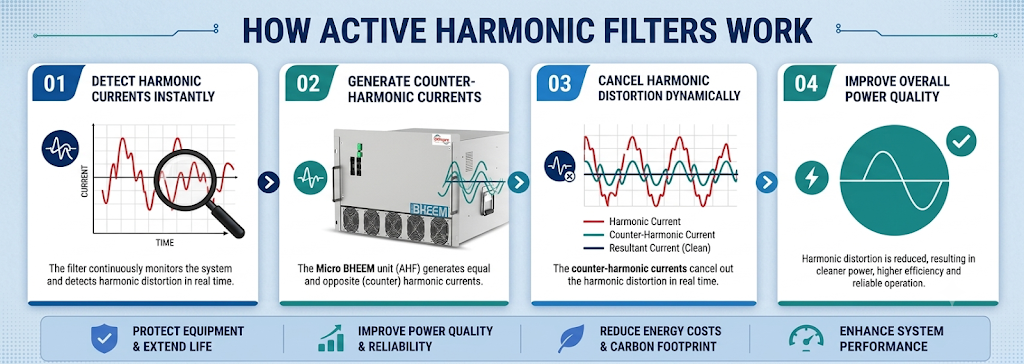
The Working Principle of Active Harmonic Filters enables industries to continuously monitor electrical networks, detect harmonic currents in real time, and inject equal and opposite compensating currents to cancel unwanted harmonics. This dynamic operation ensures stable performance even under rapidly changing industrial loads, making Active Harmonic Filters a preferred solution for modern facilities.
A comprehensive Power Quality Guide explains how harmonic mitigation improves electrical system efficiency and equipment life. Every industrial Power Quality Guide highlights the importance of reducing harmonic distortion to comply with IEEE 519 standards. A reliable Power Quality Guide also helps engineers understand how Active Harmonic Filters protect transformers, motors, capacitors, and sensitive electronic equipment from harmonic-related failures. Following a detailed Power Quality Guide allows maintenance teams to identify power quality issues before they become costly problems.
In addition, a practical Power Quality Guide demonstrates how Active Harmonic Filters improve overall system efficiency by minimizing electrical losses and preventing voltage distortion. An effective Power Quality Guide also explains how harmonic mitigation contributes to improved power factor, lower maintenance costs, and increased operational reliability. Many industries use a trusted Power Quality Guide when planning electrical system upgrades to ensure the correct harmonic mitigation strategy is selected.
As industrial automation continues to expand, every engineer and facility manager can benefit from a modern Power Quality Guide that covers harmonic analysis, filter selection, IEEE 519 compliance, and long-term system performance. Choosing solutions based on a well-structured Power Quality Guide helps industries maintain reliable operations while protecting critical electrical infrastructure. Ultimately, a comprehensive Power Quality Guide serves as an essential resource for understanding, implementing, and optimizing the Working Principle of Active Harmonic Filters in industrial power systems.
Working Principle of Active Harmonic Filters
Understanding Harmonics in Industrial Power Systems
A clear understanding of the Working Principle of Active Harmonic Filters helps engineers select the right harmonic mitigation solution. Unlike passive filters, the Working Principle of Active Harmonic Filters allows real-time adaptation to load variations, making it ideal for modern manufacturing facilities, data centers, and process industries.
What Are Power System Harmonics?
Harmonics represent distorted currents and voltages generated by nonlinear loads. Even with perfectly sinusoidal applied voltage, nonlinear devices draw non-sinusoidal currents, creating significant operational problems:
-
- Transformer and motor overheating leading to premature failure
-
- Increased cable losses reducing overall system efficiency
-
- Electronic equipment malfunctioning causing process disruptions
-
- Capacitor bank failures resulting in costly replacements
Common Sources of Industrial Harmonics
Modern industrial facilities contain numerous harmonic-generating equipment:
-
- Variable frequency drives controlling motors and pumps
-
- LED lighting systems and electronic ballasts
-
- Uninterruptible power supplies (UPS) protecting critical loads
-
- Switch-mode power supplies in control systems
Why Industrial Facilities Need Active Harmonic Filters
Regulatory Compliance Requirements
IEEE 519 Standards Compliance: Meet strict harmonic limits at the Point of Common Coupling (PCC).
Industries often follow the IEEE 519 standard to control harmonic distortion and maintain better power quality. Learn more about the standard from the IEEE Standards Association:IEEE Standards Association.
CEA Regulations: Ensure compliance with Central Electricity Authority guidelines for power quality.
Utility Penalty Avoidance: Prevent financial penalties for exceeding harmonic distortion limits.
Operational Benefits
Energy Efficiency Optimization: Reduce losses in transformers, motors, and distribution cables
Equipment Protection: Extend lifespan of electrical components and prevent premature failures
True Power Factor Improvement: Maintain optimal power factor accounting for both displacement and distortion
Process Reliability: Ensure consistent operation of sensitive automation equipment
InPhase Active Harmonic Filter Technology
Advanced Operation Principle
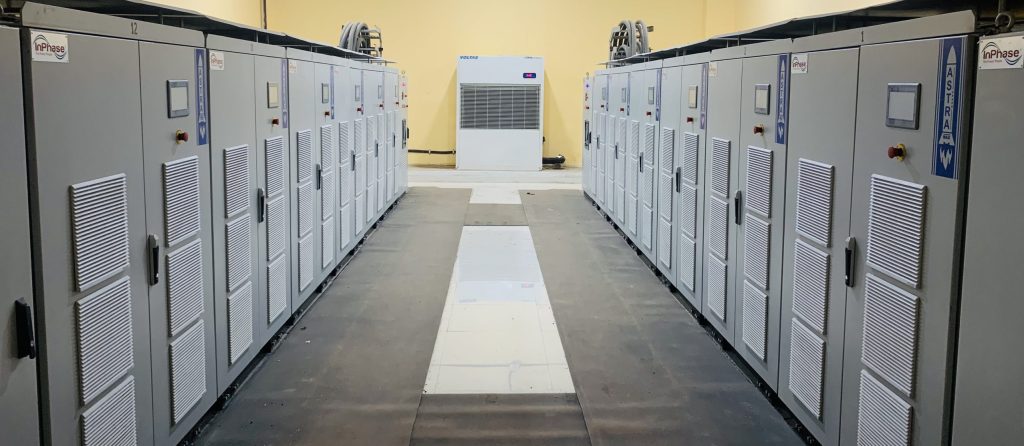
InPhase AHFs utilize parallel (shunt) connection to the power system for optimal harmonic mitigation:
-
- Real-time Monitoring: Current Transformers (CTs) continuously monitor nonlinear load currents
-
- Intelligent Analysis: Advanced DSP processing identifies harmonic content and calculates compensation requirements
-
- Active Compensation: Filter injects compensating currents 180° out of phase, effectively cancelling harmonics
-
- THDi Reduction: Total Harmonic Distortion of current reduced to acceptable levels per IEEE 519 standards
Key Performance Advantages
Comprehensive Harmonic Mitigation
-
- Reduces THDi below regulatory limits (typically <5%)
-
- Prevents voltage distortions affecting sensitive equipmentEliminates
-
- equipment overheating and premature failure
Enhanced Power Factor Correction
-
- Improves true power factor considering both displacement and distortion
-
- Reduces reactive power demand (kVAR) and associated costs
-
- Prevents utility power factor penalties
One of the biggest advantages of the Working Principle of Active Harmonic Filters is its ability to provide continuous harmonic compensation without creating resonance issues. This makes the Working Principle of Active Harmonic Filters a reliable solution for maintaining compliance with IEEE 519 standards.
Superior Equipment Protection
-
- Extends transformer, motor, and cable operational life
-
- Prevents capacitor and electronic component failures
-
- Reduces maintenance costs and unplanned downtime
Improved Energy Efficiency
-
- Minimizes losses in distribution transformers and cables
-
- Lowers overall electricity consumption and costs
-
- Optimizes system performance under varying load conditions
Regulatory Standards Compliance
-
- Ensures adherence to IEEE 519 harmonic limits
-
- Meets CEA power quality requirements
-
- Avoids utility penalties and operational restrictions
Industry-Specific Applications and Results
Food Processing Industry
Challenge: High THDi levels causing frequent electronic component failures
Solution: 200A AHF installation at Point of Common Coupling
Results: THDi reduced to <8%, eliminating equipment failures and improving process reliability
IT/ITES Facilities
Challenge: THDi ~24% with poor power factor from extensive electronic loads
Solution: 75A AHF system targeting harmonic-generating equipment
Results: THDi reduced to <5% with significant power factor improvement
Textile Manufacturing
Challenge: THDi ~12% causing capacitor bank failures and motor overheating
Solution: 600A AHF system for comprehensive facility protection
Results: THDi reduced to <3%, eliminating capacitor failures and extending equipment life
Implementation Best Practices
System Assessment and Sizing
Conduct comprehensive harmonic analysis to determine optimal AHF sizing and placement. Consider load characteristics, growth projections, and regulatory requirements for long-term effectiveness.
Installation Considerations
Install AHFs at strategic locations such as main distribution panels or near major harmonic sources for maximum effectiveness. Ensure proper grounding and protection coordination with existing systems.
Monitoring and Maintenance
Implement continuous monitoring to verify ongoing performance and compliance with harmonic standards. Regular maintenance ensures optimal operation and extends system lifespan.
Return on Investment Analysis
Direct Cost Savings
-
- Reduced utility penalty charges for power factor and harmonic violations
-
- Lower energy consumption through improved system efficiency
-
- Decreased equipment replacement costs due to extended lifespan
Operational Benefits
-
- Improved process reliability reducing production losses
-
- Enhanced equipment performance and reduced maintenance requirements
-
- Compliance with utility interconnection standards
Industrial facilities implementing InPhase Active Harmonic Filters achieve comprehensive power quality improvement through effective harmonic mitigation, enhanced power factor correction, extended equipment protection, improved energy efficiency, and regulatory compliance assurance.
As industrial electrical networks become increasingly dependent on power electronics, the Working Principle of Active Harmonic Filters is becoming essential for maintaining power quality, reducing energy losses, and protecting critical equipment. Organizations that implement solutions based on the Working Principle of Active Harmonic Filters can achieve higher efficiency and improved operational reliability.
Ready to optimize your industrial power quality? Contact InPhase Power Solutions today for professional Active Harmonic Filter assessment and implementation services designed to maximize your facility’s electrical system performance and reliability.Learn more about our Power Quality solutions at InPhase Power Technologies.