
Working Principle of Active Harmonic Filters: A Complete Guide
The Working Principle of Active Harmonic Filters is one of the most important concepts in modern power quality management. As industries increasingly adopt Variable Frequency Drives (VFDs), UPS systems, automation equipment, robotics, and renewable energy systems, harmonic distortion has become a significant challenge.
Harmonics can lead to transformer overheating, equipment failures, increased energy losses, poor power factor, and reduced system efficiency. Understanding the Working Principle of Active Harmonic Filters helps industries implement effective solutions that maintain power quality and ensure compliance with international standards such as IEEE 519.
What Are Active Harmonic Filters?
An Active Harmonic Filter (AHF) is a power electronic device designed to detect and eliminate harmonic currents in real time. Unlike passive filters, which target only specific harmonic frequencies, Active Harmonic Filters dynamically adapt to changing load conditions and provide continuous compensation.
The primary objective of an Active Harmonic Filter is to maintain a clean sinusoidal current waveform by cancelling harmonic distortion generated by nonlinear loads.
Why Harmonics Occur in Electrical Systems
Before understanding the Working Principle of Active Harmonic Filters, it is important to understand the source of harmonics.
Common harmonic-generating loads include:
- Variable Frequency Drives (VFDs)
- UPS Systems
- Switch Mode Power Supplies (SMPS)
- Battery Chargers
- Arc Furnaces
- Rectifiers
- Industrial Automation Systems
- Solar Inverters
- Data Center Equipment
These devices draw current in pulses rather than smooth sinusoidal waves, creating harmonic distortion throughout the electrical network.
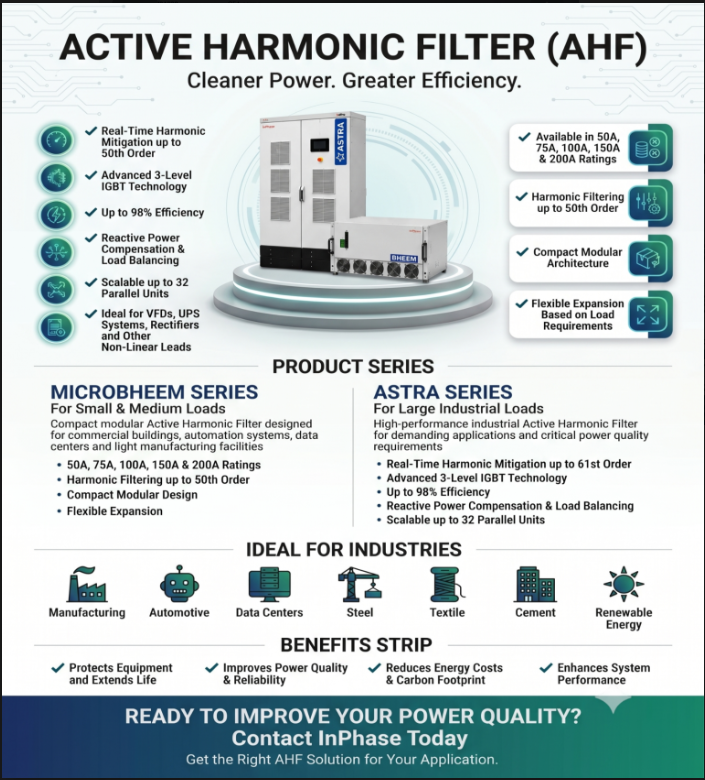
Working Principle of Active Harmonic Filters
The Working Principle of Active Harmonic Filters is based on real-time monitoring, analysis, and compensation of harmonic currents.
Step 1: Harmonic Detection
Current transformers (CTs) continuously monitor the load current flowing through the electrical system.
The Active Harmonic Filter identifies:
- Harmonic frequencies
- Harmonic magnitudes
- Phase angles
- Current distortion levels
This monitoring occurs continuously and in real time.
Step 2: Harmonic Analysis
The controller inside the Active Harmonic Filter uses advanced Digital Signal Processing (DSP) algorithms to separate the fundamental current from harmonic components.
The system instantly calculates the exact harmonic current that must be compensated.
Step 3: Generation of Compensating Current
Once the harmonics are identified, the Active Harmonic Filter generates an equal and opposite current waveform.
This compensating current is:
- Same magnitude
- Opposite phase (180°)
- Matching harmonic frequency
Step 4: Harmonic Cancellation
The compensating current is injected into the electrical system through the Active Harmonic Filter.
When the injected current combines with the load-generated harmonic current, the harmonics cancel each other.
As a result:
- Current waveform becomes nearly sinusoidal
- Total Harmonic Distortion (THD) decreases significantly
- Power quality improves
This continuous process forms the core Working Principle of Active Harmonic Filters.
Typical Installation of Active Harmonic Filters
Active Harmonic Filters are typically connected in parallel (shunt configuration) with the electrical system.
Common installation locations include:
Main Distribution Panels
Provides facility-wide harmonic mitigation.
Transformer Secondary Side
Protects transformers and downstream equipment.
Individual High-Harmonic Loads
Used for large VFDs, UPS systems, and industrial furnaces.
The flexible installation options make Active Harmonic Filters suitable for a wide range of industries.
Benefits of the Working Principle of Active Harmonic Filters
1. Real-Time Harmonic Compensation
The system continuously adapts to changing load conditions.
2. Reduced Total Harmonic Distortion
THD levels can typically be reduced below 5%, supporting IEEE 519 compliance.
3. Improved Voltage Stability
Cleaner current waveforms reduce voltage distortion and improve network stability.
4. Better Equipment Protection
Motors, transformers, cables, and sensitive electronics operate under safer conditions.
5. Improved Power Factor
Many Active Harmonic Filters also contribute to power factor improvement.
6. Reduced Energy Losses
Lower harmonic currents reduce heat generation and electrical losses.
7. Increased Equipment Lifespan
Reduced thermal stress helps extend the life of electrical assets.
Applications of Active Harmonic Filters
Industrial Automation
Manufacturing facilities with multiple VFDs and automation systems benefit significantly from Active Harmonic Filters.
Data Centers
AHFs reduce harmonic distortion generated by UPS systems and IT equipment.
Commercial Buildings
Shopping malls, office complexes, and hospitals use AHFs to maintain reliable power quality.
Renewable Energy Systems
Solar and wind installations use Active Harmonic Filters to mitigate inverter-generated harmonics.
Process Industries
Cement, steel, textile, and automotive industries rely on AHFs to improve operational efficiency.
Real-World Example
A manufacturing plant operating multiple VFD-driven production lines experienced THD levels exceeding 18%.
Solution
Installation of an InPhase Active Harmonic Filter system.
Results
- THD reduced to below 4%
- Improved power factor
- Reduced transformer heating
- Increased equipment reliability
- Compliance with IEEE 519 standards
This demonstrates the effectiveness of the Working Principle of Active Harmonic Filters in real industrial environments.
Why Choose InPhase Active Harmonic Filters?
InPhase Active Harmonic Filters are designed for modern industrial power systems and offer:
- Real-time harmonic compensation
- Fast response times
- Modular scalability
- Advanced monitoring capabilities
- IEEE 519 compliance support
- Reliable industrial performance
These features help industries achieve better power quality, lower operating costs, and improved system reliability.
Conclusion
The Working Principle of Active Harmonic Filters is based on detecting harmonic currents, generating equal and opposite compensating currents, and eliminating distortion in real time. This intelligent approach enables industries to maintain clean power, improve voltage stability, reduce losses, and protect valuable equipment.
As electrical systems continue to become more complex, understanding and implementing the Working Principle of Active Harmonic Filters is essential for achieving efficient, reliable, and standards-compliant operations.
📩 Contact InPhase Energy today to learn how Active Harmonic Filters can improve the power quality and performance of your facility.