
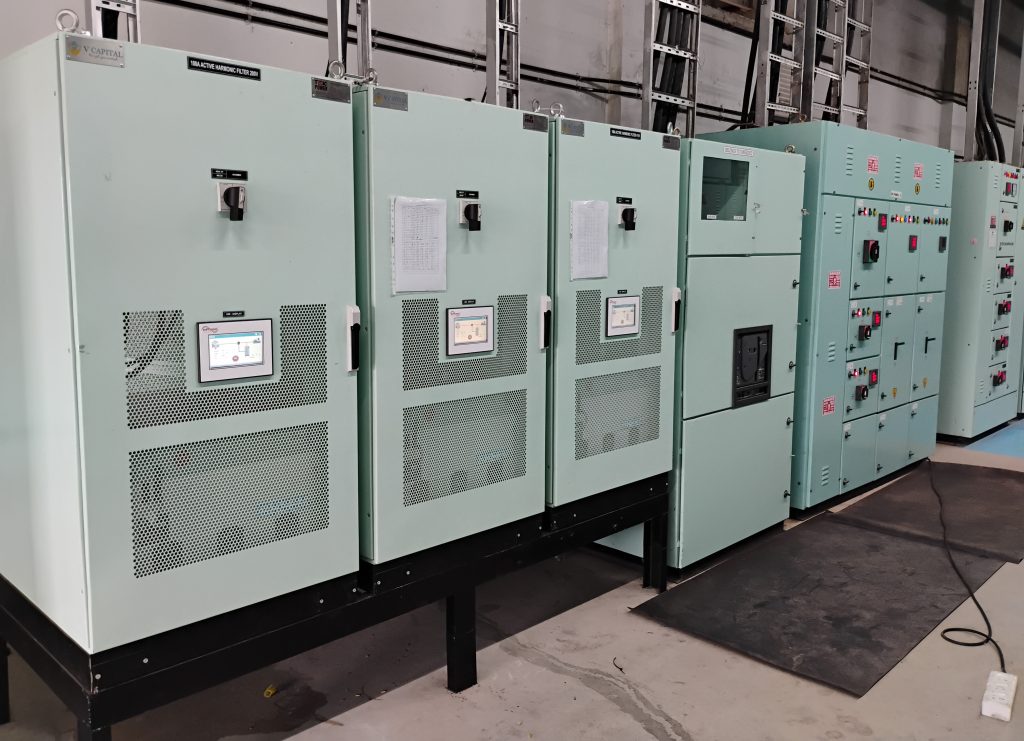
Harmonics Study: The way for efficiency
Harmonics Study is essential for identifying and controlling harmonic distortion in modern industrial electrical systems. Is your facility doing enough to manage increasing non-linear loads? As industries rely more on VFDs, UPS systems, and power electronic equipment, a comprehensive harmonics study becomes critical for improving efficiency, enhancing equipment reliability, reducing downtime, and ensuring compliance with power quality standards such as IEEE 519.
Modern non-linear loads such as VFDs, power converters, and automation systems generate harmonic currents that distort electrical waveforms, degrade power quality, increase equipment stress, and lead to higher energy costs and utility penalties. There is harmonics study become keystone in the modern industries.
| Higher Energy Bills | Transformer Overheating |
| Utility Penalties | Motor Heating |
| Increased Maintenance Costs | Capacitor Failures |
| Unexpected Production Downtime | False Breaker Tripping |
| Reduced Asset ROI | Reduced System Capacity |
| “You can’t see harmonics on a single-phase meter. But they’re silently degrading every asset in your plant.” |
Passive vs. Active: Choosing the Right Architecture
Passive filters
Passive Harmonic Filters use combinations of inductors (L) and capacitors (C) tuned to specific harmonic frequencies.
- These filters create a low-impedance path that diverts targeted harmonic currents away from the electrical network.
- they are cost-effective and suitable for stable load conditions,
- performance is limited to the harmonic orders for which they are designed (typically the 5th or 7th harmonic).
- introduce resonance issues with the utility grid.
In modern industrial environments with continuously changing loads, passive filters may struggle to maintain effective harmonic mitigation as per the regulatory standards like IEEE 519 standards, the harmonics study become complicated by the adverse effect of passive filters.
Active harmonic filters
Active Harmonic Filters (AHFs) use advanced power electronic devices such as IGBTs and high-speed DSP controllers to continuously monitor the electrical network in real time and done the harmonic mitigation .
When harmonic distortion is detected, the AHF generates and injects equal and opposite compensating currents to cancel harmonics dynamically at their source.
Unlike passive filters, AHFs can simultaneously mitigate a wide range of harmonic orders (up to the 61st order in advanced systems), automatically adapt to changing load conditions, eliminate resonance concerns, and provide consistent power quality performance across the entire network.
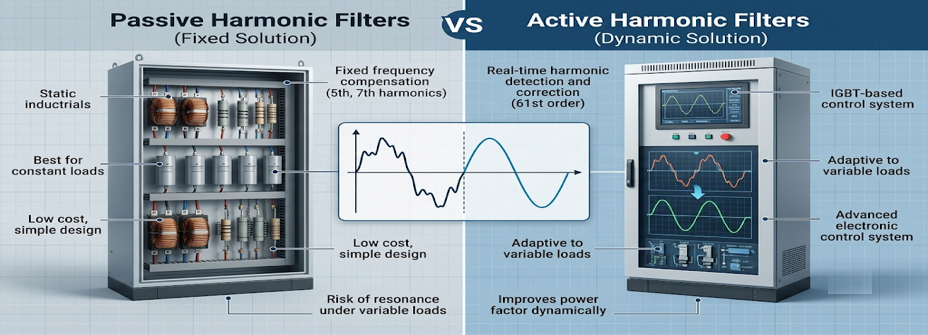
“Think of a Passive Harmonic Filter as a fixed tool designed for a specific problem, while an Active Harmonic Filter acts as an intelligent system that continuously adapts to changing electrical conditions for harmonic mitigation.”
Role of InPhase in Harmonics study and Mitigation
MicroBheem AHF is one of the flagship modular AHF of InPhase power Technologies, that can mitigate harmonics upto the range of 50th order within 0.1ms
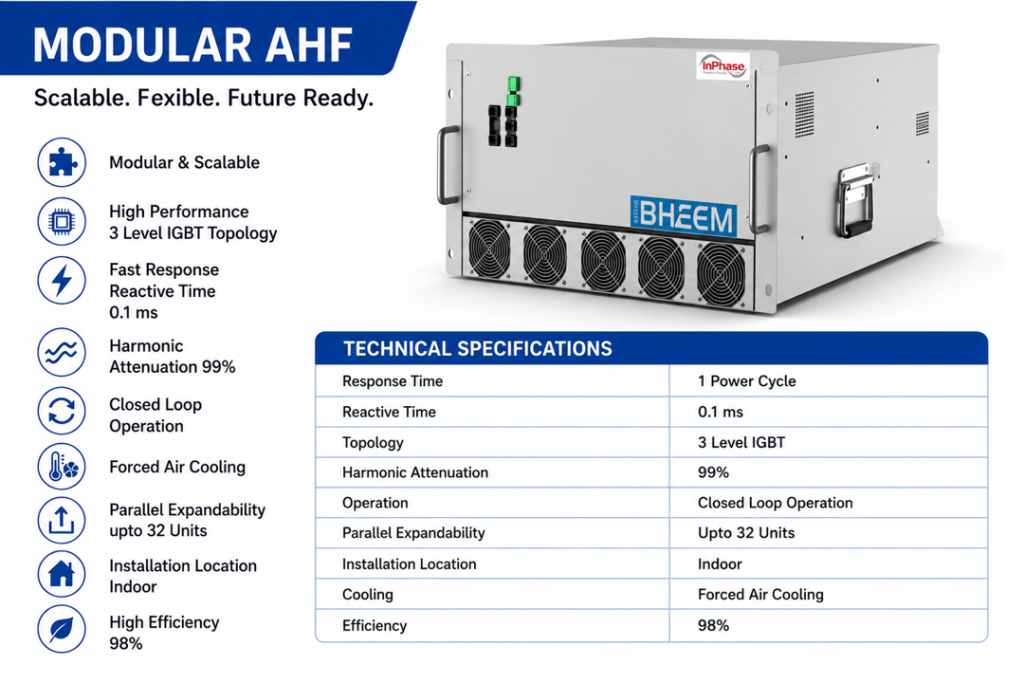
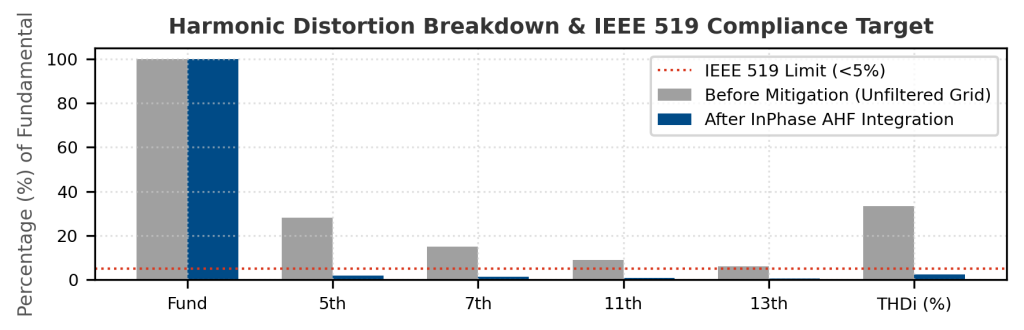
Integrating advanced active filters is a core strategic investment that permanently eliminates risk in critical power networks. Commercially, companies secure clear economic advantages: total eradication of utility power quality penalties, substantial energy cost savings by eliminating passive core heat dissipation.
The harmonic mitigation strategy ensures absolute IEEE 519 standard compliance, reduces thermal stress on expensive transformers, and eliminates insulation tracking on vital asset conductors.
As industrial infrastructure advances toward higher degrees of automation, choosing active harmonic filters of InPhase Power technologies allows operations to face next-generation grid complexities confidently.