
Hybrid Harmonic Filters: The Ultimate Solution for Industrial Power Quality
Hybrid Harmonic Filters are rapidly becoming the preferred solution for industries seeking reliable power quality improvement, harmonic mitigation, and reactive power compensation. Modern industrial facilities depend on automation, variable frequency drives (VFDs), robotics, furnaces, and UPS systems to maximize productivity. However, these nonlinear loads introduce harmonics and reactive power issues that can significantly impact electrical system performance.
Poor power quality can result in transformer overheating, equipment failures, increased energy losses, reduced power factor, and utility penalties. While traditional capacitor banks and passive filters offer partial solutions, they often struggle to meet the dynamic requirements of today’s industrial environments. Hybrid Harmonic Filters combine the strengths of passive and active filtering technologies to provide a comprehensive, cost-effective solution for modern power systems.
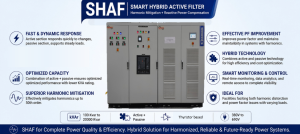
Understanding the Power Quality Challenge
Industrial facilities face two major power quality concerns:
Harmonic Distortion
Nonlinear loads such as VFDs, welding machines, UPS systems, arc furnaces, and robotics generate harmonic currents that distort the electrical waveform.
Common effects include:
-
Transformer overheating
-
Excessive neutral currents
-
Frequent tripping of circuit breakers
-
Malfunction of sensitive electronic equipment
-
Increased cable losses
-
Reduced equipment lifespan
Reactive Power Demand
Large motors, compressors, pumps, and industrial furnaces consume reactive power, leading to:
-
Low power factor
-
Utility penalties
-
Voltage instability
-
Reduced transformer capacity
-
Increased electrical losses
Addressing both challenges simultaneously is critical for maintaining efficient and reliable operations.
Limitations of Conventional Solutions
Passive Filters
Passive filters are economical and effective for specific harmonic frequencies. However, they are fixed in nature and may not adapt well to changing load conditions.
Active Harmonic Filters
Active filters provide excellent dynamic harmonic compensation but can become expensive when deployed in high-power industrial applications.
Capacitor Banks and APFC Systems
Capacitor banks improve power factor but do not effectively mitigate harmonics and often respond too slowly to rapidly changing industrial loads.
These limitations have increased the demand for Hybrid Harmonic Filters across various industries.
How Hybrid Harmonic Filters Work
Hybrid Harmonic Filters combine passive filtering technology with active harmonic compensation to deliver optimal performance.
Passive Section
The passive section provides:
-
Bulk reactive power compensation
-
Mitigation of dominant lower-order harmonics
-
Reduced system loading
-
Improved power factor
Active Section
The active section continuously monitors electrical conditions and:
-
Eliminates higher-order harmonics
-
Dynamically compensates changing loads
-
Balances phase currents
-
Maintains power quality in real time
By combining both technologies, Hybrid Harmonic Filters deliver superior performance at a lower overall cost compared to large active filter installations.
10 Powerful Benefits of Hybrid Harmonic Filters
1. Superior Harmonic Mitigation
Hybrid Harmonic Filters effectively reduce harmonic distortion and help maintain Total Harmonic Distortion (THD) within acceptable limits.
2. Improved Power Factor
The system provides dynamic reactive power compensation, enabling facilities to maintain near-unity power factor.
3. Compliance with IEEE 519
Industries can meet harmonic compliance requirements and avoid utility penalties.
4. Reduced Energy Losses
Cleaner power improves system efficiency and reduces electrical losses throughout the network.
5. Lower Operating Costs
Reduced losses and avoided penalties contribute directly to operational savings.
6. Enhanced Equipment Reliability
Motors, transformers, cables, and switchgear operate under improved electrical conditions.
7. Extended Equipment Life
Reduced thermal stress increases the lifespan of critical electrical assets.
8. Scalable Architecture
Hybrid Harmonic Filters can be expanded as facility loads increase.
9. Fast Dynamic Response
The active component responds within milliseconds to changing load conditions.
10. Cost-Effective for Large Loads
Compared to full-scale active filter solutions, Hybrid Harmonic Filters provide an excellent balance between performance and investment.
Industrial Applications of Hybrid Harmonic Filters
Steel Plants
Steel manufacturing facilities experience extreme harmonic distortion and reactive power fluctuations. Hybrid Harmonic Filters stabilize electrical systems and improve operational reliability.
Cement Industry
Heavy motors, crushers, and grinding mills create significant reactive power demand. Hybrid Harmonic Filters improve power factor and reduce system losses.
Textile Industry
VFD-intensive textile operations benefit from harmonic mitigation and improved power quality.
Renewable Energy Facilities
Solar and wind installations use inverter-based systems that generate harmonics. Hybrid Harmonic Filters help maintain grid compliance and stable operation.
Large Manufacturing Plants
Automotive, pharmaceutical, food processing, and electronics manufacturing facilities rely on Hybrid Harmonic Filters to protect sensitive equipment and improve efficiency.
Case Study: Cement Plant in Gujarat
A cement manufacturing facility in Gujarat experienced low power factor, transformer overheating, and elevated harmonic distortion levels due to heavy motor loads.
Solution
Installation of a 2000 kVAR Hybrid Harmonic Filter system.
Results
-
Power factor improved from 0.82 to 0.99
-
THD reduced to below 4%
-
Transformer overheating incidents reduced by 15%
-
Improved voltage stability
-
Annual savings of approximately ₹18 lakhs
The project demonstrated the ability of Hybrid Harmonic Filters to deliver measurable operational and financial benefits.
Frequently Asked Questions
How are Hybrid Harmonic Filters different from Active Harmonic Filters?
Hybrid Harmonic Filters combine passive and active technologies, making them more cost-effective for large industrial loads.
Can Hybrid Harmonic Filters improve power factor?
Yes. They provide reactive power compensation and can maintain near-unity power factor.
Do Hybrid Harmonic Filters help avoid utility penalties?
Yes. They support IEEE 519 compliance and improve power factor performance, helping facilities avoid penalties.
Are Hybrid Harmonic Filters suitable for renewable energy projects?
Absolutely. They effectively mitigate inverter-generated harmonics and support grid compliance.
Do Hybrid Harmonic Filters extend equipment life?
Yes. By reducing harmonics, voltage stress, and overheating, they improve the lifespan of transformers, motors, and other critical equipment.
Why Choose InPhase Hybrid Harmonic Filters?
InPhase offers customized Hybrid Harmonic Filters designed to match specific load profiles and operational requirements.
Key advantages include:
-
Tailored engineering solutions
-
Modular scalability
-
High reliability and uptime
-
Advanced monitoring capabilities
-
Expert technical support
-
Proven industrial performance
Conclusion
Hybrid Harmonic Filters combine the best features of passive and active filtering technologies to provide a scalable, efficient, and cost-effective solution for industrial power quality challenges. By reducing harmonics, improving power factor, ensuring IEEE 519 compliance, and extending equipment life, Hybrid Harmonic Filters help industries improve efficiency, reduce costs, and maintain reliable operations.
As industrial electrical systems become increasingly complex, Hybrid Harmonic Filters are emerging as an essential technology for achieving superior power quality and long-term competitiveness.
 Contact InPhase Energy today for a power quality assessment and customized Hybrid Harmonic Filter solution.