
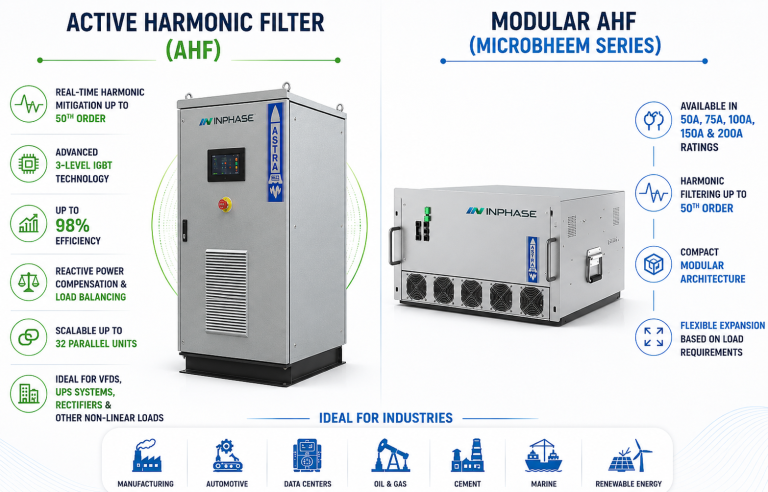
Active Harmonic Filter technology has become an essential solution for modern industrial and commercial electrical systems. As industries increasingly adopt Variable Frequency Drives (VFDs), UPS systems, LED lighting, automation equipment, and switch-mode power supplies, harmonic distortion has become a major concern.
Even when the supply voltage is perfectly sinusoidal, nonlinear loads draw distorted currents that generate harmonics. These harmonics can cause equipment failures, transformer overheating, capacitor damage, increased energy losses, and poor power quality.
An Active Harmonic Filter is specifically designed to identify and eliminate harmonic currents in real time, helping facilities maintain reliable, efficient, and standards-compliant electrical systems.
What Causes Harmonics in Electrical Systems?
Many modern devices operate using power electronic components that create nonlinear current waveforms.
Common harmonic-generating loads include:
- Variable Frequency Drives (VFDs)
- UPS Systems
- LED and CFL Lighting
- Switch Mode Power Supplies (SMPS)
- Battery Chargers
- Rectifiers
- Arc Furnaces
- SCR Controllers
- Industrial Automation Equipment
As these loads increase within a facility, harmonic distortion can quickly exceed acceptable limits.
Impact of Harmonics on Power Systems
Grid-Side Problems
Harmonics negatively affect utility networks by:
- Reducing generation efficiency
- Lowering transmission capacity
- Increasing transformer losses
- Accelerating equipment aging
- Overloading neutral conductors
Customer-Side Problems
Within industrial facilities, harmonics often result in:
- Transformer overheating
- Motor overheating
- Cable heating
- Capacitor bank failures
- Nuisance tripping of protection devices
- Increased maintenance costs
- Reduced equipment lifespan
Impact on Power Factor
Many facilities install capacitor banks to improve power factor. However, harmonics reduce the effectiveness of traditional power factor correction systems.
True Power Factor is influenced by:
- Displacement Power Factor
- Distortion Power Factor
An Active Harmonic Filter improves both by reducing harmonic distortion and optimizing overall system performance.
Harmonic Studies and Compliance Standards
Before selecting an Active Harmonic Filter, a comprehensive power quality audit should be performed.
Harmonic Analysis Includes
- Current Harmonic Levels
- Voltage Harmonic Levels
- Total Harmonic Distortion Current (THDi)
- Total Demand Distortion (TDD)
- Load Profile Analysis
Important Standards
IEEE 519
Defines recommended harmonic limits for electrical systems.
CEA Grid Connectivity Regulations
Provides power quality requirements for electrical installations in India.
Key Parameters
PCC (Point of Common Coupling)
The location where utility and customer systems connect.
Isc/IL Ratio
The ratio of available short-circuit current to maximum load current.
TDD (Total Demand Distortion)
Measures harmonic current relative to maximum demand load.
How an Active Harmonic Filter Works
An Active Harmonic Filter is connected in parallel (shunt configuration) with the electrical system.
Working Principle
- Current transformers continuously monitor load current.
- The Active Harmonic Filter identifies harmonic frequencies.
- A digital controller calculates compensating currents.
- Equal and opposite harmonic currents are injected.
- Harmonics are effectively cancelled.
The result is a cleaner current waveform with significantly reduced distortion.
Typical Installation Locations
An Active Harmonic Filter can be installed at:
Main Distribution Panel
Provides facility-wide harmonic mitigation.
Transformer Secondary
Protects transformers and downstream equipment.
Individual High-Harmonic Loads
Targets specific loads such as large VFDs, furnaces, or UPS systems.
Benefits of Active Harmonic Filter Technology
1. Reduced THDi
Maintains Total Harmonic Distortion below IEEE 519 limits.
2. Improved Power Factor
Enhances both displacement and distortion power factor.
3. Lower Transformer Losses
Reduces heating and extends transformer life.
4. Reduced Cable Heating
Minimizes current distortion and associated losses.
5. Increased System Capacity
Frees electrical infrastructure capacity for future expansion.
6. Extended Equipment Life
Protects motors, capacitors, switchgear, and electronic equipment.
7. Improved Energy Efficiency
Reduces electrical losses throughout the system.
8. Better Voltage Stability
Supports consistent and reliable system operation.
9. Compliance with Standards
Supports IEEE 519 and CEA compliance requirements.
10. Lower Operating Costs
Reduces maintenance expenses and utility penalties.
Real-World Case Studies
Food Processing Industry
Challenge
High THDi levels causing component failures and cable heating.
Solution
200A Active Harmonic Filter installed at PCC.
Result
THDi reduced to below 8%.
IT/ITES Facility
Challenge
THDi above 24%, poor power factor, and transformer overheating.
Solution
75A Active Harmonic Filter deployment.
Result
THDi reduced below 5% and transformer temperatures improved.
Textile Industry
Challenge
Capacitor failures and transformer heating due to harmonic distortion.
Solution
600A Active Harmonic Filter installation.
Result
THDi reduced below 3% while improving overall power quality.
Why Choose InPhase Active Harmonic Filter Solutions?
InPhase Active Harmonic Filter solutions are designed to deliver reliable performance across demanding industrial applications.
Key advantages include:
- Real-time harmonic compensation
- Fast dynamic response
- Modular scalability
- IEEE 519 compliance support
- Advanced monitoring and diagnostics
- Proven industrial performance
Conclusion
An Active Harmonic Filter is one of the most effective solutions for improving power quality in modern industrial and commercial facilities. By reducing harmonic distortion, improving true power factor, lowering transformer and cable losses, and ensuring compliance with IEEE 519 standards, Active Harmonic Filter technology helps organizations improve efficiency, reliability, and profitability.
As power systems become increasingly dependent on electronic loads, investing in an Active Harmonic Filter is no longer optional—it is a critical step toward achieving cleaner, safer, and more efficient electrical operations.
 Contact InPhase Energy today for a comprehensive harmonic study and customized Active Harmonic Filter solution.