
Harmonics in Power Systems are among the most overlooked causes of poor electrical performance in modern industries. While electrical systems may appear to operate normally, hidden waveform distortions can silently reduce efficiency, increase operating costs, and shorten equipment lifespan.
Today’s industrial facilities rely heavily on Variable Frequency Drives (VFDs), UPS systems, automation equipment, robotics, data centers, and renewable energy systems. These technologies improve productivity but also generate harmonic distortion that can significantly affect power quality.
Understanding and controlling Harmonics in Power Systems is essential for maintaining reliable, efficient, and compliant electrical operations.
What Are Harmonics in Power Systems?
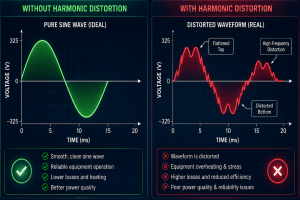
Harmonics in Power Systems occur when electrical current deviates from a pure sinusoidal waveform. Instead of operating only at the fundamental frequency (50 Hz), nonlinear loads generate additional frequencies that are multiples of the fundamental frequency such as:
- 100 Hz (2nd harmonic)
- 150 Hz (3rd harmonic)
- 250 Hz (5th harmonic)
- 350 Hz (7th harmonic)
These unwanted frequencies distort the waveform and create numerous power quality problems.
Common Sources of Harmonics
Modern industrial facilities contain many nonlinear loads that generate Harmonics in Power Systems, including:
- Variable Frequency Drives (VFDs)
- UPS Systems
- Data Centers and IT Infrastructure
- Arc Furnaces
- Robotics and Automation Equipment
- Solar Inverters
- Wind Power Converters
- Battery Chargers
- Switch Mode Power Supplies (SMPS)
As industries continue to digitize and automate operations, the level of harmonic distortion continues to increase.
Why Harmonics in Power Systems Are Dangerous
Transformer Overheating
One of the most common effects of Harmonics in Power Systems is excessive transformer heating. Harmonic currents increase losses and raise operating temperatures, reducing transformer life expectancy.
Reduced Energy Efficiency
Distorted current waveforms create additional electrical losses throughout the distribution network, increasing energy consumption and operating costs.
Equipment Malfunction
Sensitive equipment such as:
- PLCs
- Relays
- Control Systems
- Servers
- Communication Devices
can experience erratic behavior due to harmonic distortion.
High Neutral Currents
Triplen harmonics can accumulate in neutral conductors, creating dangerous overheating conditions and nuisance tripping.
Utility Penalties
Many utilities impose penalties when Total Harmonic Distortion (THD) exceeds acceptable limits. Failure to control Harmonics in Power Systems can therefore increase operating expenses.
Conventional Methods for Managing Harmonics
Passive Filters
Passive filters use tuned inductors and capacitors to reduce specific harmonic frequencies.
Advantages:
- Low initial cost
- Simple design
Limitations:
- Fixed compensation
- Limited flexibility
- Potential resonance issues
Equipment Oversizing
Some facilities install larger transformers, cables, and switchgear to handle harmonic loads.
While effective in the short term, this approach significantly increases capital expenditure.
Motor Derating
Reducing motor loading can minimize some harmonic-related heating but decreases overall operational efficiency.
Modern Solutions for Harmonics in Power Systems
Active Harmonic Filters (AHF)
Active Harmonic Filters continuously monitor electrical waveforms and inject equal and opposite harmonic currents.
Benefits include:
- Real-time compensation
- Dynamic load adaptation
- THD reduction below IEEE 519 limits
- Improved equipment protection
Hybrid Harmonic Filters (HHF)
Hybrid Harmonic Filters combine passive and active technologies.
Benefits include:
- Cost-effective harmonic mitigation
- High-capacity compensation
- Improved power factor
- Enhanced system efficiency
Static Var Generators (SVG) with Harmonic Control
SVG solutions provide:
- Reactive power compensation
- Harmonic reduction
- Voltage stabilization
- Power factor improvement
This combination makes SVG technology highly effective for modern industrial facilities.
Industries Most Affected by Harmonics in Power Systems
Steel Plants
Arc furnaces generate significant harmonic distortion and rapidly changing electrical loads.
Textile Industry
VFD-intensive processes create continuous harmonic currents.
Cement Plants
Large motors and drives increase both harmonic distortion and reactive power demand.
Data Centers
UPS systems generate triplen harmonics that can overload neutral conductors.
Hospitals
Medical equipment requires highly stable power quality to ensure safe operation.
Renewable Energy Plants
Solar and wind inverters are major sources of Harmonics in Power Systems and often require advanced filtering solutions.
InPhase Solutions for Harmonic Mitigation
InPhase Active Harmonic Filters
Provide precise real-time harmonic compensation for dynamic industrial loads.
InPhase Hybrid Harmonic Filters
Designed for high-power industrial applications where both harmonic mitigation and reactive power compensation are required.
InPhase SVG Solutions
Deliver power factor correction and harmonic reduction in a single intelligent platform.
Business Benefits of Controlling Harmonics
Organizations that effectively manage Harmonics in Power Systems gain several advantages:
Lower Operating Costs
Reduced losses result in lower electricity consumption.
Extended Equipment Life
Transformers, motors, and switchgear experience less thermal stress.
Improved Productivity
Fewer equipment failures lead to higher uptime and operational efficiency.
Regulatory Compliance
Facilities can meet IEEE 519 and utility power quality requirements.
Better Reliability
Stable electrical systems support consistent production and reduced downtime.
Conclusion
Harmonics in Power Systems may be invisible, but their impact on industrial operations is significant. Left unmanaged, they can reduce efficiency, increase energy costs, damage equipment, and create compliance challenges.
Modern solutions such as Active Harmonic Filters, Hybrid Harmonic Filters, and SVG systems provide effective ways to eliminate harmonic distortion and improve overall power quality.
By addressing Harmonics in Power Systems proactively, industries can protect critical assets, improve operational efficiency, and ensure long-term electrical reliability.
📩 Contact InPhase Energy today to schedule a power quality assessment and discover the best harmonic mitigation solution for your facility.