Capacitor Bank vs SVG: 7 Powerful Reasons to Upgrade Power Factor Control
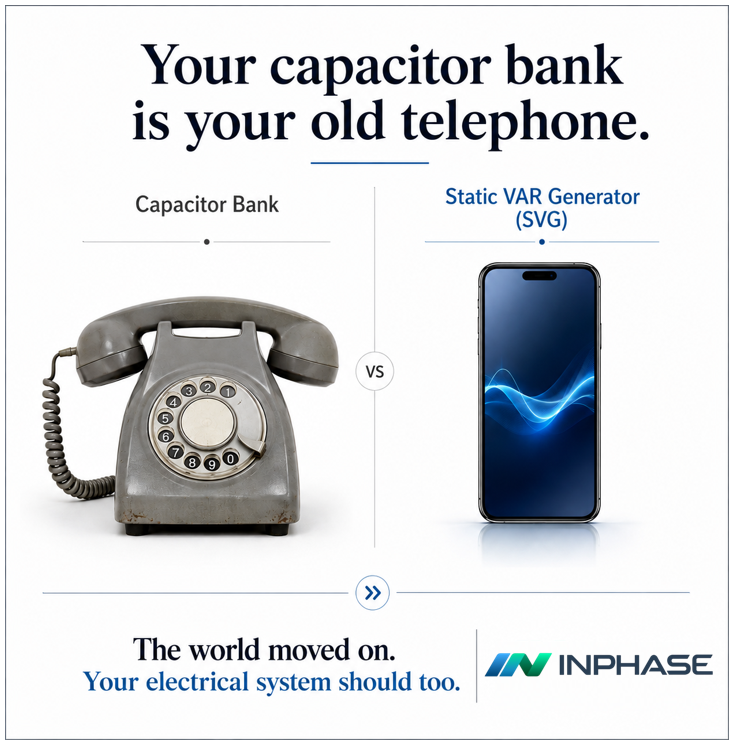
Your capacitor bank is your old telephone.
It works. Nobody is saying it doesn’t.
For decades, capacitor banks have been a reliable solution for power factor correction. They are simple, familiar, and effective for relatively stable electrical loads.
But today’s industrial plants look very different from the plants of 10, 20, or 30 years ago.
Modern factories are filled with VFDs, UPS systems, robotics, BLDC motors, inverter-driven air-conditioning systems, automation equipment, and other nonlinear loads. These loads can change rapidly, and they can introduce harmonics and continuously varying reactive power demand into the electrical network.
That is where a conventional capacitor bank can begin to show its limitations.
Why Capacitor Banks Still Matter
Let’s be clear: capacitor banks are not obsolete.
For steady and predictable loads, they remain a practical and economical way to provide reactive power compensation and improve power factor.
The problem begins when the electrical load becomes highly dynamic.
A capacitor bank works in steps. Depending on the system, contactors or thyristors switch capacitor stages in and out as the reactive power requirement changes.
But a modern factory doesn’t always change in neat, predictable steps.
A VFD can accelerate or decelerate within seconds. An HVAC system can continuously vary its load. Production machinery can start and stop throughout the day.
Your electrical system is changing constantly.
Your compensation system needs to keep up.
1. A Capacitor Bank Cannot Always Keep Up With Dynamic Loads
One of the biggest limitations of a conventional capacitor bank is its switching-based operation.
The controller measures the power factor and determines whether additional capacitance is required. It then switches capacitor stages accordingly.
That approach works well when the load changes gradually.
But when reactive power demand changes rapidly, the compensation can lag behind the actual requirement.
A Static VAR Generator (SVG) takes a fundamentally different approach.
Instead of waiting for capacitor stages to switch, an SVG continuously monitors the electrical network and dynamically generates or absorbs reactive current according to the instantaneous requirement.
The result is much faster and more precise reactive power compensation.
2. Modern Loads Are More Nonlinear Than Ever
Today’s industrial facilities have a much higher concentration of power-electronic loads.
VFDs.
UPS systems.
Servo drives.
Rectifiers.
Battery chargers.
Inverter-based HVAC systems.
Data-centre equipment.
Robotics and automation systems.
These loads can contribute to harmonic distortion while also creating rapidly changing reactive power requirements.
This is an important distinction:
Power factor correction and harmonic mitigation are not the same thing.
A capacitor bank primarily addresses reactive power.
It is not, by itself, a harmonic filtering solution.
In fact, if capacitors are applied without properly understanding the harmonic profile of the electrical network, they can interact with system inductance and create resonance conditions.
That is why blindly adding more capacitance is not always the right answer.
3. Dynamic Loads Need Dynamic Reactive Power Compensation
Imagine a manufacturing plant where large VFD-driven motors are continuously accelerating and decelerating.
At one moment, the plant may need significant reactive power compensation.
A few seconds later, the requirement may be completely different.
A conventional capacitor bank can only respond by switching predefined capacitor stages.
An SVG works differently.
It continuously tracks the reactive current requirement and injects the required compensating current dynamically.
This makes SVG technology particularly useful for facilities with:
-
Rapidly changing production loads
-
VFD-driven motors
-
HVAC systems
-
Elevators and cranes
-
Welding equipment
-
Compressors
-
Robotics
-
Automated production lines
-
Renewable-energy-connected loads
When the load changes continuously, compensation should be equally responsive.
4. Poor Power Factor Can Increase Your Electricity Costs
Power factor isn’t just a number on an electrical meter.
It can influence how efficiently your electrical infrastructure is utilized and, depending on the tariff structure and utility rules, can affect electricity costs.
Consider a facility with a large annual electricity bill and an average power factor of 0.96 instead of 0.99.
The financial impact depends on the tariff structure, demand profile, billing mechanism, and utility regulations applicable to that facility.
But the broader point remains:
Every plant should understand what its actual power factor is costing it.
Improving power factor can also help reduce unnecessary current flow and improve the utilization of transformers, cables, and other electrical infrastructure.
Instead of assuming your existing capacitor bank is working perfectly, measure the actual performance.
5. An SVG Can Respond in Less Than One Power Cycle
This is where the difference becomes especially important.
A capacitor bank compensates by switching capacitor stages.
An SVG uses power electronics to generate the required compensating current dynamically.
Modern SVG systems can respond in less than one power cycle, allowing them to react to rapidly changing reactive power requirements much faster than conventional mechanically switched capacitor systems.
That means the compensation doesn’t have to wait for the next switching decision while the load has already changed again.
For plants with highly dynamic loads, this speed can make a significant difference.
6. SVG and Capacitor Banks Solve Different Problems
This doesn’t have to be a battle between capacitor bank vs SVG.
In many facilities, the better answer is to use both.
Think of it this way:
Capacitor bank:
A practical solution for relatively stable, slow-changing reactive power demand.
SVG:
A dynamic solution for rapidly changing reactive power demand.
A hybrid approach can therefore make sense.
The capacitor bank can handle the base reactive power requirement, while the SVG responds to the dynamic component.
For example, if a facility has a relatively constant reactive load throughout the day but also has rapidly changing VFD-driven machinery, the capacitor bank can provide the baseline compensation while the SVG manages the fluctuations.
This can provide a more practical and cost-effective approach than replacing an entire existing compensation system.
7. Your Existing Capacitor Bank May Not Be the Problem
Sometimes the problem isn’t that your capacitor bank is old.
The problem is that your electrical system has changed.
A capacitor bank installed when a factory had mostly induction motors may have been perfectly suited to the original load profile.
Years later, the same facility may have added:
-
VFDs
-
Automation systems
-
UPS systems
-
New HVAC equipment
-
Solar inverters
-
Robotics
-
Electronic production equipment
The compensation system may still be operating exactly as designed.
But the load it is compensating has changed.
That is why replacing equipment without first understanding the electrical network can be an expensive mistake.
What About Harmonics?
This is where many power factor correction projects need more careful analysis.
Capacitor banks and harmonic distortion need to be evaluated together.
Adding capacitance to a network with significant harmonics can create undesirable interactions between the capacitors and the system impedance.
This doesn’t mean every capacitor bank creates harmonic problems.
It means that harmonic measurements should be part of the decision-making process.
A power quality study can help identify:
-
Total harmonic distortion
-
Individual harmonic orders
-
Reactive power demand
-
Power factor
-
Load variation
-
Voltage fluctuations
-
Current distortion
-
Transformer loading
-
Existing capacitor bank performance
Once these parameters are understood, the right solution becomes much easier to determine.
The Hybrid Approach: Capacitor Bank + SVG
You don’t necessarily have to throw out everything overnight.
For many industrial facilities, a hybrid system can be a practical option.
The existing capacitor bank can continue handling relatively stable reactive power demand.
An SVG can then be added to handle rapidly changing reactive power requirements.
This approach can offer several advantages:
-
Better dynamic power factor correction
-
Faster response to changing loads
-
Improved system flexibility
-
Better utilization of existing capacitor infrastructure
-
Reduced dependence on frequent capacitor-stage switching
-
A solution that can evolve with the plant’s changing load profile
The right configuration depends on the actual electrical characteristics of the facility.
There is no universal answer.
So, Is Your Capacitor Bank Still Enough?
Maybe.
And that is exactly why you should measure before you replace.
A capacitor bank that is perfectly adequate for a stable industrial load may be completely unsuitable for a highly dynamic modern facility.
The question isn’t:
“Are capacitor banks outdated?”
The better question is:
“Is my existing reactive power compensation system still matched to the loads in my facility?”
That is a much more useful question.
Start With a Power Quality Study
Before investing in a new capacitor bank, SVG, harmonic filter, or hybrid system, understand what is actually happening at your transformer.
A properly conducted power quality study can reveal:
-
Where reactive power is being consumed
-
How quickly the load changes
-
Whether the existing capacitor bank is responding effectively
-
Whether harmonics are present
-
How heavily the transformer is being utilized
-
Whether the plant needs fixed, switched, dynamic, or hybrid compensation
You don’t have to guess.
You don’t have to replace equipment simply because it is old.
And you don’t have to throw away a capacitor bank that still has useful life.
Start with the data.
Your old telephone served you well.
But if your factory has moved to a completely different electrical world, your power factor correction system may need to move with it.
Want to know where your facility actually stands?
Start with a power quality study at your transformer.
It can give you a clear picture of your power factor, reactive power demand, harmonic profile, load variation, and whether an SVG or hybrid solution makes sense for your plant.