Harmonics: The Hidden Threat to Your Electrical System
Harmonics in electrical systems are one of the hidden causes of industrial power quality problems. They often go unnoticed until equipment starts overheating, electronic components fail, production becomes inconsistent or electrical systems experience unexpected interruptions.
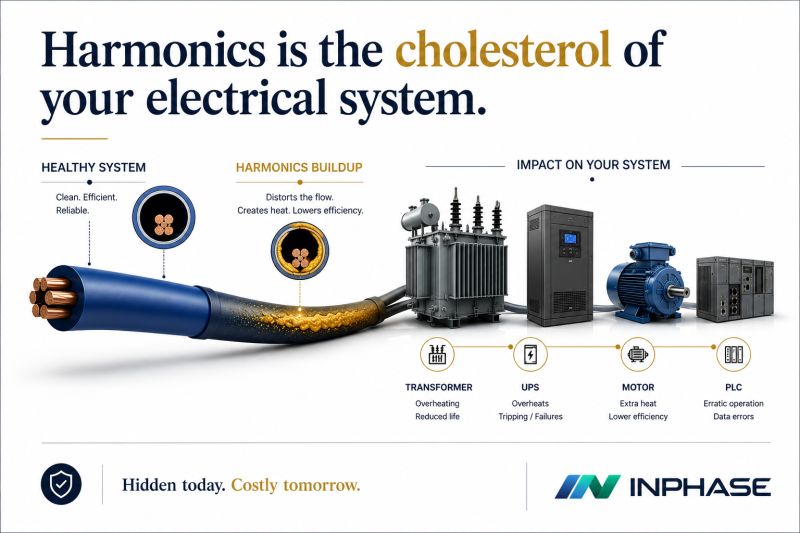
Think of harmonics as the cholesterol of your electrical system. You may not notice them immediately, but their effects can gradually impact the performance and reliability of industrial equipment.
What Are Harmonics in Electrical Systems?
Electrical harmonics are voltage and current waveform distortions caused by nonlinear electrical loads. These loads draw current in a non-sinusoidal waveform, introducing harmonic frequencies into the electrical distribution system.
Common sources include:
Variable Frequency Drives (VFDs)
UPS systems
Rectifiers and converters
Switching power supplies
LED lighting systems
Industrial automation equipment
As industries adopt more power-electronic equipment, managing harmonic distortion becomes increasingly important.
How Harmonic Distortion Affects Industrial Equipment
Consider a few industrial situations where harmonic-related problems can affect production.
1. Iron and Steel Manufacturing
An iron manufacturing facility experienced excessive pores in its finished rods. While the initial investigation focused on metallurgical processes, electrical power quality was also an important factor to investigate.
2. Dairy Processing Facilities
Unstable boiler operation and inconsistent production processes can have multiple causes. Electrical power quality, including harmonics, should be investigated alongside mechanical and process-related factors.
3. Textile Manufacturing
A textile facility experienced recurring card machine failures and lighting problems. Following the installation of an Active Harmonic Filter, machine reliability improved significantly. Energy savings were also observed and should be evaluated against actual pre- and post-installation measurements.
These examples demonstrate why industrial power quality analysis should be part of equipment reliability management.
Common Problems Caused by Harmonics
Excessive harmonic distortion can contribute to:
Electrical equipment overheating
Premature failure of electronic circuit boards
Increased transformer and cable losses
UPS and capacitor bank malfunction
Motor heating and reduced efficiency
Unexpected equipment shutdowns
Reduced electrical equipment lifespan
Production interruptions and maintenance costs
Identifying harmonic sources early can help industries reduce unnecessary equipment stress and improve operational reliability.
Industrial facilities experiencing overheating, equipment failures and electrical disturbances should investigate common industrial power quality problems to identify potential causes and suitable corrective measures.
IEEE 519 Standards for Harmonic Control
IEEE 519-2022 provides recommended harmonic control limits for electrical power systems. It establishes voltage and current distortion limits at the Point of Common Coupling (PCC).
The applicable limits depend on factors such as system voltage and the short-circuit current to maximum demand load current ratio.
For example, the voltage THD limit for systems rated up to 1 kV is 8% at the PCC. Current Total Demand Distortion (TDD) limits are determined separately based on the applicable system conditions.
Industries should conduct professional power quality measurements to evaluate compliance with the relevant IEEE 519 requirements.
How to Reduce Harmonic Distortion in Industrial Systems
An effective harmonic mitigation strategy begins with identifying the source and measuring the actual distortion levels.
Recommended steps include:
Conduct a comprehensive power quality audit.
Identify nonlinear loads and major harmonic-producing equipment.
Measure voltage THD, current harmonics and TDD.
Evaluate electrical system performance at the PCC.
Select suitable harmonic mitigation equipment.
Perform post-installation measurements to verify improvements.
How Active Harmonic Filters Improve Power Quality
An Active Harmonic Filter (AHF) is an advanced power quality solution designed to compensate for harmonic currents generated by nonlinear loads.
It continuously monitors the electrical system and injects compensating currents to reduce harmonic distortion.
Key benefits include:
Reduced harmonic current distortion
Improved electrical system performance
Reduced harmonic-related heating and losses
Better equipment reliability
Improved power quality
Support for applicable IEEE 519 compliance objectives
The actual performance depends on system design, load characteristics, filter capacity and installation conditions.
InPhase offers advanced Active Harmonic Filter solutions to compensate for harmonic currents and improve industrial electrical system performance. Explore our industrial power quality products to identify suitable solutions for your facility.
Why Industrial Facilities Need Continuous Power Quality Monitoring
Installing an Active Harmonic Filter is only one part of an effective power quality strategy. Continuous monitoring helps verify whether the electrical system is performing as expected.
Industries should consider tracking:
Power factor
Voltage Total Harmonic Distortion (THDv)
Current Total Demand Distortion (TDD)
Individual harmonic components
Electrical load variations
Energy consumption
An IoT-based energy management system can provide continuous visibility into electrical performance and help maintenance teams identify abnormal conditions.
Pre-installation and post-installation measurements are particularly important for validating the effectiveness of harmonic mitigation solutions.
Improve Industrial Power Quality with InPhase
InPhase provides industrial power quality solutions designed to address harmonic distortion, reactive power compensation and electrical system performance challenges.
Our solutions include:
Active Harmonic Filters (AHF)
Static VAR Generators (SVG)
Automatic Power Factor Correction (APFC) systems
Power quality monitoring and energy management solutions
Whether you operate a textile mill, steel plant, manufacturing facility or processing industry, understanding your harmonic profile is an important step towards improving electrical system reliability.
Do you experience unexplained equipment failures, overheating or electrical disturbances in your facility?
Start with a professional power quality assessment. Share your electrical load details with the InPhase team to explore suitable harmonic analysis and mitigation solutions.
For industrial facilities requiring reactive power compensation, a Static VAR Generator (SVG) can provide dynamic reactive power compensation and help maintain improved power factor.
For detailed technical requirements and recommended harmonic control limits, refer to the official IEEE 519-2022 Standard.