
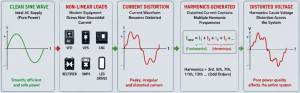
Active Harmonic Filters Pros and Cons are important considerations for industries looking to improve power quality, reduce harmonics, and enhance energy efficiency. Industrial and commercial electrical systems increasingly rely on nonlinear loads such as Variable Frequency Drives (VFDs), UPS systems, LED lighting, and Switch Mode Power Supplies (SMPS). While these technologies improve efficiency, they also generate harmonics that affect power quality.
What Are Active Harmonic Filters?
An Active Harmonic Filter (AHF) is a power electronic device connected in parallel with an electrical distribution system. It continuously monitors harmonic currents generated by nonlinear loads and injects equal and opposite compensating currents to cancel harmonics in real time.
Active Harmonic Filters are widely used in manufacturing plants, commercial buildings, data centers, and process industries where power quality is critical.
Active Harmonic Filters Pros and Cons: Understanding the Benefits
1. Superior Harmonic Mitigation
One of the biggest advantages of Active Harmonic Filters is their ability to reduce Total Harmonic Distortion of Current (THDi) effectively.
Benefits include:
- Compliance with IEEE 519 standards
- Reduced voltage distortion
- Improved power quality
- Lower transformer heating
2. Improved True Power Factor
Active Harmonic Filters improve both displacement power factor and distortion power factor.
Advantages include:
- Reduced reactive power demand
- Lower utility penalties
- Improved electrical system efficiency
3. Protection of Electrical Equipment
AHFs help protect critical electrical assets by reducing harmonic stress.
They help extend the life of:
- Transformers
- Motors
- Capacitor banks
- Switchgear
- Cables
4. Energy Efficiency Improvements
By reducing harmonic losses, Active Harmonic Filters contribute to lower energy consumption and better system performance.
5. Flexible and Scalable Solution
Unlike passive filters, AHFs can adapt automatically to changing load conditions.
Applications include:
- Main PCC installations
- Transformer secondary panels
- Individual high-harmonic loads
6. Real-Time Dynamic Compensation
Active Harmonic Filters respond instantly to load changes and harmonic fluctuations, ensuring consistent power quality.
7. Compliance with Industry Standards
Active Harmonic Filters help industries comply with:
- IEEE 519 Harmonic Standards
- CEA Power Quality Guidelines
- Utility power factor requirements
Active Harmonic Filters Pros and Cons: Understanding the Limitations
1. Higher Initial Investment
Compared with passive harmonic filters, Active Harmonic Filters generally require a higher upfront investment.
However, many facilities recover the investment through:
- Reduced downtime
- Lower maintenance costs
- Improved equipment lifespan
2. Professional Installation Required
Proper harmonic analysis, load assessment, and system integration are necessary to achieve optimum performance.
3. Periodic Maintenance Requirements
Although maintenance is relatively low, routine inspections and firmware updates may be required.
4. Capacity Limitations in Extremely Distorted Systems
Facilities with very high harmonic levels may require multiple Active Harmonic Filters or hybrid harmonic mitigation solutions.
5. Performance Depends on Load Characteristics
The effectiveness of Active Harmonic Filters can vary depending on the type and behavior of nonlinear loads connected to the system.
Real-World Results Using Active Harmonic Filters
Food Processing Industry
Challenge:
High THDi and frequent electronic equipment failures.
Solution:
200A Active Harmonic Filter installation.
Result:
THDi reduced below 8%.
IT and Data Center Facility
Challenge:
Transformer overheating and low power factor.
Solution:
75A Active Harmonic Filter.
Result:
THDi reduced below 5% with improved power factor.
Textile Manufacturing Plant
Challenge:
Capacitor failures and transformer heating.
Solution:
600A Active Harmonic Filter.
Result:
THDi reduced below 3% and equipment reliability improved.
Conclusion
Understanding Active Harmonic Filters Pros and Cons is essential for selecting the right power quality solution. While Active Harmonic Filters require a higher initial investment and professional installation, their benefits in harmonic mitigation, power factor correction, equipment protection, energy efficiency, and regulatory compliance make them one of the most effective solutions available for modern industrial facilities.
Understanding Active Harmonic Filters Pros and Cons helps facility managers select the right harmonic mitigation solution. While evaluating Active Harmonic Filters Pros and Cons, industries should consider both the long-term operational benefits and the initial investment requirements.
For industries facing harmonic distortion challenges, Active Harmonic Filters provide a long-term investment that improves power quality, reliability, and operational efficiency.