
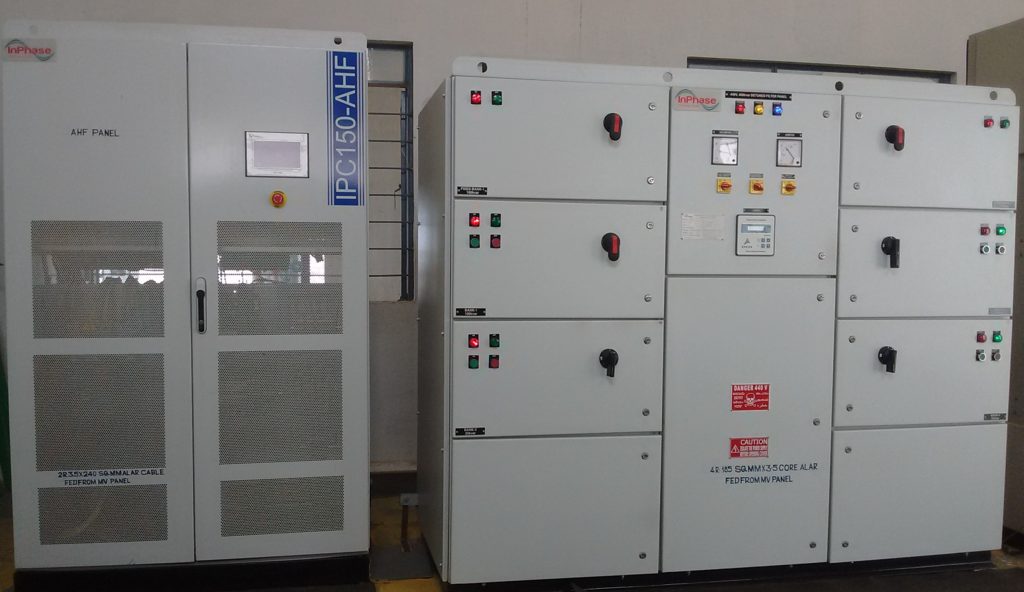
Importance of Power Quality Monitoring has become a critical factor in ensuring the reliability, efficiency, and stability of modern electrical power systems. As industries increasingly adopt non-linear loads, renewable energy sources, and digital technologies, maintaining high power quality is more important than ever. Advanced solutions such as Active Harmonic Filters (AHFs) and Smart Grids enable real-time monitoring, harmonic mitigation, and predictive analysis to prevent equipment failures and optimize system performance. By continuously tracking key power quality parameters such as voltage, current, frequency, power factor, and total harmonic distortion (THD), organizations can reduce energy losses, improve operational efficiency, achieve IEEE 519 compliance, and build a more resilient electrical infrastructure for the future.
How Active Harmonic Filters Are Powering the Future of Smart Grids
The importance of power quality monitoring is increasing as Smart Grids become more intelligent, automated, and data-driven. Modern electrical networks must handle growing numbers of non-linear loads, including Variable Frequency Drives (VFDs), EV chargers, UPS systems, and renewable energy sources, all of which generate harmonic distortion and affect power quality.
Active Harmonic Filters (AHFs) play a vital role in overcoming these challenges. By continuously monitoring electrical waveforms and eliminating harmonic currents in real time, AHFs reduce Total Harmonic Distortion (THD), improve power factor, stabilize voltage, and enhance overall grid reliability. Their fast and adaptive response makes them an ideal solution for dynamic Smart Grid applications.
When combined with advanced power quality monitoring, Active Harmonic Filters enable predictive maintenance, improve energy efficiency, protect critical equipment, and support IEEE 519 compliance. As Smart Grids continue to evolve, AHFs will remain a key technology for delivering reliable, efficient, and sustainable power systems.The importance of power quality monitoring is becoming increasingly evident as renewable energy sources such as solar and wind are integrated into Smart Grids.
Why Power Quality Matters in Smart Grids
The importance of power quality monitoring is fundamental to the successful operation of Smart Grids. Modern power networks rely on real-time communication, distributed energy resources, and sensitive electronic equipment, making them more vulnerable to power quality issues such as harmonic distortion, voltage fluctuations, and poor power factor. Without effective power quality monitoring, these disturbances can reduce system reliability, increase maintenance costs, and compromise grid performance.
Poor power quality can result in:
- Overheating of transformers, cables, and motors
- Increased energy losses and reduced efficiency
- Unexpected equipment failures and costly downtime
- Malfunction of sensitive electronic devices
- Reduced power factor and higher electricity costs
- Non-compliance with IEEE 519 power quality standards
Continuous power quality monitoring, combined with Active Harmonic Filters (AHFs), helps detect and mitigate these issues before they affect critical operations. By maintaining low Total Harmonic Distortion (THD), improving voltage stability, and enhancing overall grid reliability, organizations can maximize the efficiency, resilience, and sustainability of modern Smart Grid systems.
Importance of Power Quality Monitoring in Smart Grids
Importance of Power Quality Monitoring is increasing as Smart Grids become more intelligent, automated, and interconnected. Continuous monitoring of electrical parameters such as voltage, current, frequency, power factor, and Total Harmonic Distortion (THD) enables utilities and industries to detect abnormalities before they affect system performance. Real-time power quality monitoring also supports faster fault identification, predictive maintenance, and improved grid reliability.
The importance of power quality monitoring extends beyond fault detection. It helps optimize energy efficiency, maintain voltage stability, protect sensitive equipment, and ensure compliance with IEEE 519 standards. When combined with Active Harmonic Filters (AHFs), continuous monitoring minimizes harmonic distortion, reduces downtime, and enables Smart Grids to deliver safe, reliable, and sustainable power.
The importance of power quality monitoring is becoming increasingly significant as electrical networks evolve into intelligent and interconnected Smart Grids. Continuous monitoring enables utilities and industries to identify harmonic distortion, voltage fluctuations, and power factor issues before they impact system performance. Understanding the importance of power quality monitoring allows organizations to improve operational efficiency, protect critical electrical assets, and maintain a stable power supply.
With the growing integration of renewable energy, electric vehicles, and digital automation, the importance of power quality monitoring will continue to increase. When combined with Active Harmonic Filters (AHFs), real-time monitoring helps reduce Total Harmonic Distortion (THD), improve voltage stability, ensure IEEE 519 compliance, and enhance overall grid reliability.
Power Quality Parameters in Smart Grids
The importance of power quality monitoring is closely linked to measuring and maintaining key power quality parameters in Smart Grids. Continuous monitoring of these parameters helps identify electrical disturbances, improve system performance, and ensure a stable and reliable power supply. By understanding these parameters, utilities and industries can take proactive measures to maintain optimal power quality. https://ieeexplore.ieee.org/document/5274162
The key power quality parameters include:
- Voltage Stability: Maintains a consistent voltage level to prevent equipment damage and ensure reliable operation.
- Frequency: Keeps the power system operating at its rated frequency for stable grid performance.
- Total Harmonic Distortion (THD): Measures harmonic distortion caused by non-linear loads. Lower THD improves equipment efficiency and extends asset life.
- Power Factor: A high power factor reduces reactive power demand, minimizes energy losses, and lowers electricity costs.
- Voltage Unbalance: Prevents overheating and performance issues in motors and other three-phase equipment.
- Voltage Sags and Swells: Continuous power quality monitoring helps detect short-term voltage variations that can affect sensitive electrical equipment.
- Flicker: Monitors rapid voltage fluctuations that impact lighting quality and industrial processes.
Challenges in Power Quality Monitoring for Smart Grids
The importance of power quality monitoring is increasing as Smart Grids become more complex with distributed energy resources, electric vehicles, and digital substations. However, monitoring power quality across a large and interconnected network presents several challenges. Utilities must process vast amounts of real-time data while accurately detecting harmonic distortion, voltage fluctuations, transient events, and power factor variations. Advanced monitoring systems, combined with Active Harmonic Filters, help overcome these challenges by providing continuous analysis, faster fault detection, and improved grid stability.
Role of Active Harmonic Filters in Smart Grids
Active Harmonic Filters (AHFs) are essential for maintaining power quality in Smart Grids. They continuously monitor the electrical network, detect harmonic distortion, and inject compensating currents in real time to reduce Total Harmonic Distortion (THD). This improves power factor, stabilizes voltage, enhances grid reliability, and supports IEEE 519 compliance, enabling Smart Grids to operate efficiently and reliably.
Real-Time Harmonic Correction
Active Harmonic Filters continuously detect harmonic currents and inject equal and opposite compensation currents. This real-time correction eliminates distortion and maintains a clean sinusoidal waveform throughout the electrical network.
Integration with Smart Grid Monitoring Systems
Modern Active Harmonic Filters can seamlessly integrate with intelligent monitoring and energy management platforms. This allows facility managers and utility operators to track power quality performance, analyze harmonic trends, and optimize electrical system operation.
Improved Energy Efficiency and Reliability
By reducing harmonic distortion, Active Harmonic Filters decrease electrical losses and minimize stress on critical equipment. This results in improved reliability, reduced maintenance costs, and longer equipment lifespan.
Key Benefits of Active Harmonic Filters for Smart Grids
Active Harmonic Filters (AHFs) provide an effective solution for improving power quality in Smart Grids. By continuously monitoring and mitigating harmonic distortion, they enhance system reliability, improve energy efficiency, maintain voltage stability, and ensure compliance with IEEE 519 standards. Their intelligent and adaptive operation makes them a key technology for modern, resilient electrical networks.
Smart Grids Reduced Energy Losses
Harmonic currents increase conductor losses and transformer heating. Active Harmonic Filters help reduce these losses, improving overall energy efficiency.
Compliance with Modern Grid Standards
Smart grid infrastructures require compliance with standards such as IEEE 519. Active Harmonic Filters help maintain Total Harmonic Distortion (THD) within acceptable limits and support regulatory compliance.
Enhanced Industrial and Commercial Performance
Industries, commercial buildings, hospitals, and data centers benefit from improved equipment performance, fewer disruptions, and greater operational reliability through effective harmonic mitigation.
Support for Renewable Energy Integration
As solar and wind energy systems become more common, harmonics generated by power electronic converters increase. Active Harmonic Filters help ensure stable integration of renewable energy sources into the grid.
The Future of Power Quality Management
The importance of power quality monitoring will continue to grow as Smart Grids become more intelligent and interconnected. Future power quality management will rely on Active Harmonic Filters (AHFs), AI-driven analytics, IoT-enabled monitoring, and real-time data to detect and mitigate power quality issues instantly. These advanced technologies will improve grid reliability, enhance energy efficiency, reduce harmonic distortion, and ensure compliance with IEEE 519 standards, creating more resilient and sustainable electrical networks.
Why smart industries switch to inphase harmonic solutions
MICRO BHEEM AHF
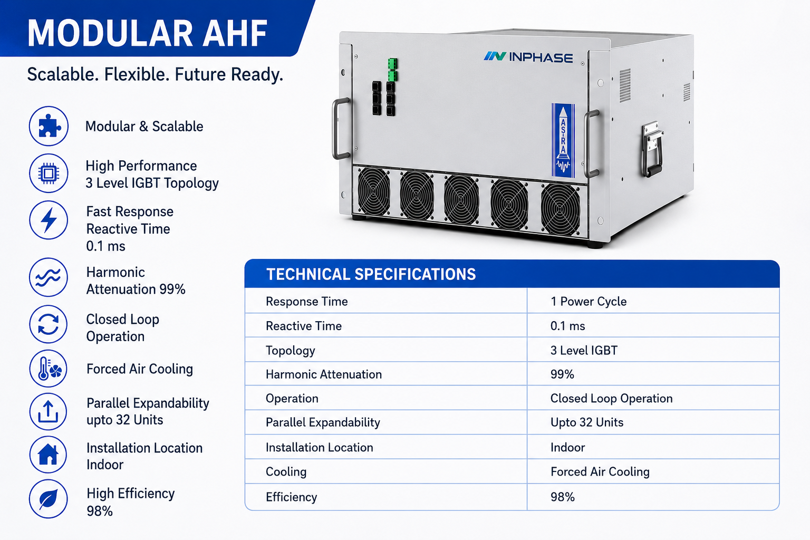
MicroBheem AHF is InPhase’s modular active harmonic filter designed to deliver real-time harmonic mitigation in a compact and scalable form. It continuously eliminates harmful harmonics, improves power quality, reduces energy losses, and protects critical electrical equipment. Its modular architecture enables easy capacity expansion, making it an ideal solution for growing industrial facility.https://modular.inphase.in/
- Comprehensive Harmonic Management
- Flexible Operation Modes
- Smart Integration
- Industrial Grade Reliability
Specifications :
- Efficiency – 98%
- Topology – 3-Level IGBT
- Harmonic range – Up to 50th order harmonics
Future-Proof Your Electrical System with InPhase
InPhase Active Harmonic Filters provide advanced real-time harmonic mitigation solutions designed for modern industrial, commercial, and utility applications. With intelligent control technology, IEEE 519 compliance support, and seamless smart grid integration, InPhase helps organizations achieve superior power quality and long-term reliability.
FAQ
1. What is the importance of power quality monitoring?
The importance of power quality monitoring lies in its ability to detect electrical disturbances such as harmonic distortion, voltage fluctuations, and power factor issues in real time. Continuous monitoring improves system reliability, protects critical equipment, reduces energy losses, and supports efficient power system operation.
2. Why is power quality monitoring essential for Smart Grids?
Power quality monitoring enables Smart Grids to identify and respond to electrical disturbances quickly. It helps maintain voltage stability, improve power factor, reduce Total Harmonic Distortion (THD), and ensure a reliable power supply for modern electrical networks.
3. How do Active Harmonic Filters improve power quality?
Active Harmonic Filters (AHFs) continuously detect and eliminate harmonic currents generated by non-linear loads. They reduce THD, improve power factor, stabilize voltage, and enhance the overall efficiency and reliability of Smart Grid systems.
4. What are the key power quality parameters monitored in Smart Grids?
The most important power quality parameters include:
- Voltage
- Current
- Frequency
- Total Harmonic Distortion (THD)
- Power Factor
- Voltage Unbalance
- Voltage Sags and Swells
- Flicker
Monitoring these parameters helps maintain reliable and efficient electrical system performance.
5. How does the importance of power quality monitoring support IEEE 519 compliance?
The importance of power quality monitoring extends to maintaining compliance with IEEE 519 standards by continuously measuring harmonic distortion and identifying power quality issues. This allows industries to take corrective action before harmonic levels exceed recommended limits.