
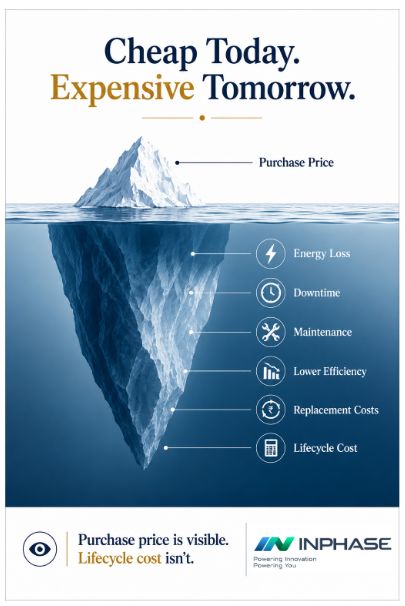
Cheap Today. Expensive Tomorrow.
The Active Harmonic Filter lifecycle cost is much higher than its initial purchase price when energy losses, maintenance, downtime and replacement expenses are considered. Imported Active Harmonic Filters may be 20–40% cheaper upfront, but industrial buyers should evaluate their efficiency, performance under Indian operating conditions and long-term service support before making a purchasing decision.
Why Cheap Imported Active Harmonic Filters Can Cost More
Imported Active Harmonic Filters (AHFs) can be 20–40% cheaper upfront. That’s a real purchasing advantage. But the initial price tag doesn’t tell the complete story.
At InPhase, we’ve installed and maintained hundreds of systems across industries. Based on our field experience, we’ve seen recurring challenges when industrial customers switch to low-cost imported units without evaluating their long-term operating performance.
Consider these efficiency differences:
-
Peak efficiency: Around 97% compared with up to 98.5% for a well-designed indigenous unit.
-
Real-world operating efficiency: Some imported units may deliver only 92–96% efficiency under demanding Indian operating conditions.
-
Annual energy losses: Depending on filter capacity, operating hours, loading and electricity tariffs, even a small efficiency gap can translate into ₹1 lakh or more in additional annual electricity costs.
In certain operating scenarios, the initial purchase-price advantage can disappear within 4–5 months.
These figures represent examples and observations that should be validated against actual product specifications and site measurements. Actual savings vary from installation to installation.
When evaluating Active Harmonic Filter lifecycle cost, operating efficiency is one of the most important factors because even small efficiency differences can affect electricity expenses over thousands of operating hours.
The Hidden Performance Problems of Low-Cost Imported AHFs
Efficiency is only one part of the problem. Industrial facilities must also consider operating conditions, reliability and after-sales support. A complete Active Harmonic Filter lifecycle cost assessment should include local service availability, spare parts, maintenance expenses and equipment downtime.
1. Designed for Different Operating Conditions
Some low-cost imported units may be designed around operating conditions that differ significantly from those found in Indian industrial facilities.
High ambient temperatures, voltage variations and changing nonlinear loads can create additional challenges.
A unit designed for approximately 60% of the required operating conditions or application demand may struggle when subjected to demanding real-world loads. Always verify the rated capacity, thermal design and operating specifications before purchasing.
2. Performance Derating
Temperature, ventilation, load variations and electrical network conditions can affect filter performance.
Some units may derate under demanding operating conditions and fail to deliver their specified harmonic compensation capacity.
The result can be insufficient harmonic mitigation precisely when the facility needs it most.
3. Lack of Local Service and Technical Support
What happens when an imported Active Harmonic Filter breaks down?
In some cases, industrial customers face:
-
Limited local technical support
-
Delayed replacement components
-
Long repair turnaround times
-
Dependence on overseas suppliers
-
Expensive panel-level replacement instead of component-level repair
Without a dependable local service network, even a relatively small equipment fault can become an expensive operational problem.
4. No Continuous Harmonic Performance Verification
Harmonic mitigation is not something that should be assumed to work simply because an AHF has been installed.
It requires continuous monitoring and periodic verification.
Many facilities install a harmonic filter and assume that their electrical problems have been solved. Without 24/7 monitoring, they may not know whether the filter is operating correctly, whether its compensation capacity is sufficient or whether harmonic distortion has increased again.
An IoT-based energy management system and suitable power quality monitoring can help facilities monitor performance and identify abnormal operating conditions.
Calculate the Real Active Harmonic Filter Lifecycle Cost
Before purchasing an Active Harmonic Filter, procurement teams should compare the complete cost of ownership rather than only the quotation price.
Consider these factors:
-
Initial purchase and installation cost
-
Actual operating efficiency
-
Annual energy losses
-
Performance under Indian ambient conditions
-
Harmonic compensation capacity
-
Maintenance and spare parts expenses
-
Local service availability
-
Monitoring and performance verification
-
Potential production downtime
A cheaper filter may look attractive on the purchase order, but its actual lifecycle cost can be significantly higher.
The right comparison is not simply imported versus indigenous. It is verified performance, operating efficiency, reliability and long-term service support.
Why InPhase Takes a Different Approach
At InPhase, we believe an Active Harmonic Filter should be evaluated as a long-term investment in industrial electrical health.
Our approach focuses on:
-
Application-specific harmonic assessment
-
Appropriate filter capacity selection
-
Performance under actual operating conditions
-
Efficient thermal and cooling design
-
Local engineering and technical support
-
Continuous power quality monitoring
-
Pre-installation and post-installation performance verification
Explore our Active Harmonic Filter solutions and industrial power quality products.
The question every procurement head should ask is simple: What is the lifecycle cost, not just the purchase cost?
A harmonic filter is not a commodity. It is a health system for your electrical network.
Choose based on performance. Measure before and after installation. Think beyond the initial price.
I’ve seen this cycle too many times. A facility buys on price alone, can’t verify performance, and two years later reinvests the same amount again.
The question every procurement head should ask — what is the lifecycle cost, not just the purchase cost?
A harmonic filter is not a commodity. It’s a health system for your electrical network. Treat it like one.
Comparing Active Harmonic Filter lifecycle cost instead of only the initial purchase price helps procurement teams make better long-term investment decisions.
For understanding harmonic control requirements and recommended distortion limits, refer to the official IEEE 519-2022 Standard for Harmonic Control in Electric Power Systems.
Think Beyond the Purchase Price
The question every procurement head should ask is simple: What is the lifecycle cost, not just the purchase cost?
A harmonic filter is not a commodity. It is a long-term investment in the health, reliability and performance of your electrical network.
At InPhase, we believe in measuring performance, evaluating actual operating costs and choosing solutions that deliver long-term value.
Choose based on performance. Measure before and after installation. Think beyond the initial price.