
Power Quality Challenges in Renewable Energy: Why They Matter
Power Quality Challenges in Renewable Energy are becoming increasingly important as solar farms, wind parks, and other renewable energy projects expand worldwide. While renewable energy is essential for a sustainable future, integrating large amounts of solar and wind power into the grid introduces significant challenges related to harmonics, power factor, voltage stability, and grid compliance.
Utilities and transmission operators enforce strict standards to maintain grid reliability. Failure to comply with these requirements can result in financial penalties, reduced power export capability, equipment stress, and operational inefficiencies. Addressing Power Quality Challenges in Renewable Energy is therefore critical for ensuring reliable, efficient, and profitable plant operation.
Understanding the Major Power Quality Challenges in Renewable Energy
Renewable energy systems rely heavily on power electronic converters and inverters. While these technologies improve energy conversion efficiency, they can also create power quality disturbances.
Harmonics Generated by Inverters
Modern solar and wind inverters generate harmonic currents that distort electrical waveforms.
Common impacts include:
- Transformer overheating
- Increased cable losses
- Nuisance tripping of protection devices
- Reduced equipment life
- Poor system efficiency
Without proper harmonic mitigation, Total Harmonic Distortion (THD) can exceed permissible limits and create grid compliance issues.
Low Power Factor
Power output from renewable sources varies continuously due to changing sunlight and wind conditions. These fluctuations can affect reactive power flow and reduce overall power factor.
A low power factor can lead to:
- Utility penalties
- Increased system losses
- Reduced grid stability
- Lower energy transfer efficiency
Voltage Fluctuations and Flicker
Rapid changes in renewable generation can create voltage variations and flicker that impact grid performance and connected loads.
Load Imbalance
Distributed renewable installations often experience phase imbalance due to uneven loading and varying generation conditions, resulting in reduced system efficiency and increased equipment stress.
Grid Codes and Compliance Requirements
To overcome Power Quality Challenges in Renewable Energy, operators must comply with international and utility-specific standards.
Key Compliance Requirements
IEEE 519
Maintains Total Harmonic Distortion (THD) below 5%.
Power Factor Requirements
Most utilities require power factor operation between 0.95 lagging and 0.95 leading.
Dynamic Reactive Power Support
Renewable plants must provide rapid reactive power compensation to support grid stability.
Low Flicker Levels
Voltage fluctuations must remain within prescribed limits to ensure network reliability.
Why Conventional Solutions Are No Longer Sufficient
Many renewable projects still rely on traditional correction methods.
Capacitor Banks and APFC Systems
While useful for basic reactive power correction, capacitor banks respond too slowly to rapidly changing renewable generation conditions.
Passive Harmonic Filters
Passive filters are tuned for specific frequencies and provide limited harmonic mitigation under varying operating conditions.
Oversized Inverters
Using larger inverters to manage power quality issues significantly increases project capital expenditure without fully addressing harmonics and reactive power challenges.
InPhase Solutions for Renewable Energy Applications
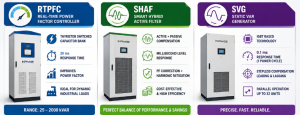
Static Var Generator (SVG)
InPhase SVG provides dynamic reactive power compensation with response times below 10 milliseconds.
Benefits
- Maintains near-unity power factor
- Improves voltage stability
- Supports grid compliance
- Modular and scalable architecture
Active Harmonic Filter (AHF)
InPhase Active Harmonic Filters continuously detect and eliminate harmonic currents generated by solar and wind inverters.
Benefits
- Reduces THD below IEEE 519 limits
- Protects transformers and cables
- Improves system efficiency
- Enhances equipment reliability
Hybrid Harmonic Filter (HHF)
For large renewable installations, InPhase Hybrid Harmonic Filters combine passive and active filtering technologies.
Benefits
- Cost-effective harmonic mitigation
- High-capacity compensation
- Improved power quality
- Lower operating costs
Real-World Renewable Energy Success Stories
100 MW Solar Park
Challenge
The facility experienced harmonic distortion levels exceeding 12%.
Solution
Deployment of InPhase Active Harmonic Filter technology.
Results
- THD reduced from 12% to 3%
- Full IEEE 519 compliance achieved
- Annual savings of approximately ₹20 lakhs
- Improved inverter reliability
Wind Farm Application
Challenge
Power factor fluctuations created instability and increased grid stress.
Solution
Installation of InPhase SVG systems.
Results
- Power factor stabilized at 0.99
- Improved voltage regulation
- Reduced reactive power penalties
- Enhanced grid compatibility
Business Benefits of Solving Power Quality Challenges in Renewable Energy
Organizations that proactively address Power Quality Challenges in Renewable Energy gain significant advantages.
Zero Compliance Penalties
Maintaining harmonic and power factor limits ensures uninterrupted operation and regulatory compliance.
Higher Return on Investment
Reduced losses and improved efficiency maximize energy revenue.
Future-Proof Infrastructure
Scalable solutions support future capacity expansion and evolving grid requirements.
Improved Investor Confidence
Reliable power quality performance demonstrates operational excellence and reduces project risk.
Enhanced Sustainability
Lower electrical losses contribute to improved environmental performance and energy efficiency.
Conclusion
Power Quality Challenges in Renewable Energy will continue to grow as solar and wind generation expand across the world. Harmonics, power factor issues, voltage fluctuations, and grid compliance requirements can significantly impact plant performance and profitability.
InPhase SVG, Active Harmonic Filters, and Hybrid Harmonic Filters provide advanced solutions that help renewable energy operators achieve IEEE 519 compliance, improve efficiency, maintain grid stability, and maximize return on investment.
By addressing Power Quality Challenges in Renewable Energy with the right power quality solutions, renewable projects can deliver cleaner energy while maintaining reliable and compliant grid operation.
📩 Contact InPhase Energy today for a renewable energy power quality assessment and customized grid compliance solution.