
Active Harmonic Filter Technology: From Early Power Systems to Smart Grids
Active Harmonic Filter Technology has transformed the way industries manage power quality. As industrial automation, power electronics, and renewable energy systems have become more widespread, the challenge of harmonic distortion has grown significantly. Today, Active Harmonic Filter Technology plays a crucial role in maintaining electrical efficiency, protecting equipment, and ensuring compliance with international standards such as IEEE 519.
Understanding the history and evolution of Active Harmonic Filter Technology helps industries appreciate how modern power quality solutions have developed and where they are heading in the future.
The Early Days of Power Quality Challenges
Before the 1970s, electrical systems primarily powered linear loads such as induction motors, heaters, and lighting systems. Harmonic distortion was relatively low because most loads consumed current in a predictable sinusoidal manner.
However, as industries adopted electronic controls, rectifiers, and variable-speed drives, power systems began experiencing increasing levels of harmonic distortion. Transformers overheated, circuit breakers tripped unexpectedly, and sensitive equipment became vulnerable to electrical disturbances.
These growing challenges highlighted the need for advanced harmonic mitigation solutions.
The Birth of Active Harmonic Filter Technology
The first generation of Active Harmonic Filter Technology emerged during the late 1970s and early 1980s. Engineers recognized that traditional passive filters had limitations because they could only target specific harmonic frequencies.
Unlike passive filters, Active Harmonic Filter Technology continuously monitors electrical waveforms and injects equal and opposite harmonic currents to cancel distortion in real time.
This innovative concept represented a major breakthrough in power quality management.
Evolution Through the 1990s
During the 1990s, semiconductor technology advanced significantly. Improvements in IGBT (Insulated Gate Bipolar Transistor) devices enabled faster switching speeds and more efficient power electronics.
As a result, Active Harmonic Filter Technology became:
- More reliable
- More compact
- More energy efficient
- Easier to integrate into industrial systems
Industries such as automotive manufacturing, steel production, and data centers increasingly adopted active harmonic filtering solutions.
Modern Active Harmonic Filter Technology
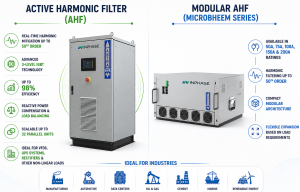
Today’s Active Harmonic Filter Technology uses advanced digital signal processors (DSPs), real-time monitoring systems, and intelligent control algorithms.
Modern systems can:
Detect Harmonics Instantly
AHFs continuously monitor current waveforms and identify harmonic frequencies within milliseconds.
Provide Dynamic Compensation
Unlike fixed passive solutions, Active Harmonic Filter Technology adapts automatically to changing load conditions.
Improve Power Factor
Many modern AHFs simultaneously improve power factor while reducing harmonic distortion.
Support Smart Monitoring
Integration with SCADA systems, Modbus communication, and cloud-based monitoring allows operators to track power quality performance in real time.
Key Benefits of Active Harmonic Filter Technology
1. Reduced Harmonic Distortion
AHFs can reduce Total Harmonic Distortion (THD) below 5%, supporting IEEE 519 compliance.
2. Improved Equipment Reliability
Reduced harmonic stress protects transformers, motors, generators, and sensitive electronics.
3. Lower Energy Losses
Cleaner electrical waveforms reduce losses throughout the power distribution network.
4. Enhanced System Efficiency
Facilities achieve better overall electrical performance and lower operating costs.
5. Increased Equipment Lifespan
Reduced overheating extends the life of electrical infrastructure.
Industries Benefiting from Active Harmonic Filter Technology
Many sectors rely on Active Harmonic Filter Technology to maintain stable operations:
- Manufacturing plants
- Data centers
- Hospitals
- Pharmaceutical facilities
- Automotive industries
- Steel and cement plants
- Commercial buildings
- Renewable energy projects
As industrial processes become increasingly automated, demand for advanced harmonic mitigation continues to grow.
The Future of Active Harmonic Filter Technology
The future of Active Harmonic Filter Technology is closely connected to Industry 4.0, smart grids, and renewable energy integration.
Artificial Intelligence and Predictive Analytics
Future AHFs will use AI-based algorithms to predict power quality disturbances before they occur.
IoT Connectivity
Internet of Things (IoT) integration will enable continuous monitoring and remote diagnostics.
Renewable Energy Integration
Solar and wind power systems rely heavily on power electronic converters, making Active Harmonic Filter Technology essential for maintaining grid stability.
Smart Grid Compatibility
As utilities adopt smart grid infrastructure, AHFs will provide dynamic support for voltage regulation, harmonic control, and reactive power management.
Higher Efficiency Designs
Future generations of AHFs will deliver even faster response times, reduced losses, and improved scalability.
Real-World Example
A large manufacturing facility experiencing harmonic distortion levels above 18% installed an InPhase Active Harmonic Filter solution.
Results
- THD reduced to below 4%
- Power factor improved significantly
- Transformer temperature reduced
- Equipment downtime minimized
- Compliance with IEEE 519 achieved
The project demonstrated how modern Active Harmonic Filter Technology can deliver measurable operational and financial benefits.
Conclusion
Active Harmonic Filter Technology has evolved from an innovative concept into an essential component of modern power quality management. As industries adopt automation, renewable energy, and smart manufacturing systems, the need for effective harmonic mitigation continues to increase.
With real-time compensation, intelligent monitoring, and future-ready capabilities, Active Harmonic Filter Technology will remain a critical solution for ensuring efficient, reliable, and standards-compliant electrical systems.
 Contact InPhase Energy to learn how Active Harmonic Filter Technology can improve power quality and protect your critical operations.