Power factor plays a vital role in determining the efficiency of an electrical distribution system. In industrial facilities, a poor power factor increases reactive power demand, leading to higher electricity bills, increased system losses, reduced transformer capacity, and utility penalties. As industries continue to adopt advanced automation, maintaining an optimal power factor has become essential for ensuring energy efficiency and reliable operations.
This is where Auto Power Factor Correction (APFC) becomes an indispensable solution. Unlike manual capacitor banks that require operator intervention, Auto Power Factor Correction systems continuously monitor electrical loads and automatically switch capacitor banks to maintain the desired power factor. The result is improved energy efficiency, reduced operating costs, and better utilization of electrical infrastructure.
For decades, Auto Power Factor Correction has been the preferred solution for industries seeking to improve power factor. However, with the growing use of nonlinear loads such as Variable Frequency Drives (VFDs), UPS systems, servo drives, CNC machines, and industrial automation equipment, modern electrical systems face challenges that extend beyond reactive power compensation alone. Understanding how Auto Power Factor Correction works is the first step toward selecting the right power quality solution for today’s industrial environments.
What is Auto Power Factor Correction (APFC)?
Auto is an intelligent electrical system designed to maintain the power factor of an industrial installation automatically. It continuously monitors the reactive power demand of connected loads and switches capacitor banks ON or OFF through an automatic power factor controller. This dynamic operation ensures that the required reactive power is supplied only when necessary, allowing the electrical system to operate close to unity power factor.
Unlike conventional manual capacitor banks, an Auto Power Factor Correction system responds instantly to changing load conditions. As motors start, stop, or vary in operation, the controller continuously analyzes the power factor and activates the appropriate capacitor stages to compensate for reactive power. This automatic adjustment minimizes utility penalties, reduces current drawn from the supply, and improves the overall efficiency of the electrical distribution network.
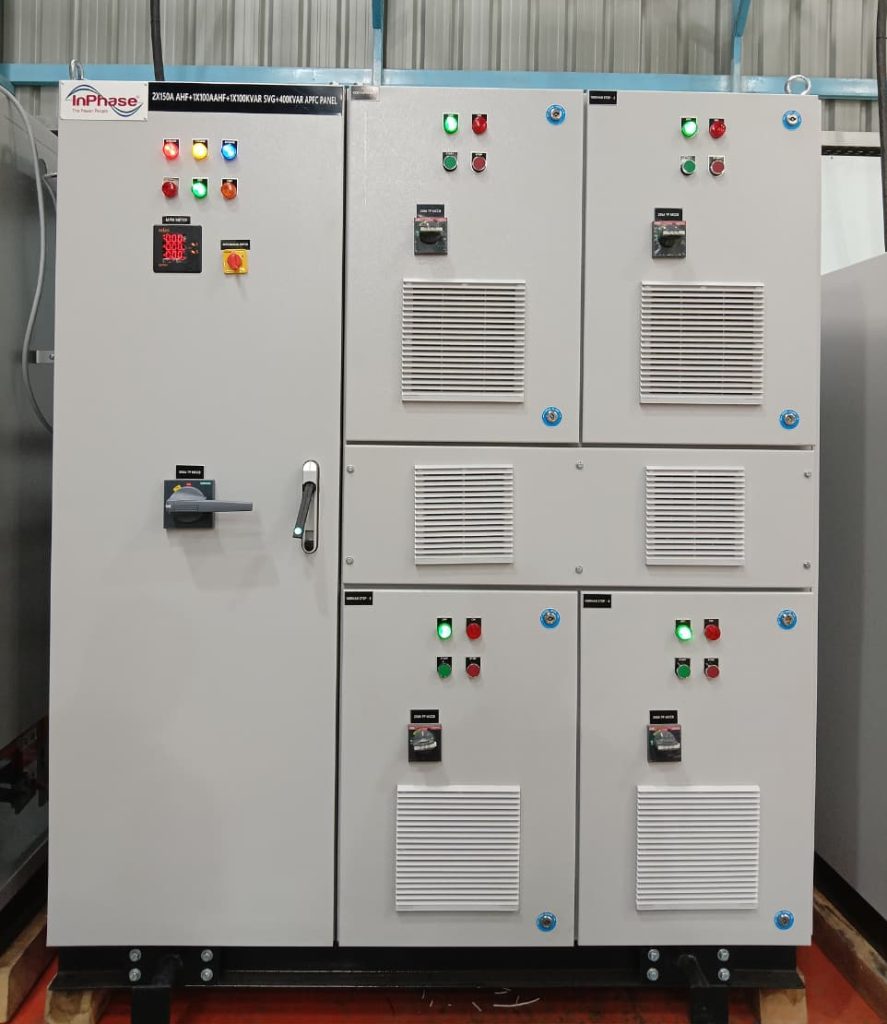
An Auto Power Factor Correction panel typically consists of a power factor controller, capacitor banks, contactors or thyristor switches, protection devices, and monitoring equipment. Together, these components provide a reliable and cost-effective method of improving power factor across manufacturing plants, commercial buildings, process industries, and other facilities with varying electrical loads.
By maintaining an optimal power factor, Auto Power Factor Correction helps industries reduce energy losses, improve voltage stability, increase transformer and cable utilization, and extend the lifespan of electrical equipment. For facilities with predominantly linear loads, APFC remains one of the most practical and economical solutions for reactive power compensation.
How Does Auto Power Factor Correction Work?
The Auto Power Factor Correction (APFC) system operates by continuously monitoring the electrical network and automatically compensating for reactive power whenever the load changes. Instead of relying on manual intervention, the system intelligently switches capacitor banks to maintain the desired power factor, ensuring efficient utilization of electrical energy under varying operating conditions.
The working principle of Auto Power Factor Correction can be understood in the following stages:
1. Continuous Monitoring of Electrical Parameters
The APFC controller continuously measures system voltage, current, power factor, and reactive power using current transformers (CTs) and voltage sensing circuits. This real-time monitoring enables the controller to determine whether the system requires additional reactive power compensation.
2. Power Factor Analysis
Based on the measured electrical parameters, the controller compares the existing power factor with the preset target value, typically between 0.95 and unity (1.0). If the power factor falls below the desired level due to inductive loads such as motors, transformers, or compressors, the controller calculates the amount of reactive power required.
3. Automatic Capacitor Switching
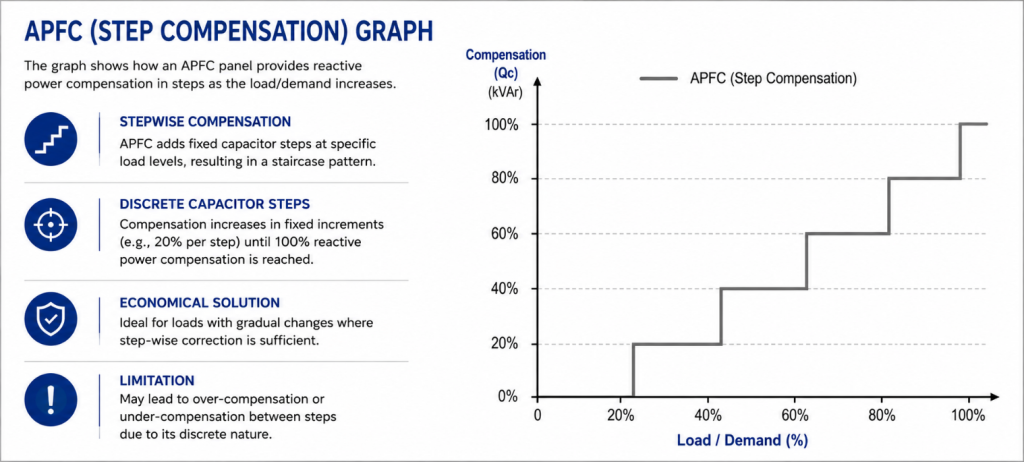
Once the reactive power requirement is determined, the Auto Power Factor Correction controller automatically switches the appropriate capacitor bank stages into the circuit. As the load decreases, unnecessary capacitor stages are disconnected to prevent overcompensation. This automatic operation ensures that only the required amount of reactive power is supplied at any given time.
4. Continuous Power Factor Optimization
Since industrial loads change throughout the day, the Auto Power Factor Correction system continuously repeats this process in real time. The controller keeps monitoring, calculating, and switching capacitor stages to maintain a stable power factor, improve electrical efficiency, and minimize utility penalties without interrupting plant operations.
Benefits of This Automatic Operation
Because the entire process occurs automatically, Auto Power Factor Correction offers several operational advantages:
Maintains a consistently high power factor under varying load conditions.
Reduces electricity penalties associated with poor power factor.
Improves transformer and cable utilization.
Minimizes reactive power demand from the utility.
Reduces system losses and improves overall energy efficiency.
Eliminates the need for manual capacitor bank switching.
While Auto Power Factor Correction is highly effective for compensating reactive power in conventional electrical systems, its performance depends on the nature of the connected loads. As industries increasingly rely on nonlinear equipment such as Variable Frequency Drives (VFDs), UPS systems, and automation technologies, additional power quality challenges begin to emerge that cannot be addressed through capacitor switching alone. This makes it important to understand both the strengths and the practical limitations of APFC systems in modern industrial environments.
Is APFC Panels a Solution for Power Factor Improvement?
To address poor power factor, many industries deploy Automatic Power Factor Correction (APFC) Panels.
APFC Panels continuously monitor electrical load conditions and automatically switch capacitor banks to maintain a healthy power factor. By ensuring that reactive power is compensated efficiently, APFC systems help organizations improve electrical efficiency and reduce unnecessary costs.
Moving Beyond Power Factor Correction
As industrial facilities become increasingly automated, electrical systems are also becoming more dynamic. Variable Frequency Drives (VFDs), CNC machines, UPS systems, robotics, renewable energy systems, and other modern equipment demand a broader approach to power quality management.
Today, organizations are not only looking to improve power factor but also seeking solutions that enhance overall electrical system performance, reliability, and efficiency.
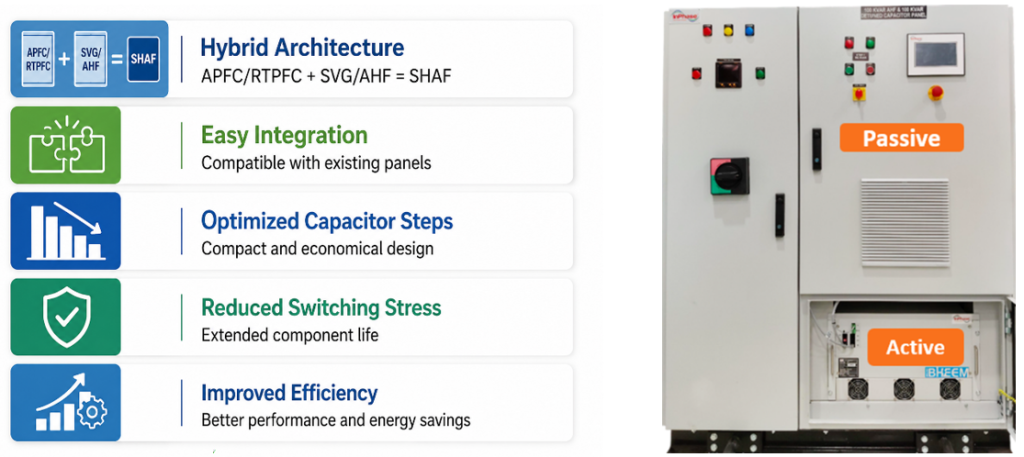
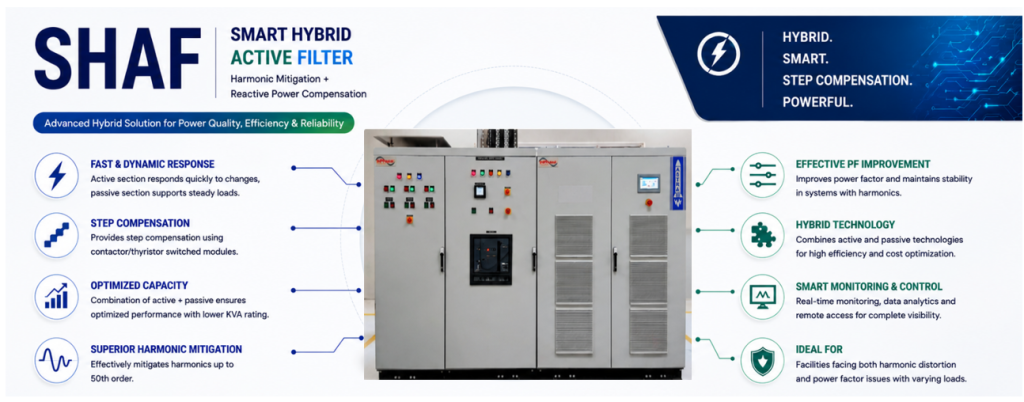
This is where advanced power quality solutions such as Static Hybrid Active Filters (SHAF) play an important role.
SHAF: A Comprehensive Power Quality Solution
Static Hybrid Active Filters (SHAF) combine reactive power compensation with intelligent harmonic mitigation to support healthier and more efficient electrical networks.
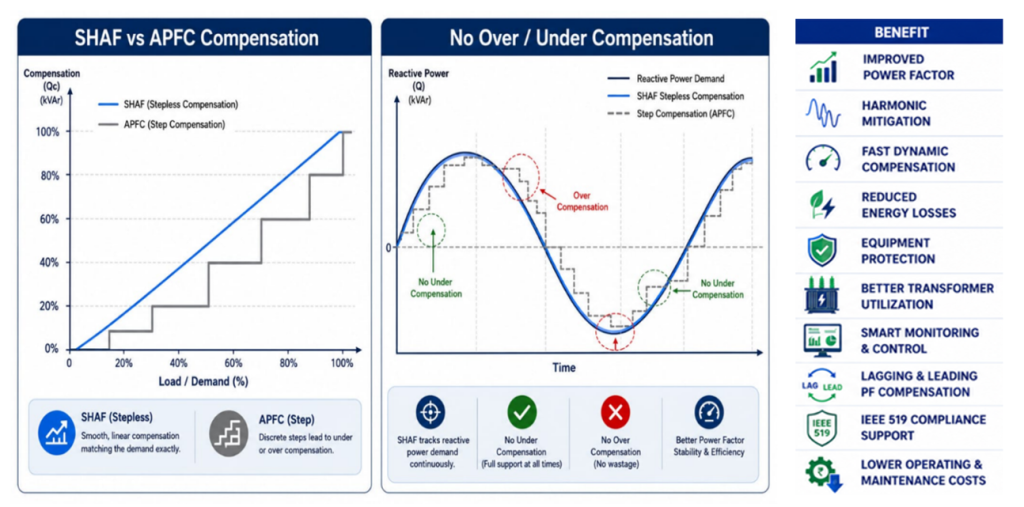
By continuously monitoring system conditions and dynamically responding to changing load requirements, SHAF helps maintain stable electrical performance while improving overall power quality.
Rather than focusing solely on power factor improvement, SHAF enhances overall power distribution system reliability and efficiency by mitigating harmonic distortion and supporting compliance with the IEEE 519 standard, which helps industries maintain superior power quality. Learn more about the standard from the IEEE Standards Association: IEEE STANDARDS
Why InPhase Power Technologies?
At InPhase Power Technologies, we understand the evolving challenges faced by modern industries. Our SHAF solutions are engineered to deliver effective power quality improvement while supporting long-term operational reliability and energy efficiency.