
Active Harmonic Filter Working Principle: How an AHF Cleans Up Harmonics?
The Active Harmonic Filter Working Principle is based on measuring harmonic currents and injecting equal-and-opposite compensation currents in real time. Understanding the Active Harmonic Filter Working Principle helps industries improve power quality and comply with IEEE 519 standards.
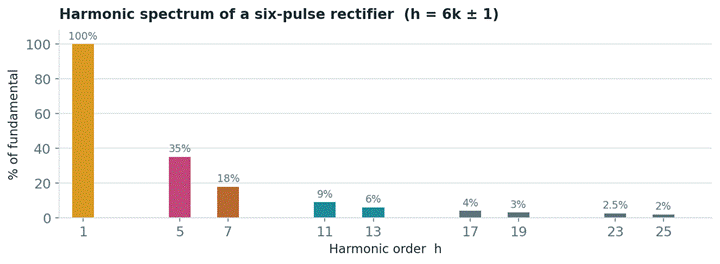
A typical six-pulse drive injects a strong 5th, 7th, 11th and 13th harmonic — exactly what an AHF is designed to cancel.
Why the Active Harmonic Filter Working Principle Is Important?
The Active Harmonic Filter Working Principle enables real-time harmonic mitigation without the resonance risks associated with passive filters. This makes the technology ideal for dynamic industrial loads.
What is an Active Harmonic Filter?
Modern industries rely heavily on non-linear electrical loads to improve productivity, automation, and energy efficiency. Equipment such as variable frequency drives (VFDs), DC drives, UPS systems, rectifiers, induction furnaces, welding machines, and switch-mode power supplies (SMPS) are now standard in manufacturing plants, commercial buildings, data centers, and process industries. While these devices enhance operational performance, they draw current in short, irregular pulses instead of a smooth sinusoidal waveform.
This non-linear current consumption generates harmonic currents that distort the electrical system, leading to poor power quality. Understanding the Active Harmonic Filter Working Principle is the first step toward solving these power quality challenges. The Active Harmonic Filter Working Principle enables industries to identify and eliminate harmonic distortion before it affects critical electrical equipment.
As harmonic distortion increases, industries face several operational challenges. Excessive harmonics can overheat transformers, motors, generators, and power cables, causing premature insulation failure and reducing equipment life. They can also overload neutral conductors, trigger nuisance tripping of circuit breakers, damage capacitor banks, interfere with sensitive electronic equipment, lower overall system efficiency, and increase energy losses.
If left unaddressed, these problems result in higher maintenance costs, unexpected production downtime, and reduced reliability of the electrical distribution system. This is why the Active Harmonic Filter Working Principle has become increasingly important in modern industrial facilities. Engineers rely on the Active Harmonic Filter Working Principle to maintain system reliability, improve efficiency, and comply with power quality standards.
An Active Harmonic Filter (AHF) is a modern power quality solution specifically designed to eliminate these harmonic currents. The Active Harmonic Filter Working Principle is based on continuously monitoring load currents and generating compensating currents in real time. Installed as a shunt-connected power electronic converter, an AHF continuously monitors the electrical network, detects harmonic distortion, and injects equal and opposite compensating currents into the system.
This dynamic compensation effectively cancels unwanted harmonics while maintaining a clean, nearly sinusoidal current waveform. The Active Harmonic Filter Working Principle ensures that harmonic mitigation remains effective even when electrical loads change rapidly. Because of the Active Harmonic Filter Working Principle, industries can achieve stable operation without interrupting production processes.
Unlike conventional passive harmonic filters, which are tuned to suppress only one or a few specific harmonic frequencies, an Active Harmonic Filter operates intelligently across a wide range of harmonic orders. The Active Harmonic Filter Working Principle allows the filter to adapt automatically to changing electrical conditions without manual intervention. It automatically adapts to changing load conditions in real time without requiring manual tuning.
Active Harmonic Filter working principle
The Active Harmonic Filter (AHF) operates on a simple yet highly effective principle that can be summarized in four stages: Measure, Compute, Inject, and Cancel. The Active Harmonic Filter Working Principle is based on these four coordinated stages that continuously monitor and compensate for harmonic distortion. These four stages work together continuously to detect harmonic distortion, generate compensating currents, and restore the electrical system to a near-sinusoidal condition. The Active Harmonic Filter Working Principle enables the filter to analyze changing electrical conditions with high accuracy and speed.
Since this entire process takes place in real time, the filter can respond instantly to changing load conditions without interrupting industrial operations. The Active Harmonic Filter Working Principle allows industries to maintain stable power quality even when non-linear loads fluctuate continuously. Another advantage of the Active Harmonic Filter Working Principle is its ability to detect harmonic currents within milliseconds and calculate the exact compensation required.
The Active Harmonic Filter Working Principle uses intelligent digital control algorithms to ensure precise harmonic mitigation under varying operating conditions. By continuously measuring, computing, injecting, and cancelling unwanted harmonic currents, the Active Harmonic Filter Working Principle maintains a clean sinusoidal current waveform and improves overall system efficiency. The Active Harmonic Filter Working Principle also helps protect transformers, motors, capacitor banks, and other electrical equipment from the harmful effects of harmonic distortion.
Overall, the Active Harmonic Filter Working Principle provides a fast, reliable, and intelligent approach to harmonic mitigation, making it an essential technology for modern industrial power quality improvement.
Measure — In the first stage, a Current Transformer (CT) continuously measures the load current flowing through the electrical distribution system. The current is sampled thousands of times every second to capture both the fundamental current and all harmonic components with high accuracy. This continuous monitoring ensures that even small variations in load conditions are detected immediately, providing the Active Harmonic Filter with accurate real-time data for analysis.
Compute — The measured current signals are then sent to a high-speed Digital Signal Processor (DSP), which acts as the brain of the Active Harmonic Filter. Using advanced control algorithms such as the Instantaneous Power (p–q) Theory, the DSP separates the fundamental 50 Hz component from the unwanted harmonic components. It continuously calculates the magnitude, phase angle, and harmonic order of the distortion, enabling the system to determine the exact compensation current required.
Inject — Based on these calculations, a high-speed IGBT-based Voltage Source Inverter (VSI) generates a compensating current that is equal in magnitude but opposite in phase to the detected harmonic currents. The inverter injects this compensation current directly into the electrical network through a shunt connection. Because the inverter responds within milliseconds, it can accurately compensate for harmonics even when industrial loads change rapidly.
Cancel — At the Point of Common Coupling (PCC), the injected compensation current combines with the harmonic current produced by the non-linear load. Since the two currents are equal and opposite, they effectively cancel each other according to the principle of superposition. As a result, the utility source supplies only the clean fundamental current, significantly reducing Total Harmonic Distortion (THD), improving power quality, protecting electrical equipment, and ensuring compliance with IEEE 519 harmonic standards.
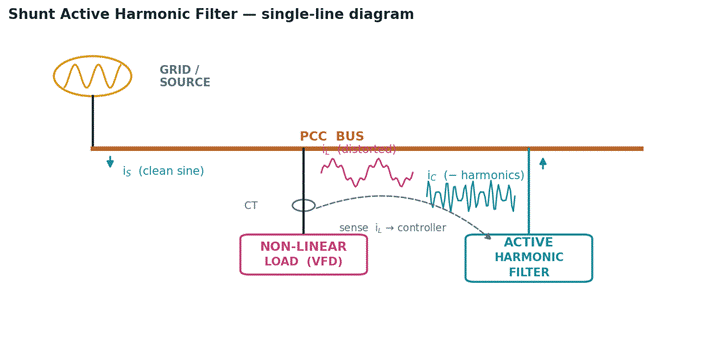
Shunt AHF: the CT senses distorted load current; the inverter injects the inverse harmonics so the source current stays clean.
Because the inverter is current-controlled and re-computes its output every switching cycle, the AHF follows load changes within milliseconds and never presents a tuned impedance that could resonate with the supply.
InPhase ASTRA active harmonic filter specifications
InPhase manufactures the indigenously developed ASTRA range — a 3-level IGBT active harmonic filter built for Indian and global industrial conditions.
| Parameter | ASTRA AHF |
| Current rating | 30 A to 30,000 A |
| Harmonic compensation | Up to the 61st order |
| System type | 3-phase 3-wire / 4-wire |
| Voltage | 415 V and 690 V AC |
| Topology | 3-level IGBT, multi-level |
| Efficiency | Up to 98% |
| Control | Dual quad-core DSP, cloud connectivity |
| Extra functions | Reactive power (near unity PF) + load-balancing |
Key benefits
-
- Cuts THD to keep systems within IEEE 519 limits and avoid utility penalties
-
- 3-level topology and ~98% efficiency mean low losses and lower running cost
-
- Auto voltage stabilisation and grid-resonance elimination protect equipment
-
- Hybrid compensation: harmonics, reactive power and unbalance in one unit
-
- Cloud monitoring for real-time power-quality data and energy management
- One of the biggest advantages of the Active Harmonic Filter Working Principle is its ability to compensate for changing harmonic conditions within milliseconds.
Where Active Harmonic Filters are used
Active Harmonic Filters (AHFs) are widely deployed in industries where non-linear electrical loads dominate and harmonic distortion is a major power quality concern. Modern industrial facilities increasingly depend on power electronic equipment to improve productivity, process accuracy, automation, and energy efficiency. However, these non-linear loads draw current in an irregular manner, producing harmonic currents that distort the electrical waveform and degrade overall power quality. As a result, industries require intelligent harmonic mitigation solutions that can adapt to continuously changing operating conditions.
AHFs are commonly installed in steel plants, cement plants, textile mills, foundries, pharmaceutical manufacturing facilities, chemical and process industries, food and beverage plants, paper mills, oil and gas facilities, mining operations, water and wastewater treatment plants, automobile manufacturing units, railways, metro systems, airports, commercial buildings, hospitals, data centres, and renewable energy installations such as solar and wind power plants. These industries operate numerous Variable Frequency Drives (VFDs), DC drives, rectifiers, induction furnaces, welding machines, UPS systems, battery chargers, and Switch-Mode Power Supplies (SMPS), all of which are major sources of harmonic distortion.
Active Harmonic Filters continuously monitor the electrical network, detect harmonic currents in real time, and inject equal and opposite compensating currents to eliminate distortion before it reaches the utility supply. Unlike passive filters, AHFs automatically adapt to changing load conditions without requiring manual tuning, making them suitable for facilities where electrical demand changes throughout the day. Their fast response enables effective mitigation of multiple harmonic orders simultaneously while also improving power factor and reducing load unbalance in many applications.
International standards & compliance
Power-quality limits are set by internationally recognised standards, and InPhase solutions are engineered to meet them across regions: IEEE 519 (harmonic control, referenced worldwide), IEC 61000-3-2 / 61000-3-12 and IEC 61000-2-4 (harmonic emission and compatibility levels used across Europe, the Middle East and Asia), and EN 50160 (voltage quality on public networks). Meeting these limits at the Point of Common Coupling (PCC) typically around 5% voltage THD helps you avoid utility penalties and pass third-party power-quality audits in any country you operate.
Why choose InPhase?
InPhase Power Technologies is a specialist power-quality manufacturer with R&D approved by DSIR (Government of India) and an installed base measured in kilo-amperes across 10+ countries and sectors such as steel, cement, metro, textile, oil & gas, data centres and green hydrogen.
-
- Only Indian company 100% dedicated to industrial power quality
-
- Solutions from 330 V up to 33 kV, including in-house medium-voltage technology
-
- Proven installations across steel, cement, metro, textile and data-centre sectors
- Industries prefer solutions based on the Active Harmonic Filter Working Principle because they provide adaptive harmonic mitigation across multiple harmonic orders.
The Active Harmonic Filter Working Principle offers a reliable and future-ready approach to harmonic control, power factor improvement, and electrical system protection.
Frequently asked questions
What is the working principle of an active harmonic filter?
An AHF measures the harmonic content of the load current with a CT, computes the inverse waveform using a DSP, and injects an equal-and-opposite current through an IGBT inverter. The injected current cancels the harmonics at the connection point, leaving a clean sine wave on the supply side.
What is the difference between an active and a passive harmonic filter?
A passive filter is tuned to fixed frequencies and can resonate with the grid, while an active harmonic filter adapts in real time, cancels many harmonic orders at once, and carries no resonance risk. AHFs are preferred for dynamic or mixed loads.
How much can an AHF reduce THD?
A correctly sized AHF typically brings current THD down to around 3–5%, which is within IEEE 519 limits for most supply conditions.
How do I size an active harmonic filter?
An AHF is rated in harmonic amps — the RMS of the harmonic current it must inject, not the total load current. InPhase engineers size the unit from a power-quality survey of your harmonic spectrum, with margin for future load growth.
IEEE 519 Harmonic Standard: https://standards.ieee.org
IEC Power Quality Standards: https://webstore.iec.ch
Learn more about our Active Harmonic Filter solutions at https://inphase.in/
Need to bring your plant within IEEE 519? Talk to InPhase about an ASTRA active harmonic filter sized for your load – visit inphase.in or email sales@inphase.in.
Related reading: InPhase Smart Hybrid Active Filter (SHAF), Modular AHF, and Static VAR Generator (SVG).