
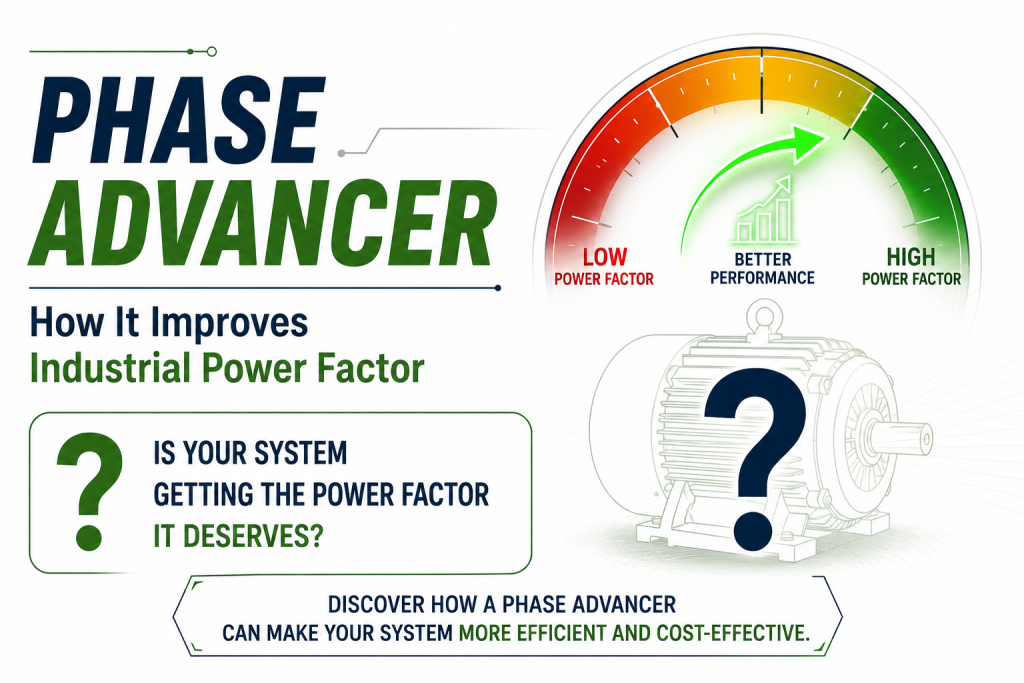
Your phase advancer is designed to improve the power factor of a suitable industrial motor. But what happens when a motor is running normally, production is continuing, and there is no obvious sign of an electrical problem?
Behind this normal operation, the motor may still be drawing reactive power from the electrical system.
This is where power factor becomes important.
Large induction motors require reactive power to establish the magnetic field needed for operation. When this reactive power demand becomes significant, the motor can operate at a lower power factor, particularly under certain loading conditions.
So, what is a phase advancer, how does it work, and where can it be useful in an industrial electrical system?
Let’s take a closer look.
What Is a Phase Advancer?
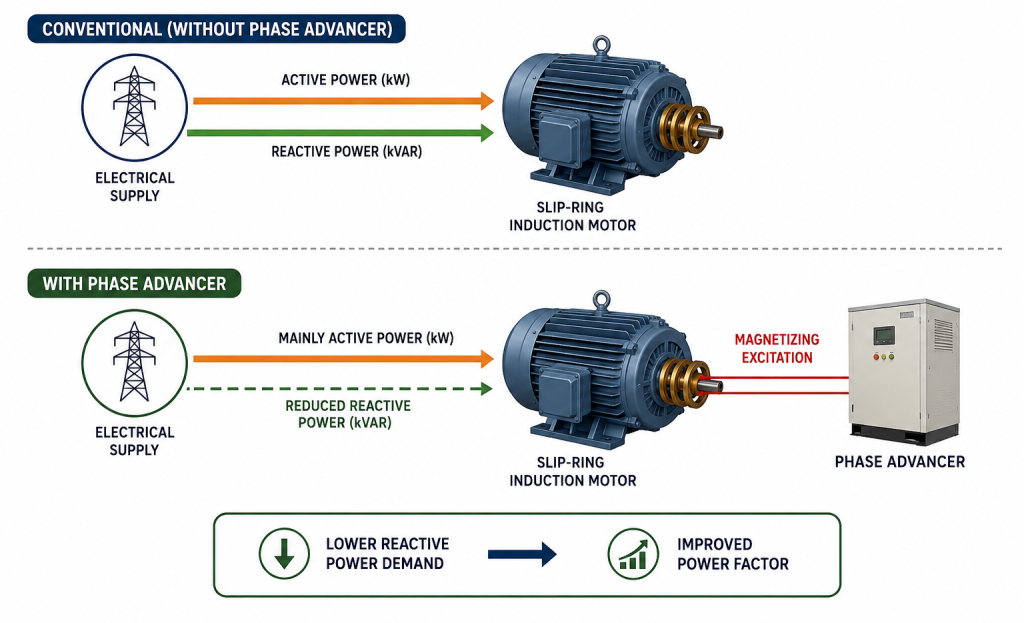
A phase advancer is a device used to improve the power factor of an induction motor by supplying the required magnetizing current to the motor through an auxiliary excitation arrangement. In a conventional induction motor, the magnetizing current required to establish the rotating magnetic field is supplied from the electrical network. This contributes to the motor’s reactive power demand.
A phase advancer provides excitation to the rotor circuit of a slip ring induction motor at the appropriate phase relationship. This reduces the reactive current that needs to be drawn from the supply.
How Does a Phase Advancer Work?
A phase advancer works by supplying excitation to the rotor circuit of a slip ring induction motor. In a slip ring motor, the rotor winding is connected to external circuits through slip rings. This makes it possible to introduce an external excitation arrangement.
The phase advancer supplies current to the rotor at the appropriate slip frequency and phase relationship. This excitation contributes to the magnetizing requirement of the motor.
As a result, the motor can draw less reactive current from the supply. However, this approach is specifically associated with suitable slip ring induction motors. It is not a universal power factor correction method for every type of motor or industrial load.
What Are the Advantages of Using a Phase Advancer?
When applied to a suitable slip ring induction motor, a phase advancer can provide several benefits.
The main advantages include :
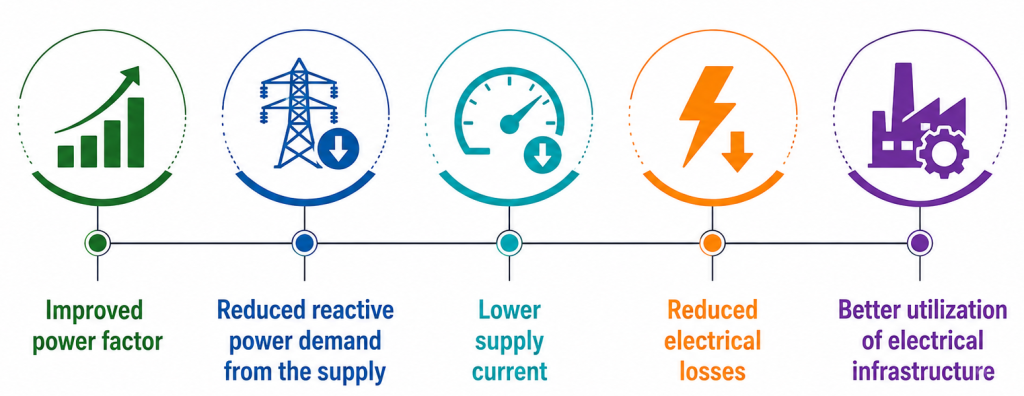
By reducing the reactive component of current drawn from the supply, the motor’s electrical demand can be managed more effectively. But this raises another question.
Is a phase advancer suitable for every industrial application?
Where Can a Phase Advancer Be Used?
Phase advancers are particularly associated with large slip ring induction motors used in applications where high starting torque and heavy mechanical loads are involved.
Examples can include:
Large pumps
Compressors
Fans and blowers
Crushers
Mills
Heavy industrial machinery
In such applications, improving the motor’s power factor can help reduce the reactive burden placed on the electrical supply. However, modern industrial facilities are rarely made up of only one type of motor. They may contain induction motors, VFDs, rectifiers, converters, welding equipment, and other nonlinear or rapidly changing loads. This makes plant wide power management more complex.
Can a Phase Advancer Solve Every Power Quality Problem?
A phase advancer can help address the reactive power requirement of a suitable induction motor, but it is not designed to solve every power quality problem.
Modern industrial power systems can involve:
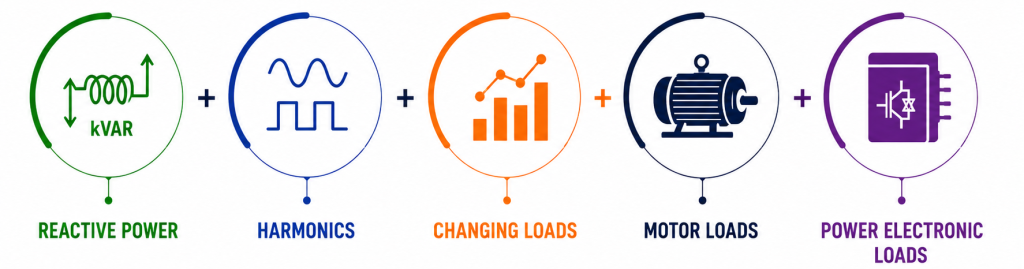
These conditions require a broader approach to power quality management. Traditional compensation methods can still be useful for stable loads. However, when the electrical demand changes continuously, a more flexible compensation solution may be required.
What Are the Modern Approaches to Power Factor Improvement?
Modern industries are moving beyond solutions designed for a single motor or a single type of load. Depending on the application, power factor improvement can involve automatic capacitor based compensation, dynamic compensation, active filtering, or hybrid solutions.
The objective is not simply to improve the power factor at one point. It is to maintain better electrical performance as the industrial load changes. This is where modern hybrid power quality solutions become useful.
How Does SHAF Fit Into This?
For industries that need a broader solution, SHAF – Smart Hybrid Active Filter provides a modern approach to power quality management.
Unlike a phase advancer, which is primarily associated with a suitable slip ring motor, SHAF is designed around the requirements of the wider industrial electrical system. It combines passive and active compensation to address changing electrical conditions.
The passive section can handle the bulk compensation requirement, while the active section provides dynamic correction when the load changes. This makes the approach more suitable for industrial environments where different types of loads operate together.
Industrial loads do not always remain constant. Motors may start and stop, production levels may change, and power electronic loads can introduce additional power quality challenges.
IEEE 519 provides recommended limits for harmonic voltage and current distortion at the point of common coupling (PCC). Effective harmonic management therefore becomes an important part of maintaining power quality in modern industrial electrical systems.
This is where a more flexible solution can make a difference.
Why Consider InPhase SHAF?
InPhase SHAF is designed to provide a broader approach to industrial power quality management. It combines passive and active compensation to respond to the changing requirements of the electrical system.
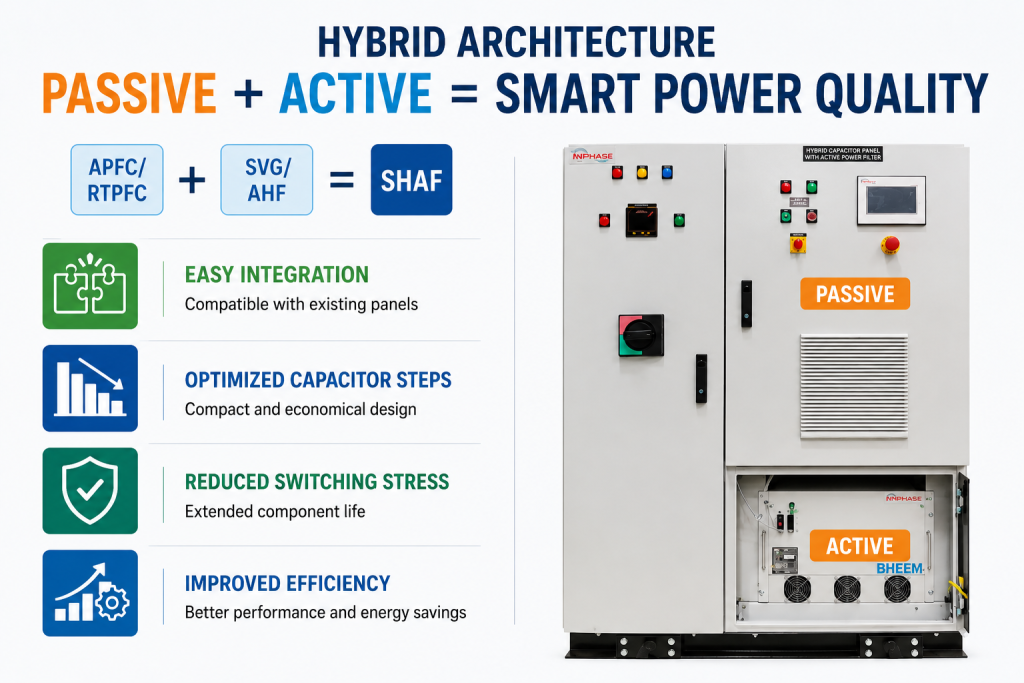
The hybrid approach helps manage the changing reactive power requirements of industrial loads while also supporting overall power-quality improvement. Unlike a phase advancer, which is mainly associated with the excitation requirements of a suitable slip ring induction motor, SHAF addresses the broader electrical system and its changing load conditions. This makes it a more suitable approach for modern industrial facilities where different types of loads operate together.
InPhase SHAF provides a hybrid approach for:
Dynamic reactive power compensation
Power factor improvement
Changing industrial loads
Mixed electrical loads
Overall power quality management
Looking for a smarter way to manage power factor and power quality in your industrial facility?
Explore InPhase SHAF and discover a modern approach to hybrid power quality compensation.