
₹4 Crore Electricity Bill. ₹15 Lakhs Saved. One Power Factor Improvement.
Power factor improvement can make a significant financial difference to industrial electricity expenses, especially in states where electricity billing is based on kVA demand.
This is not a hypothetical example. It is based on a real industrial case in India, where improving power factor from 0.96 to 0.99 helped achieve substantial electricity bill savings.
The annual electricity bill was approximately ₹4 crore. The reported savings were ₹15 lakh following the power factor improvement.
The estimated payback period for the investment was as short as six months, depending on the applicable operating and billing conditions. In other cases, payback may extend to around 1.5 years.
One change in electrical performance. A significant difference in operating costs.
How Power Factor Improvement Can Reduce Industrial Electricity Costs
Power factor measures how effectively an electrical system converts supplied apparent power into useful working power.
A lower power factor means the facility draws more apparent power (kVA) to deliver the same active power (kW).
For industrial facilities, this can increase demand-related electricity charges where the tariff structure uses kVA billing or demand-based charges.
Consider the difference:
-
Initial power factor: 0.96
-
Improved power factor: 0.99
-
Total annual electricity bill: Approximately ₹4 crore
-
Reported annual savings: ₹15 lakh
The actual financial benefit depends on the electricity tariff, billing methodology, load profile, operating hours and applicable power factor incentives or penalties.
This is why a proper power quality assessment should come before selecting a correction solution.
Why the Cheapest Power Quality Equipment Can Become Expensive
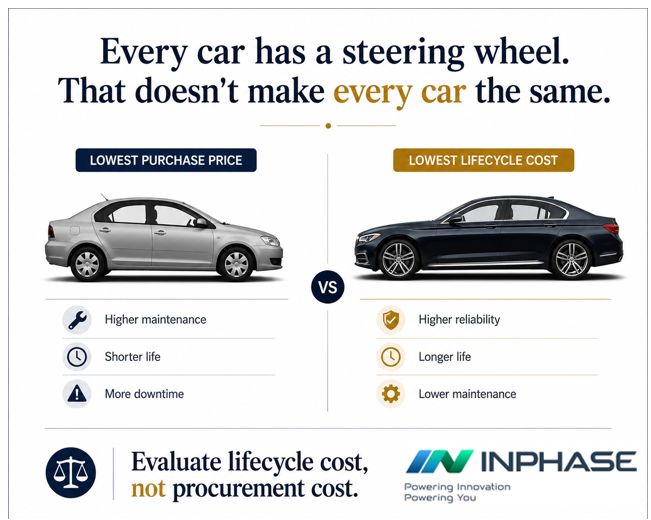
One of the most common mistakes in industrial procurement is comparing electrical equipment based only on its purchase price.
Two products may have similar ratings and specification sheets. That does not mean they offer the same reliability, efficiency or lifecycle performance.
As we often explain at InPhase:
“They see that both cars have a steering wheel, so they assume it’s the same car. They don’t see the Benz and Maruti difference until it breaks.”
The same principle applies to industrial power quality equipment.
A lower-cost solution may appear attractive initially. However, if it uses a non-modular architecture and a single-board failure requires complete board replacement, the long-term cost can increase significantly.
In some cases, customers may need to reinvest within two to three years.
The real comparison should include reliability, serviceability, replacement costs and expected equipment life.
5 Questions Every Procurement Head Should Ask Before Buying an AHF or SVG
Before issuing a Request for Quotation (RFQ) for an Active Harmonic Filter (AHF) or Static VAR Generator (SVG), procurement teams should ask the following questions.
1. Can the Equipment Operate Reliably at Our Factory Temperature?
Industrial facilities can experience high ambient temperatures, demanding operating schedules and varying electrical loads.
Ask the supplier about rated operating temperatures, cooling arrangements, thermal protection and derating characteristics.
A product should be evaluated against the actual installation environment, not just its laboratory specifications.
2. What Happens When the Equipment Breaks Down?
A product’s purchase price does not tell you how much a failure will cost.
Ask about replacement component costs, local technical support, service response times and spare parts availability.
A dependable service network can help reduce unnecessary downtime and avoid expensive equipment replacement.
3. Is the Architecture Modular?
This is an important consideration when comparing Active Harmonic Filters and other power quality equipment.
In a modular architecture, individual modules can potentially be serviced or replaced without replacing the entire system, depending on the design.
Ask whether a single-board or module failure will affect the complete installation.
Also evaluate redundancy, fault isolation and maintainability.
4. What Is the Lifecycle Cost, Not Just the Procurement Cost?
Evaluate the complete ownership cost:
-
Initial purchase price
-
Installation and commissioning
-
Energy losses
-
Maintenance expenses
-
Spare parts and replacement costs
-
Service support
-
Production downtime
-
Expected equipment life
A product with a higher initial cost may provide better long-term value if it offers verified reliability and lower maintenance requirements.
5. How Can We Verify Performance After Installation?
This is the question that almost nobody asks.
Installing an Active Harmonic Filter does not automatically guarantee that harmonic distortion will remain within the required limits.
Harmonic levels change as industrial loads change.
Without proper monitoring, a facility may not know whether its filter is delivering the expected compensation.
Pre-installation measurements, post-installation verification and continuous power quality monitoring help establish whether the solution is performing as intended.
An IoT-based Energy Management System can provide additional visibility into electrical parameters and equipment performance.
Why Power Quality Monitoring Is Essential
Power factor correction and harmonic mitigation are related aspects of electrical power quality, but they address different problems.
A Static VAR Generator can provide dynamic reactive power compensation to help maintain power factor under changing loads.
An Active Harmonic Filter helps mitigate current harmonics generated by nonlinear loads.
Depending on the facility’s electrical requirements, both technologies may be needed.
Continuous monitoring helps track:
-
Power factor
-
Active and reactive power
-
Voltage and current
-
Harmonic distortion
-
Total Demand Distortion (TDD)
-
Equipment operating status
-
Load variations
A properly designed monitoring system allows engineering teams to identify abnormal conditions and evaluate whether installed equipment is delivering the expected results.
Why kVA Billing Makes Power Factor Improvement More Important
In electricity tariff structures that use kVA-based demand billing, power factor can directly influence the apparent power demand recorded by the utility.
Improving power factor can reduce the kVA required to support a given kW load, subject to the actual load and billing structure.
As more industrial facilities encounter demand-based billing arrangements, evaluating power factor becomes an important part of energy cost management.
According to the operating and tariff information reported for this case, 16 Indian states were practising kVA billing, with more expected to move in that direction. Always check the latest applicable state electricity tariff before estimating savings.
The financial case for improving power quality deserves attention from both engineering and procurement teams.
InPhase: Industrial Power Quality Solutions
At InPhase, we work with industrial facilities to address power quality challenges through application-specific engineering and equipment solutions.
Our product range includes:
-
Active Harmonic Filters (AHF): Designed to mitigate harmonic distortion caused by nonlinear electrical loads.
-
Static VAR Generators (SVG): Designed for dynamic reactive power compensation and power factor improvement.
-
Power Quality Solutions: Designed to address industrial electrical network challenges.
-
Energy Management Systems: Help monitor electrical parameters and evaluate equipment performance.
Explore our Active Harmonic Filter solutions, Static VAR Generators and Industrial Power Quality Solutions.
Lifecycle Cost Over Procurement Cost. Every Single Time.
The engineering team in your facility already understands the importance of reliable electrical infrastructure.
The challenge is getting procurement to evaluate equipment using the same engineering perspective.
A cheaper product may reduce the initial purchase order, but a failure, replacement or unexpected downtime can make that decision expensive.
Before your next AHF or SVG purchase, evaluate performance, modularity, serviceability, monitoring and total ownership cost.
Lifecycle cost over procurement cost. Every single time.
At InPhase, we believe the best power quality investment is one that delivers measurable performance, dependable operation and long-term value.
Industrial facilities should evaluate harmonic distortion in accordance with applicable power quality requirements. Refer to the official IEEE 519-2022 Standard for Harmonic Control in Electric Power Systems.
For industrial power quality assessment, facilities should also refer to the official IEEE 519-2022 Standard for Harmonic Control to understand recommended harmonic distortion limits and power quality requirements.