
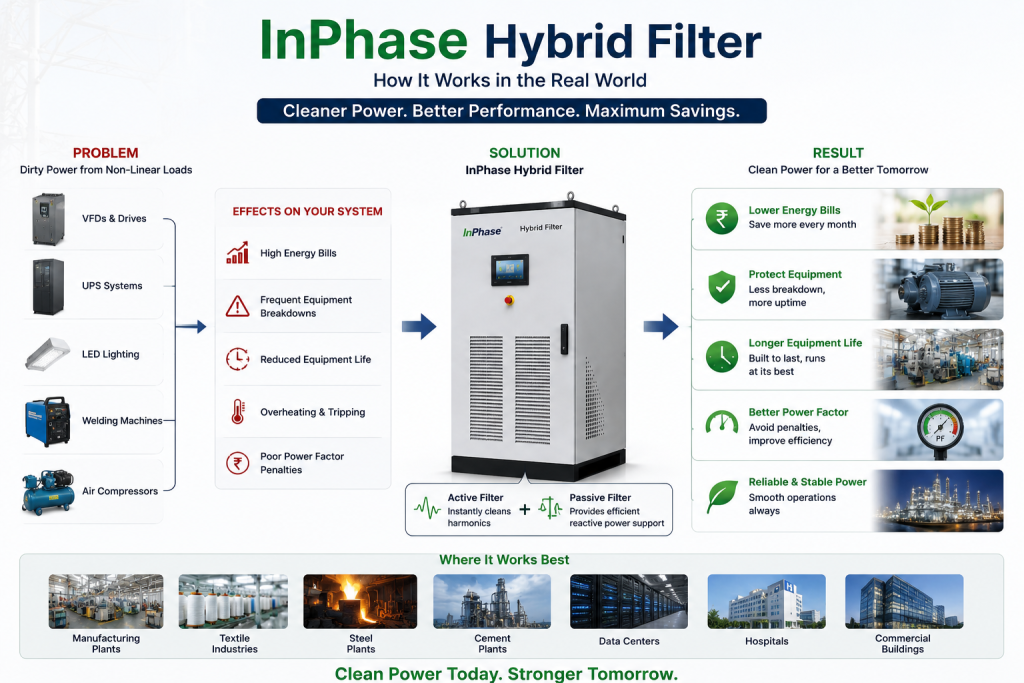
Hybrid Filter Specifications play a critical role in determining how effectively a power quality solution can mitigate harmonics, improve power factor, and protect industrial electrical systems. While technical specifications may appear to be a list of numbers, they directly impact system performance, reliability, scalability, and return on investment.
InPhase Hybrid Filters are engineered to combine the advantages of passive and active filtering technologies, providing comprehensive harmonic mitigation and reactive power compensation for modern industrial applications. Understanding these Hybrid Filter Specifications helps engineers and facility managers select the right solution for achieving IEEE 519 compliance and improving overall power quality.
Understanding Hybrid Filter Specifications
When evaluating a harmonic mitigation solution, it is important to review the key Hybrid Filter Specifications that influence performance under real-world operating conditions.
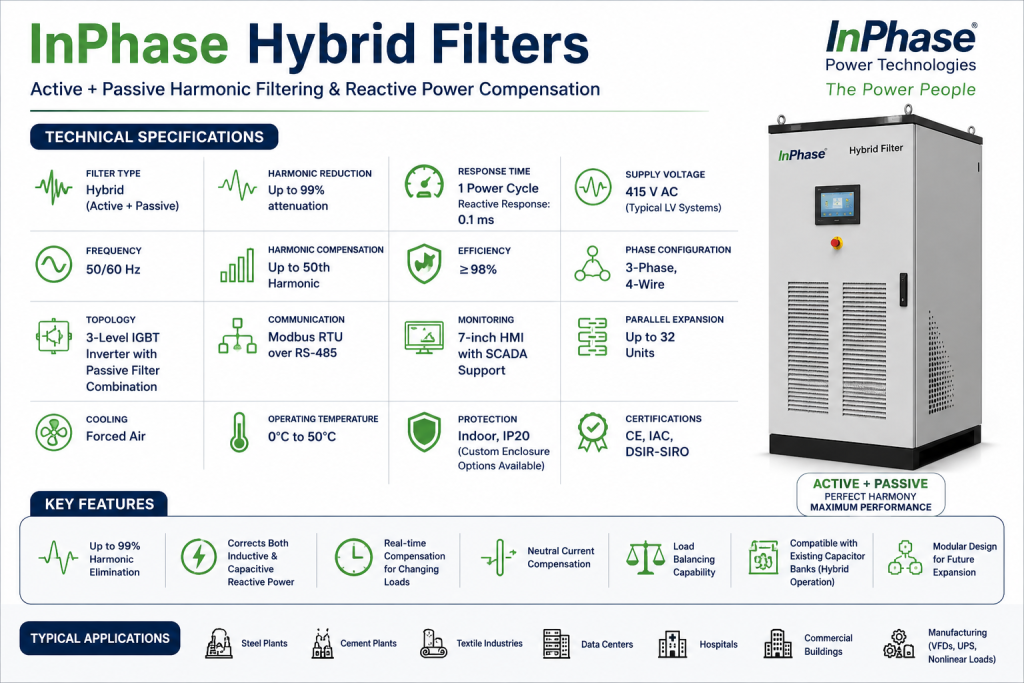
Key Hybrid Filter Specifications at a Glance
| Parameter | InPhase Hybrid Filter |
|---|---|
| Reactive Power Compensation | Up to 2 MVAR, Modular & Scalable |
| Harmonic Mitigation | Effective up to 50th Order Harmonics |
| Response Time | < 10 Milliseconds |
| System Efficiency | > 98% |
| Operating Voltage | 415V ±10% |
| Cooling System | Intelligent Air Cooling |
| Communication Protocols | Modbus RTU, TCP/IP, Ethernet |
| Compliance Standards | IEEE 519, IEC 61000, CEA Norms |
These Hybrid Filter Specifications demonstrate the capability of the system to address complex industrial power quality challenges.
Hybrid Filter Specifications for Reactive Power Compensation
One of the most important Hybrid Filter Specifications is reactive power compensation capability.
Up to 2 MVAR Reactive Power Compensation
Industrial facilities with motors, welding machines, induction furnaces, rolling mills, and large drive systems require significant reactive power support.
Benefits include:
-
Improved power factor
-
Reduced utility penalties
-
Lower transformer loading
-
Enhanced system efficiency
-
Better voltage regulation
The modular architecture allows multiple units to be combined for higher compensation requirements.
Hybrid Filter Specifications for Harmonic Mitigation
Harmonics generated by non-linear loads can severely impact electrical system performance.
Harmonic Mitigation up to the 50th Order
A major advantage of these Hybrid Filter Specifications is the ability to mitigate harmonics up to the 50th order.
This capability helps eliminate:
-
Transformer overheating
-
Capacitor bank failures
-
Cable overheating
-
Motor losses
-
Nuisance tripping
-
Voltage distortion
By controlling harmonics effectively, facilities can maintain compliance with IEEE 519 standards.
Hybrid Filter Specifications for Fast Response Time
Industrial loads change rapidly throughout the production cycle.
Less Than 10 Milliseconds Response Time
One of the most valuable Hybrid Filter Specifications is the ultra-fast response time.
Fast response enables:
-
Dynamic harmonic compensation
-
Voltage stability
-
Reduced flicker
-
Improved power factor control
-
Better performance under fluctuating loads
Unlike conventional capacitor banks, Hybrid Filters react almost instantly to changing system conditions.
Hybrid Filter Specifications for High System Efficiency
Energy efficiency directly impacts operational costs.
Greater Than 98% Efficiency
The high-efficiency design of InPhase Hybrid Filters minimizes internal losses while maximizing compensation effectiveness.
Benefits include:
-
Reduced energy waste
-
Lower operating costs
-
Improved sustainability
-
Enhanced return on investment
These Hybrid Filter Specifications make the solution suitable for continuous industrial operation.
Hybrid Filter Specifications for Voltage Stability
Voltage fluctuations can affect equipment performance and production reliability.
Operating Voltage Range of 415V ±10%
This specification ensures reliable performance even under varying supply conditions.
Advantages include:
-
Continuous protection
-
Stable operation
-
Improved equipment reliability
-
Reduced downtime
The robust design allows Hybrid Filters to operate effectively in demanding industrial environments.
Hybrid Filter Specifications for Cooling and Thermal Management
Temperature control is critical for long-term reliability.
Intelligent Air-Cooled Design
Advanced cooling technology offers:
-
Efficient heat dissipation
-
Lower maintenance requirements
-
Longer equipment lifespan
-
Reliable operation in harsh environments
These Hybrid Filter Specifications help ensure consistent performance over many years of operation.
Hybrid Filter Specifications for Communication and Monitoring
Modern industrial facilities require real-time visibility into electrical system performance.
Modbus RTU, TCP/IP, and Ethernet Connectivity
Built-in communication capabilities enable:
-
SCADA integration
-
Remote monitoring
-
Predictive maintenance
-
Performance analytics
-
Energy management reporting
These communication-focused Hybrid Filter Specifications support Industry 4.0 initiatives and digital transformation projects.
Hybrid Filter Specifications and Compliance Standards
Compliance with international standards is essential for industrial power quality management.
IEEE 519 Compliance
Supports harmonic control requirements and helps facilities avoid power quality-related penalties.
IEC 61000 Compliance
Ensures electromagnetic compatibility and reliable operation within industrial electrical environments.
CEA Norms Compliance
Supports Indian regulatory requirements for power quality and electrical system performance.
These compliance-related Hybrid Filter Specifications provide confidence for engineers, consultants, and plant operators.
Case Study: Steel Plant in Maharashtra
A steel manufacturing facility experienced frequent transformer overheating and poor power factor conditions due to high harmonic distortion.
Following the installation of InPhase Hybrid Filters:
-
Transformer overheating reduced by 40%
-
Power factor improved from 0.78 to 0.96
-
Annual savings exceeded ₹18 lakhs
-
Harmonic levels reduced significantly
-
System reliability improved
This example demonstrates how properly selected Hybrid Filter Specifications translate into measurable operational and financial benefits.
Frequently Asked Questions About Hybrid Filter Specifications
Why is a response time below 10 milliseconds important?
Fast response ensures system stability during sudden load changes and provides effective dynamic compensation.
Are 2 MVAR Hybrid Filters suitable for large industries?
Yes. The modular architecture allows multiple units to be connected for higher compensation capacities.
How do Hybrid Filter Specifications support IEEE 519 compliance?
The system continuously mitigates harmonics and maintains distortion levels within acceptable limits.
Can Hybrid Filters be monitored remotely?
Yes. Integrated Modbus, Ethernet, and TCP/IP communication protocols enable remote monitoring and SCADA integration.
Why Choose InPhase Hybrid Filters?
InPhase Power Technologies designs Hybrid Filters specifically for industries requiring reliable harmonic mitigation and reactive power compensation.
Key advantages include:
-
Advanced Hybrid Filter Specifications
-
IEEE 519 compliance support
-
High system efficiency
-
Fast dynamic response
-
Modular scalability
-
Intelligent monitoring capabilities
-
Long service life
Conclusion
Hybrid Filter Specifications define the real-world performance, reliability, and effectiveness of a power quality solution. InPhase Hybrid Filters combine advanced harmonic mitigation, reactive power compensation, fast response times, and intelligent monitoring to deliver superior industrial power quality.
By selecting a solution with the right Hybrid Filter Specifications, industries can reduce energy losses, protect critical equipment, improve power factor, maintain compliance, and achieve long-term operational savings.
For detailed datasheets, application engineering support, or customized power quality solutions, contact the InPhase technical team today.